
How to Control Aquarium Snail Population Naturally
This guide is created by Green Chapter — Nature Workshop Studio, where we focus on creating living ecosystems through hands-on experience. We share practical insights across terrariums, aquascaping, plants, and natural systems to help you build and care for your own.
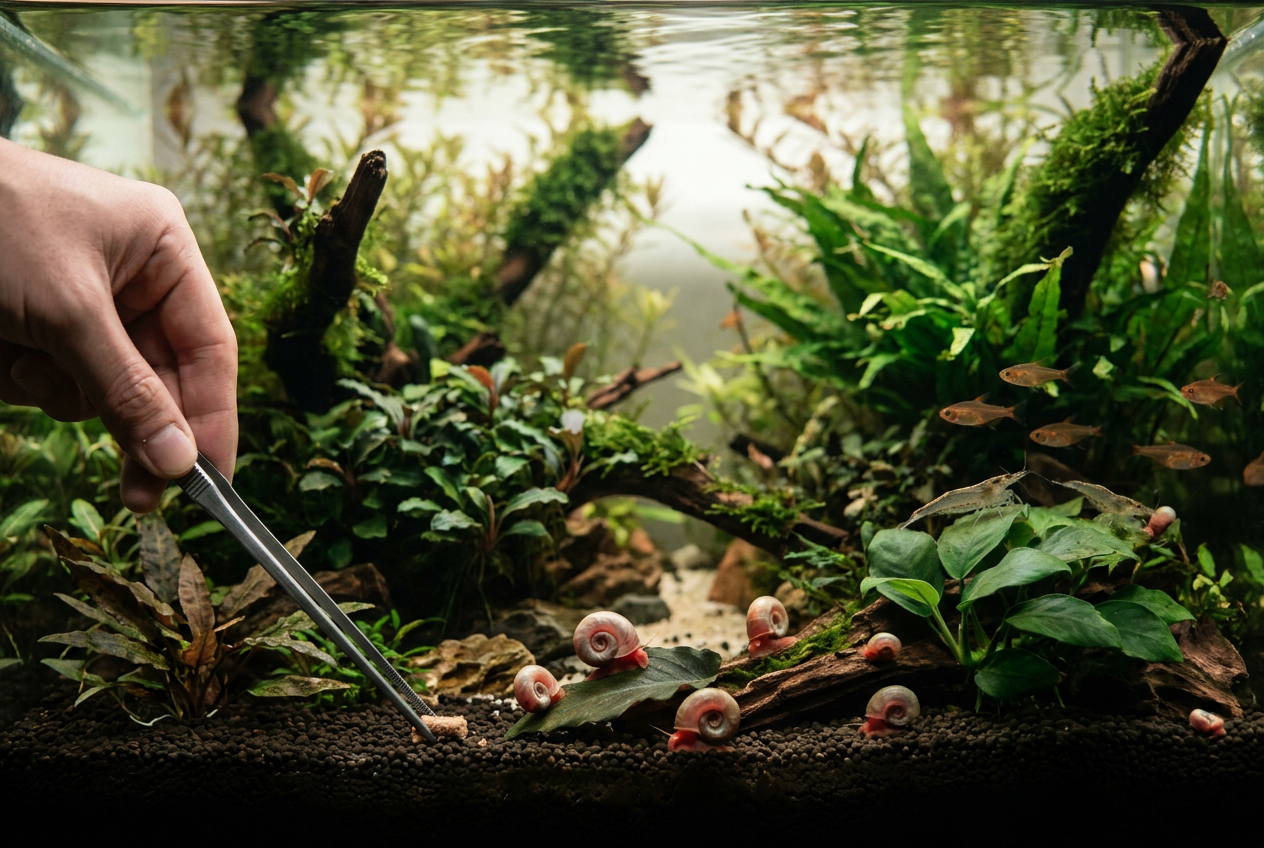
Many freshwater aquarium hobbyists panic the first time they notice tiny snails appearing across their glass and plants.
At first, there may only be a few.
Then suddenly, dozens appear overnight.
Small red ramshorn snails gather on the glass during feeding time. Tiny juvenile snails hide beneath leaves. Egg clutches appear on plants and hardscape. What once felt like a clean planted aquarium suddenly feels “infested.”
The immediate reaction is often to blame the snails themselves.
But in reality, snails are usually not the root problem.
They are symptoms of an aquarium ecosystem with too much available food.
Understanding this changes everything.
In many freshwater aquariums, snails are actually beneficial members of the ecosystem. They consume leftover food, algae, biofilm, dying plant matter, and organic waste. The problem only begins when the ecosystem produces enough excess nutrients to support a rapidly expanding population.
Instead of trying to destroy snails completely, the better approach is learning how to naturally control their numbers while maintaining a healthier planted tank overall.
Why Aquarium Snail Populations Explode
Most freshwater snail species reproduce according to food availability.
If your aquarium consistently contains:
- leftover fish food,
- decaying leaves,
- algae buildup,
- uneaten pellets,
- soft organic waste,
- or dying plant matter,
the snails simply respond by multiplying.
This is especially common in Singapore’s tropical aquarium environment, where warm temperatures accelerate metabolism and breeding cycles.
In many cases, a snail outbreak is actually a warning sign from the ecosystem itself.
The snails are telling you:
“There is more waste here than the aquarium can naturally process.”
That is why removing only the snails rarely solves the problem long term.
If excess nutrients remain, the next generation simply replaces them again.

Snails Are Usually Part of the Cleanup Crew
One of the biggest misconceptions in freshwater aquariums is that all snails are “bad.”
In reality, many snails perform useful ecosystem functions.
They help:
- consume leftover fish food,
- recycle dead plant matter,
- graze algae,
- break down waste,
- and clean biofilm from surfaces.
Small populations of snails are completely normal in healthy planted tanks.
In nature, freshwater ecosystems are filled with decomposers and scavengers. Your aquarium is no different.
The goal is not creating a sterile snail-free environment.
The goal is maintaining balance.
Step 1: Reduce Overfeeding
This is the single most effective way to naturally reduce snail populations.
Most aquarium tanks are overfed.
Fish often eat far less food than hobbyists expect, especially in planted aquariums where microfauna and biofilm already exist naturally.
If food reaches the substrate uneaten every day, snails gain a constant breeding advantage.
A simple rule:
Only feed what your fish can consume within a few minutes.
For shrimp tanks and nano tanks, this becomes even more important because excess food accumulates quickly.
In many cases, simply reducing feeding for 1 to 2 weeks dramatically slows snail reproduction.

Step 2: Remove Dying Plant Leaves
Decaying plant matter is one of the biggest hidden food sources for snails.
In planted aquariums, melting leaves continuously release soft organic material into the ecosystem. Snails quickly consume this material and gain nutrients for reproduction.
Regular trimming helps reduce this buildup.
Focus especially on:
- melting crypt leaves,
- damaged stem plants,
- dying moss sections,
- and trapped debris beneath hardscape.
Cleaner plants create fewer breeding opportunities for snails.
Step 3: Improve Substrate Maintenance
Organic waste often accumulates in areas hobbyists rarely clean:
- beneath driftwood,
- inside dense carpeting plants,
- around feeding zones,
- and underneath rocks.
This hidden waste becomes a long-term food source for snails.
Gentle siphoning during water changes helps remove excess detritus without destroying the biological balance of the tank.
For heavily planted aquariums, focus on:
- open substrate zones,
- dead flow areas,
- and visible debris pockets.
You do not need to sterilise the aquarium.
You simply want to reduce excess nutrient buildup.

Step 4: Manually Remove Excess Snails
Manual removal is still useful — especially for rapid outbreaks.
But it works best together with nutrient control.
You can:
- remove visible adults during water changes,
- scrape egg clutches,
- place blanched vegetables overnight as snail traps,
- or physically reduce clusters during feeding periods.
Ramshorn snails are easiest to control manually because they gather visibly on glass and food.
The key is consistency.
Removing a few snails occasionally while continuing heavy overfeeding will not solve the underlying problem.
Should You Use Snail-Killing Chemicals?
In most planted aquariums, chemical snail killers are not recommended.
Many copper-based medications can harm:
- shrimp,
- sensitive fish,
- beneficial bacteria,
- and plants.
Large snail die-offs may also destabilise water quality because decaying bodies release ammonia into the aquarium.
Natural ecosystem management is usually safer and more stable long term.
For most hobbyists, prevention and balance work far better than aggressive eradication.
What About Assassin Snails?
Assassin Snail are often introduced to control pest snails naturally.
They prey on smaller snails and can reduce ramshorn or bladder snail populations over time.
However, they are not magic solutions.
Assassin snails:
- still require food,
- may reproduce slowly themselves,
- and may attack desirable snail species if smaller prey becomes limited.
They work best as part of a broader ecosystem management approach rather than as the only solution.

Which Snails Are Most Likely to Overpopulate?
Not all aquarium snails reproduce equally.
Some species reproduce very slowly.
Others can rapidly expand under heavy feeding conditions.
Generally:
Fast breeders:
- ramshorn snails,
- bladder snails,
- pond snails.
Slow breeders:
- rabbit snails,
- mystery snails,
- assassin snails.
Snails like nerites may lay eggs frequently, but the babies rarely survive in freshwater aquariums.
Understanding each species helps prevent unnecessary panic.
A Balanced Aquarium Usually Balances Snails Too
In stable aquariums, snail populations often regulate themselves naturally.
As food availability decreases:
- breeding slows,
- survival rates decrease,
- and population size stabilises.
This is why mature planted tanks often maintain only small visible snail populations despite initially having outbreaks.
Instead of viewing snails purely as pests, it helps to see them as biological indicators.
A large sudden snail population usually means:
- too much waste,
- too much feeding,
- or too much decaying material somewhere inside the ecosystem.

Final Thoughts
Most aquarium snail outbreaks are not actually caused by snails.
They are caused by excess nutrients inside the ecosystem.
Snails simply respond to the environment available to them.
By reducing overfeeding, trimming dying plants, improving maintenance, and controlling organic waste buildup, most freshwater aquariums naturally stabilise their snail populations over time.
The goal is not complete elimination.
The goal is balance.
In a healthy planted aquarium, small snail populations are often signs of a functioning ecosystem rather than a disaster.
Continue Learning
Aquarium snails are far more diverse than many hobbyists realise. Some reproduce explosively in freshwater, while others barely multiply at all. Some are excellent algae grazers, while others become indicators of excess waste and overfeeding. Understanding how different snail species behave helps you build a healthier, more balanced aquarium ecosystem.
Continue exploring these related freshwater aquarium guides:
- Why Some Aquarium Snails Multiply Like Crazy — While Others Never Reproduce
- How to Breed Rabbit Snails Successfully
- Why Nerite Snail Eggs Never Hatch in Freshwater
- How to Control Algae Naturally in Your Aquarium (Without Chemical)
- How to Control Aquarium Snail Population Naturally
- Are Snails Good for Aquarium Maintenance?
Each article explores a different part of freshwater aquarium ecology, helping Singapore hobbyists better understand snail behaviour, breeding patterns, algae control, ecosystem balance, and long-term planted tank stability.


