
Why Some Aquarium Snails Multiply Like Crazy — While Others Never Reproduce
This guide is created by Green Chapter — Nature Workshop Studio, where we focus on creating living ecosystems through hands-on experience. We share practical insights across terrariums, aquascaping, plants, and natural systems to help you build and care for your own.
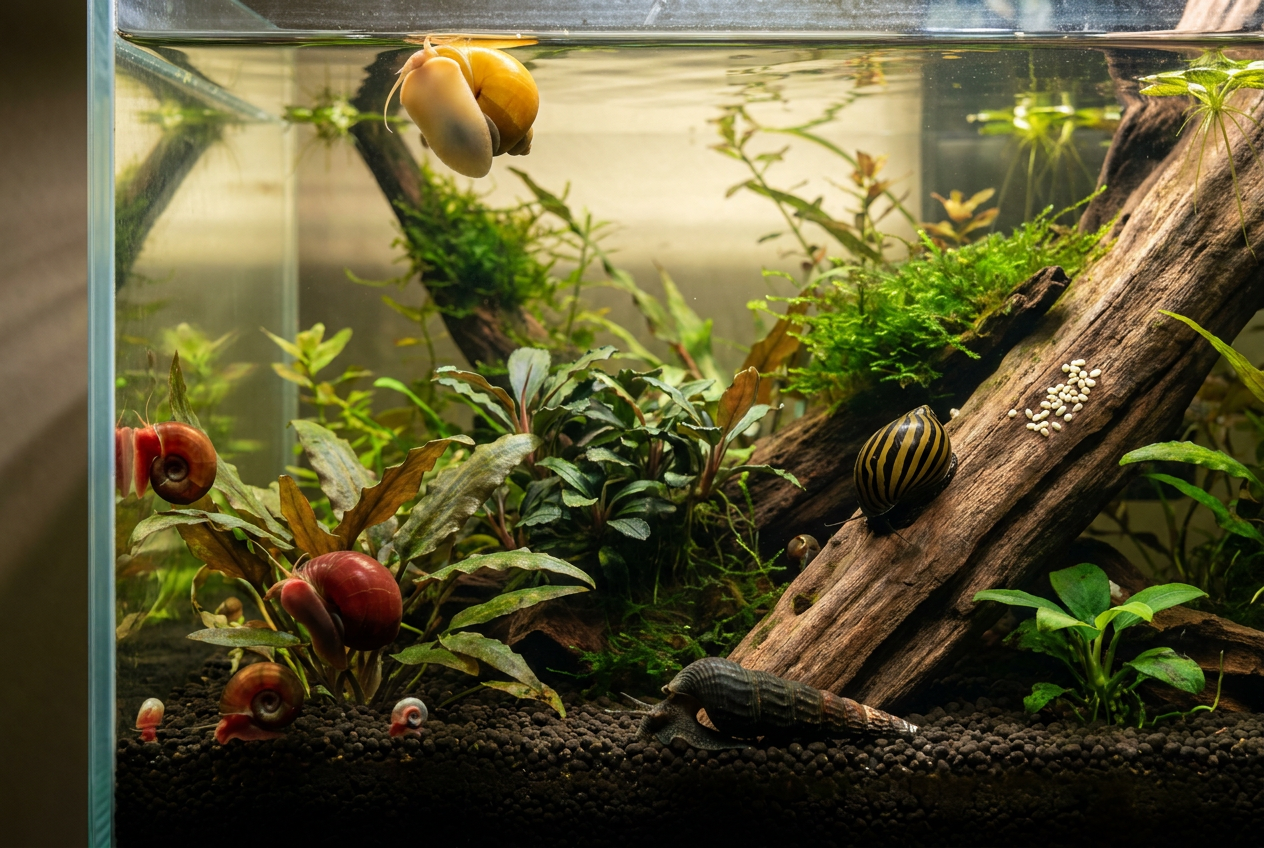
There is a moment many freshwater aquarium hobbyists experience.
You start with one or two small snails in your planted tank. A few weeks later, tiny snails are everywhere — on the glass, under the leaves, across the substrate, and even inside the filter area.
Then another hobbyist keeps nerite snails for years. The snails lay white eggs all over the driftwood and glass, but not a single baby snail ever appears.
So why do some aquarium snails multiply like crazy, while others seem to never reproduce?
The answer is simple but fascinating: different snails use completely different breeding strategies.
Some snails can complete their whole life cycle inside a freshwater aquarium. Some need separate males and females. Some lay eggs underwater. Some lay eggs above the waterline. Some give birth to live babies. And some, like nerite-type snails, need brackish or marine conditions for their larvae to survive.
Once you understand this, snail behaviour becomes much easier to manage.
Not All Aquarium Snails Breed the Same Way
Many beginners assume all aquarium snails reproduce the same way.
They do not.
In freshwater aquariums, the most common snail breeding types include:
- hermaphroditic snails that can reproduce very quickly,
- separate-gender snails that need male and female individuals,
- livebearing snails that release fully formed babies,
- and brackish-dependent snails whose eggs will not hatch properly in freshwater.
This is why one snail species may become a population problem, while another keeps laying eggs with no babies appearing.
Red Ramshorn Snails: The Fast Multipliers
Red ramshorn snails are one of the best examples of fast freshwater breeders.
They are hermaphrodites, meaning each snail has both male and female reproductive organs. They usually prefer to mate with another ramshorn snail, but their reproductive system makes breeding very easy once food is available.
Ramshorn snails lay their eggs underwater in soft, transparent jelly-like clutches. These egg clutches are often found on plant leaves, glass, hardscape, filter pipes, or hidden surfaces.
Inside the jelly, tiny baby snails develop. After about 10 to 14 days, they hatch directly into the aquarium as miniature snails.
No brackish water is needed.
No special breeding tank is needed.
No larval stage is needed.
That is why ramshorn snails can multiply so quickly in a Singapore freshwater tank.

Why Ramshorn Snails Suddenly Become “Pests”
Ramshorn snails are often blamed when their population explodes, but the real cause is usually excess food.
They multiply according to available resources.
If the tank has leftover fish food, dying plant leaves, algae, biofilm, or organic waste, the snails have more to eat — and the population grows.
In Singapore’s warm climate, this can happen even faster because tropical temperatures support faster metabolism and breeding.
So a ramshorn outbreak is usually not just a snail problem. It is a sign that the aquarium has too much available food or waste.
To reduce their numbers, reduce overfeeding, remove decaying leaves, siphon waste, and improve routine maintenance.
Mystery Snails: Easy Freshwater Breeders, But They Need Air Space
Mystery snails are very different from ramshorn snails.
They are not hermaphrodites. They have separate males and females, so you need both sexes for breeding.
Their egg-laying behaviour is also very unique. Instead of laying eggs underwater, the female climbs above the waterline and lays a large pink or orange egg clutch on a dry surface.
This is why mystery snail tanks need an air gap between the water surface and the lid.
If the tank is filled completely to the top, the female may not find a proper place to lay her eggs. In some cases, she may climb out of the tank.
For Singapore hobbyists, mystery snail eggs often do well because the local humidity helps keep the clutch moist without drowning it.

Rabbit Snails: The Slow and Controlled Breeders
Rabbit snails reproduce much more slowly.
They have separate males and females, so you need both sexes to breed them. Because they are difficult to sex visually, hobbyists usually keep a small group to increase the chance of having both male and female individuals.
Rabbit snails are livebearers. The female does not lay a large clutch of eggs. Instead, she releases one small white capsule containing a single fully formed baby snail.
The capsule dissolves shortly after being released, and a miniature rabbit snail crawls out.
This is why rabbit snails rarely become a pest. Even in ideal freshwater conditions, their reproduction is slow and controlled.
They are a good choice for hobbyists who want interesting snails without sudden population explosions.

Nerite Snails: Eggs Everywhere, But No Babies
Nerite snails are one of the most confusing snails for beginners.
They live well in freshwater. They graze algae. They may mate in the aquarium. Females may lay many small, hard, white eggs on driftwood, rocks, glass, and even other snail shells.
But the eggs do not hatch successfully in normal freshwater aquariums.
This is because nerite snails have a more complex natural life cycle. In the wild, their larvae drift into brackish or marine environments before developing further.
So even though adult nerites are commonly kept in freshwater tanks, their babies require brackish or marine conditions during the larval stage.
That is why nerite eggs appear everywhere, but baby nerites almost never appear in a freshwater planted tank.

Abalone Snails: Similar Problem, Even Harder to Breed
Freshwater “abalone snails”, such as Septaria porcellana, are also related to nerite-type snails.
They may live well in freshwater aquariums and lay tough white egg capsules on hard surfaces, but their young cannot complete development in ordinary freshwater conditions.
Like nerites, they require a specialised larval stage that depends on brackish or marine conditions.
For most home aquariums, this means abalone snails may lay eggs, but hobbyists should not expect successful babies in a normal freshwater planted tank.
They are better understood as display and algae-grazing snails, not easy breeding snails.
Freshwater Breeders vs Brackish-Dependent Snails
The easiest way to understand aquarium snail breeding is to separate them into two groups.
Some snails can complete their full life cycle in freshwater.
Others can live as adults in freshwater, but need brackish or marine conditions for their young to survive.
| Snail Type | Breeds in Freshwater? | Babies Survive in Freshwater? | Population Result |
|---|---|---|---|
| Red Ramshorn Snail | Yes | Yes | Very fast growth |
| Mystery Snail | Yes | Yes | Moderate to high growth |
| Rabbit Snail | Yes | Yes | Very slow growth |
| Nerite Snail | Adults may mate and lay eggs | No | Eggs appear, but no babies |
| Abalone Snail | Adults may lay eggs | No | Very difficult to breed |
What This Means for Singapore Aquarium Hobbyists
In Singapore, freshwater aquariums are usually warm throughout the year.
This can make snail breeding more active compared to cooler climates.
For ramshorn snails, warm water and excess food can quickly lead to population explosions.
For mystery snails, the warm and humid environment can support successful egg development, especially if there is a proper air gap above the water.
For rabbit snails, warm stable water helps, but they still reproduce slowly.
For nerite and abalone snails, Singapore’s tropical weather does not change the main issue: the larvae still need brackish or marine conditions to survive.
So the question is not just, “Will this snail lay eggs?”
The better question is:
Can this snail complete its full life cycle in my freshwater aquarium?
Are Snail Populations Good or Bad?
Snails are not automatically good or bad.
In a balanced aquarium, they can be very helpful. They graze algae, consume leftover food, break down dead plant matter, and contribute to the small cleanup crew of the ecosystem.
The problem begins when their population becomes too large.
A sudden snail explosion often points to:
- too much feeding,
- excess organic waste,
- decaying plant leaves,
- heavy algae growth,
- or poor maintenance rhythm.
Instead of only removing snails, it is better to correct the cause.
When the aquarium becomes cleaner and food becomes limited, the snail population usually stabilises naturally.

Final Thoughts
Some aquarium snails multiply quickly because they are built for fast freshwater reproduction.
Others lay eggs but never produce babies because their life cycle is incomplete in freshwater.
Ramshorn snails can multiply rapidly when food is abundant. Mystery snails can breed well if they have space above the waterline. Rabbit snails reproduce slowly and steadily. Nerite and abalone snails may lay eggs in freshwater, but their young need brackish or marine conditions to develop.
Once you understand this, snail behaviour becomes much less confusing.
You will know which snails may become population problems, which ones are easy to breed, and which ones are best kept as algae grazers rather than breeding projects.
In a well-managed aquarium, snails are not just pests.
They are part of the ecosystem.
Continue Learning
Aquarium snails are far more diverse than many hobbyists realise. Some reproduce explosively in freshwater, while others barely multiply at all. Some are excellent algae grazers, while others become indicators of excess waste and overfeeding. Understanding how different snail species behave helps you build a healthier, more balanced aquarium ecosystem.
Continue exploring these related freshwater aquarium guides:
- Why Some Aquarium Snails Multiply Like Crazy — While Others Never Reproduce
- How to Breed Rabbit Snails Successfully
- Why Nerite Snail Eggs Never Hatch in Freshwater
- How to Control Algae Naturally in Your Aquarium (Without Chemical)
- How to Control Aquarium Snail Population Naturally
- Are Snails Good for Aquarium Maintenance?
Each article explores a different part of freshwater aquarium ecology, helping Singapore hobbyists better understand snail behaviour, breeding patterns, algae control, ecosystem balance, and long-term planted tank stability.


