
Why Do Some Guppies Need Salt While Others Thrive in Pure Freshwater?
This guide is created by Green Chapter — Nature Workshop Studio, where we focus on creating living ecosystems through hands-on experience. We share practical insights across terrariums, aquascaping, plants, and natural systems to help you build and care for your own.
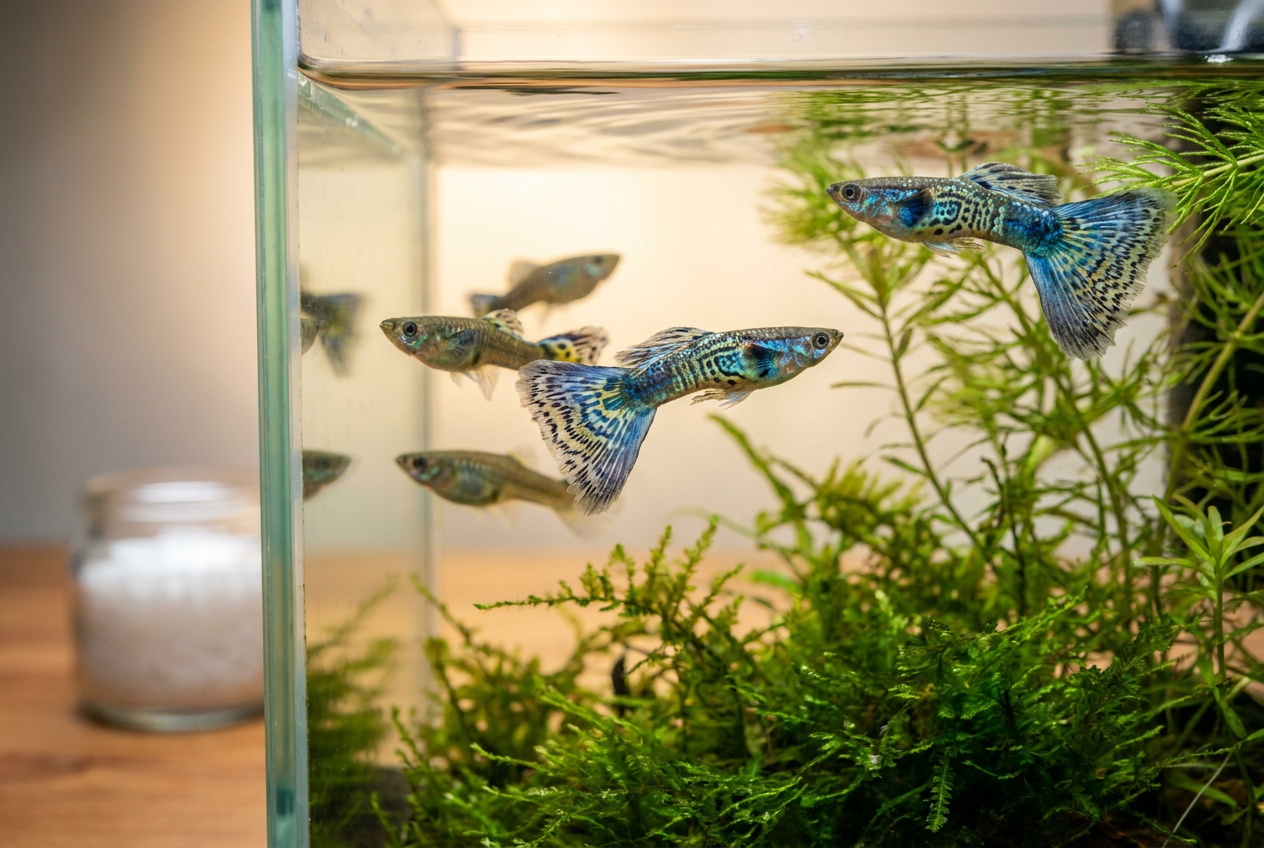
Why Do Some Guppies Need Salt While Others Thrive in Pure Freshwater?
Guppies are often marketed as one of the easiest aquarium fish to keep. Yet many beginners quickly run into conflicting advice:
- “Always add aquarium salt.”
- “Never add salt to freshwater fish.”
- “Fancy guppies need salt.”
- “Mine breed fine without it.”
So what is actually happening?
The answer lies in understanding:
- where the guppies came from,
- how they were bred,
- the mineral content of the water,
- and how fish regulate salt and fluids inside their bodies.
Guppies Are Freshwater Fish — But It’s More Complicated Than That
Wild guppies, scientifically known as Guppy, naturally come from streams and waterways in South America. They are fundamentally freshwater fish.
However, unlike many delicate softwater fish, guppies are extremely adaptable. Wild populations are known to tolerate:
- hard alkaline water,
- coastal brackish environments,
- and even gradually acclimated marine conditions.
This adaptability is one reason guppies became one of the world’s most widely distributed aquarium fish.
But adaptability does not mean every guppy strain behaves identically.

The Real Difference: Wild Genetics vs Modern Fancy Guppies
Modern guppies can generally be separated into two broad categories:
1. Hardy “Farm” or Wild-Type Guppies
These include:
- feeder guppies,
- Endler-type guppies,
- outdoor pond strains,
- and simpler commercial guppies.
These fish are often:
- bred outdoors,
- exposed to fluctuating conditions,
- raised in mineral-rich water,
- and selected more for survival than appearance.
As a result, they usually tolerate:
- pure freshwater,
- temperature swings,
- harder tap water,
- and lower-maintenance setups.
Many can transition into freshwater planted aquariums with little issue.
2. Fancy Selective-Bred Guppies
These are the highly ornamental strains:
- mosaic guppies,
- dragon guppies,
- dumbo ear guppies,
- ribbon guppies,
- platinum strains,
- and other show-quality fish.
Over many generations, breeders selectively emphasized:
- larger fins,
- brighter coloration,
- unusual body shapes,
- and specific tail patterns.
Unfortunately, heavy selective breeding also reduced hardiness in many lines.
Some fancy strains became:
- more disease-prone,
- less tolerant of unstable water,
- weaker swimmers,
- and more sensitive to stress.
This is where salt often enters the picture.

Why Aquarium Salt Is Commonly Used for Guppies
In commercial guppy farms, fish are often raised in:
- crowded systems,
- bare-bottom tanks,
- export facilities,
- and high-density breeding setups.
Under these conditions, aquarium salt is frequently used because it can help:
- reduce osmotic stress,
- suppress some parasites,
- reduce bacterial pressure,
- and support weakened fish during transport.
Salt acts more like a management tool than a biological necessity.
Many imported guppies arrive already adapted to lightly salted water. Hobbyists then bring them home and suddenly place them into:
- ultra-soft water,
- acidic planted tanks,
- or unstable beginner aquariums.
The fish then become stressed and may develop:
- fin rot,
- fungal infections,
- shimmying,
- lethargy,
- or white spot disease.
This leads many hobbyists to conclude:
“Guppies need salt.”
But in reality, the underlying problem is often:
- unstable water chemistry,
- insufficient minerals,
- or poor acclimation.
Understanding Osmoregulation — Why Minerals Matter
Fish constantly regulate the balance of water and salts inside their bodies through a process called osmoregulation.
Freshwater fish naturally absorb water through their bodies because freshwater is less concentrated than their internal fluids.
To compensate, fish must:
- actively absorb minerals through their gills,
- retain salts internally,
- and expel excess water.
Guppies generally perform best in:
- moderate to hard water,
- mineral-rich environments,
- and slightly alkaline conditions.
When kept in extremely soft water:
- mineral balance becomes unstable,
- stress increases,
- breeding declines,
- and disease resistance weakens.
This is why many hobbyists mistakenly think salt is required, when the actual issue may simply be insufficient hardness (GH/KH).

Aquarium Salt vs Hard Water — They Are Not the Same Thing
This is one of the biggest misunderstandings in fishkeeping.
Aquarium salt:
- increases salinity slightly,
- provides electrolytes,
- and temporarily reduces stress.
Hard water:
- contains dissolved minerals like calcium and magnesium,
- stabilizes fish physiology,
- and supports long-term health.
A guppy can survive without added salt.
But guppies usually do poorly in:
- ultra-soft RO water,
- unstable acidic conditions,
- or mineral-deficient tanks.
In many cases, improving hardness solves the issue without adding salt continuously.
Do Guppies Need Salt in Planted Tanks?
Usually, no.
Many hobbyists successfully keep guppies in heavily planted aquariums without ever adding aquarium salt.
In fact, excessive salt can create problems for:
- sensitive aquatic plants,
- some shrimps,
- snails,
- and bioactive microorganisms.
Most planted tank keepers instead focus on:
- stable parameters,
- proper filtration,
- mineral balance,
- oxygenation,
- and regular maintenance.
This creates a healthier long-term system than relying on continuous salt dosing.

When Salt Can Actually Be Helpful
Aquarium salt can still be useful in certain situations:
Temporary Quarantine Support
Especially for:
- imported guppies,
- stressed shipments,
- or weak fancy strains.
Mild Disease Prevention
Low doses may help reduce:
- external parasites,
- minor bacterial infections,
- and stress-related illness.
Recovery Tanks
Salt is sometimes used short-term during:
- fin rot treatment,
- transport recovery,
- or acclimation periods.
Hardening Weak Fancy Strains
Some delicate strains simply perform more consistently in lightly mineralized or lightly salted systems.
The Most Important Factor Is Stability
Most guppy problems blamed on “lack of salt” are actually caused by:
- unstable water,
- ammonia spikes,
- low oxygen,
- poor acclimation,
- overcrowding,
- or weak genetics.
Healthy guppy systems prioritize:
- clean water,
- mineral stability,
- proper hardness,
- strong filtration,
- and consistent maintenance routines.
These factors matter far more than salt alone.
So… Do Guppies Really Need Aquarium Salt?
The honest answer is:
Most guppies do not biologically require aquarium salt to survive.
However:
- some selectively bred strains tolerate stress poorly,
- some imported fish are already adapted to salted systems,
- and some hobbyists use salt as a preventative management tool.
In many aquariums, especially planted tanks, maintaining stable hard freshwater is often the better long-term approach.
The goal should not be:
“Add salt because guppies are guppies.”
Instead, ask:
- What type of guppy is this?
- What water was it raised in?
- Is my water too soft?
- Is the fish stressed from transport?
- Is my aquarium stable?
Understanding those differences is the key to keeping healthy guppies long-term.


