
Why Nerite Snail Eggs Never Hatch in Freshwater
This guide is created by Green Chapter — Nature Workshop Studio, where we focus on creating living ecosystems through hands-on experience. We share practical insights across terrariums, aquascaping, plants, and natural systems to help you build and care for your own.
Many freshwater aquarium hobbyists eventually encounter the same mystery.
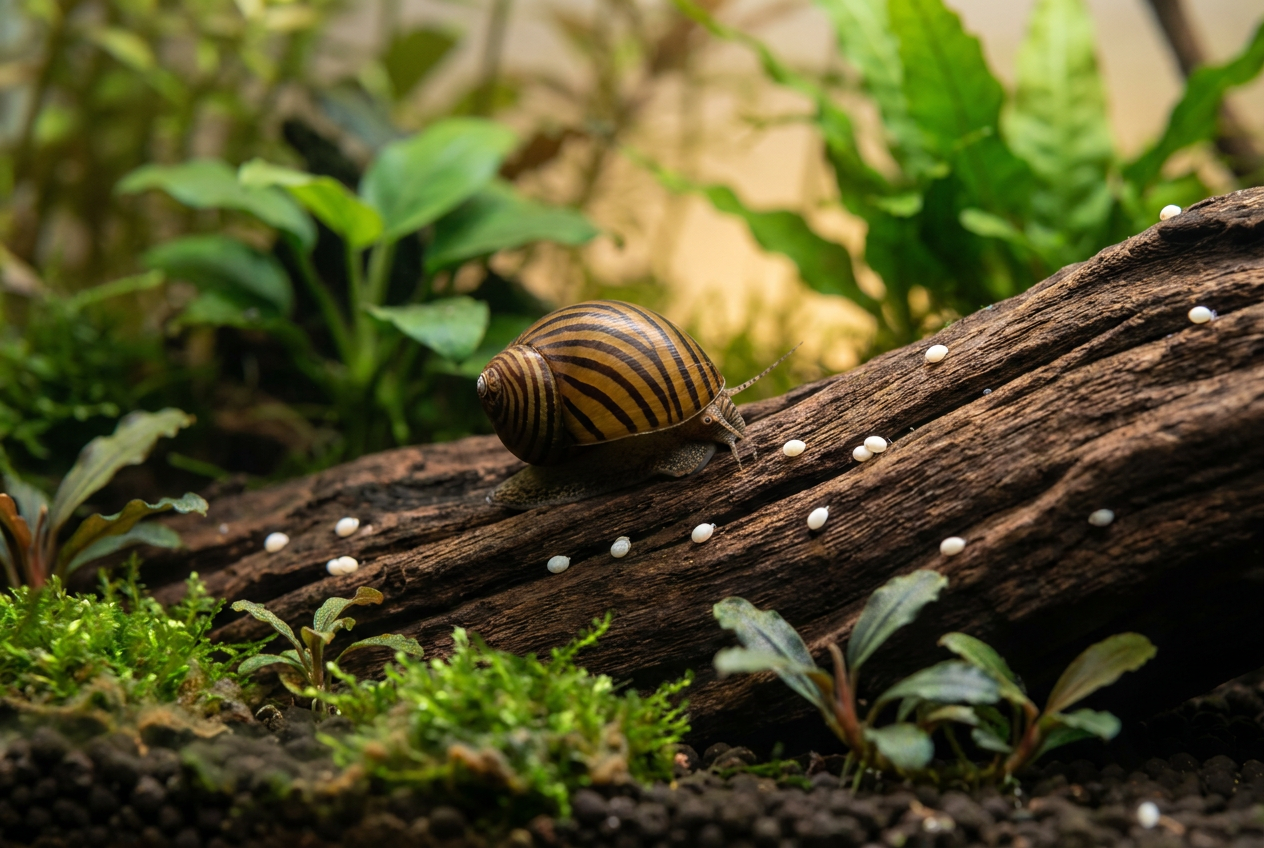
You buy a beautiful nerite snail to help clean algae from your planted aquarium. The snail settles in well, actively grazing across driftwood and glass.
Then one day, tiny white dots begin appearing everywhere.
Soon:
- driftwood is covered,
- rocks have white spots,
- filter pipes develop tiny hard capsules,
- and even other snail shells may become decorated with small white eggs.
But despite all these eggs, no baby nerite snails ever appear.
So what is happening?
Are the eggs infertile?
Are the babies dying?
Or are nerite snails somehow impossible to breed?
The answer is actually much more fascinating.
Nerite snails are not true full freshwater breeders. Although the adults live very well inside freshwater aquariums, their babies require completely different environmental conditions during early development.
Understanding this lifecycle explains why hobbyists constantly see nerite eggs but almost never see nerite babies.
Nerite Snails Lay Eggs Very Easily
Nerite Snail are actually quite willing to reproduce.
In healthy aquariums:
- males and females may mate naturally,
- females regularly lay eggs,
- and egg production often increases in warm stable tanks.
The eggs are laid as tiny hard white capsules attached firmly onto:
- driftwood,
- rocks,
- aquarium glass,
- filter pipes,
- decorations,
- and even other snail shells.
Unlike soft transparent ramshorn egg clutches, nerite eggs are:
- hard,
- calcified,
- durable,
- and individually attached.
This is why many aquascapers find them difficult to remove once they appear.

The Eggs Are Not “Dead”
One of the biggest misconceptions is that nerite eggs are infertile or non-viable.
In many cases, the eggs are actually perfectly normal.
The real problem is the environment.
Nerite snails evolved in river systems connected to coastal estuaries. Their reproductive cycle depends on both freshwater and brackish or marine conditions.
The adults typically live upstream in freshwater habitats.
But after hatching, the microscopic larvae drift downstream toward brackish coastal waters where early development continues.
This means the aquarium lifecycle is incomplete.
The adults may reproduce successfully in freshwater, but the larvae cannot survive there.
Nerite Snails Have a Planktonic Larval Stage
This is the key reason nerite breeding becomes so difficult.
After hatching, nerite larvae do not immediately become miniature snails crawling around the aquarium.
Instead, they enter a microscopic free-swimming stage called a veliger.
At this stage, the larvae drift through moving water while feeding on microscopic organisms and algae.
They behave more like plankton than like adult snails.
Most freshwater planted aquariums cannot support:
- the required salinity,
- the correct microscopic food sources,
- or the proper larval environment.
As a result, the larvae usually die shortly after hatching, long before becoming visible juvenile snails.

Why Nerite Eggs Appear More Often in Singapore Aquariums
Singapore hobbyists often notice nerite egg laying more frequently than hobbyists in cooler countries.
Warm tropical temperatures increase:
- metabolism,
- grazing activity,
- mating behaviour,
- and reproductive cycles.
Stable planted aquariums with:
- algae,
- biofilm,
- oxygen-rich water,
- and mature hardscape
often encourage nerites to lay eggs regularly.
This is why beautiful planted aquascapes frequently develop stubborn white nerite eggs across driftwood and rocks.
Ironically, healthy aquariums often encourage more egg laying.
Why Nerite Eggs Are Difficult to Remove
Unlike soft jelly egg clutches from ramshorn snails, nerite eggs are extremely tough.
The female attaches each capsule firmly onto hard surfaces using strong adhesive secretions.
Once hardened, they behave almost like tiny calcified spots.
This makes them difficult to:
- scrape off glass,
- remove from driftwood,
- or clean from porous rocks.
Many aquascapers simply accept them as part of keeping nerite snails.
Others choose dark hardscape because the white eggs become less visually noticeable.

Can Nerite Snails Be Bred Successfully?
Technically, yes.
But it is extremely difficult.
Successful breeding usually requires:
- separate brackish breeding systems,
- stable salinity,
- microscopic planktonic foods,
- oxygen-rich moving water,
- and careful larval management.
Most hobbyists fail not because the adults will not breed, but because the larval stage is incredibly fragile.
The larvae are tiny, difficult to observe, and highly sensitive to water conditions.
Even professional breeders often struggle to raise nerite larvae consistently.
Do Nerite Snails Need Brackish Water as Adults?
No.
Adult nerite snails live very well in freshwater aquariums.
That is why they remain popular cleanup crew snails for planted tanks.
The brackish requirement mainly applies to the larval development stage.
Adults are commonly kept successfully in:
- planted aquariums,
- shrimp tanks,
- nano tanks,
- and freshwater community setups.
They are especially valued because:
- they consume algae effectively,
- usually avoid healthy plants,
- and do not overpopulate freshwater tanks.
Ironically, the same lifecycle that prevents breeding is also why many hobbyists like them.
They clean algae without creating snail infestations.

Are the Eggs Harmful?
No.
Nerite eggs are mostly cosmetic.
They:
- do not damage healthy plants,
- do not poison the water,
- and usually do not spread uncontrollably.
The main complaint is visual appearance.
In minimalist aquascapes, the tiny white eggs may stand out strongly against dark driftwood or clean stones.
But biologically, they are generally harmless.
Why Nerite Snails Are Still Excellent Cleanup Crew
Despite the eggs, nerite snails remain one of the best algae-eating snails for planted aquariums.
They help consume:
- soft algae films,
- diatoms,
- biofilm,
- and surface algae.
Because they do not reproduce successfully in freshwater aquariums, their population remains naturally controlled.
For many hobbyists, this trade-off is worthwhile:
- excellent algae control,
- but occasional visible eggs.

Final Thoughts
Nerite snail eggs rarely hatch in freshwater aquariums because the nerite lifecycle is incomplete without brackish or marine larval development.
The adults may live and reproduce in freshwater, but the microscopic veliger larvae require very different environmental conditions to survive.
This is why hobbyists constantly see:
- white eggs,
- but almost never baby nerite snails.
Ironically, this difficult lifecycle is also one reason nerites are so popular.
They provide excellent algae control without creating uncontrollable freshwater snail populations.
For many planted aquarium hobbyists, that balance makes nerite snails one of the most useful cleanup crew species available.
Continue Learning
Aquarium snails are far more diverse than many hobbyists realise. Some reproduce explosively in freshwater, while others barely multiply at all. Some are excellent algae grazers, while others become indicators of excess waste and overfeeding. Understanding how different snail species behave helps you build a healthier, more balanced aquarium ecosystem.
Continue exploring these related freshwater aquarium guides:
- Why Some Aquarium Snails Multiply Like Crazy — While Others Never Reproduce
- How to Breed Rabbit Snails Successfully
- Why Nerite Snail Eggs Never Hatch in Freshwater
- How to Control Algae Naturally in Your Aquarium (Without Chemical)
- How to Control Aquarium Snail Population Naturally
- Are Snails Good for Aquarium Maintenance?
Each article explores a different part of freshwater aquarium ecology, helping Singapore hobbyists better understand snail behaviour, breeding patterns, algae control, ecosystem balance, and long-term planted tank stability.


