
Lepidothelphusa Crabs — The Peaceful Borneo Stream Crab Most Hobbyists Mistake for Vampire Crabs
This guide is created by Green Chapter — Nature Workshop Studio, where we focus on creating living ecosystems through hands-on experience. We share practical insights across terrariums, aquascaping, plants, and natural systems to help you build and care for your own.
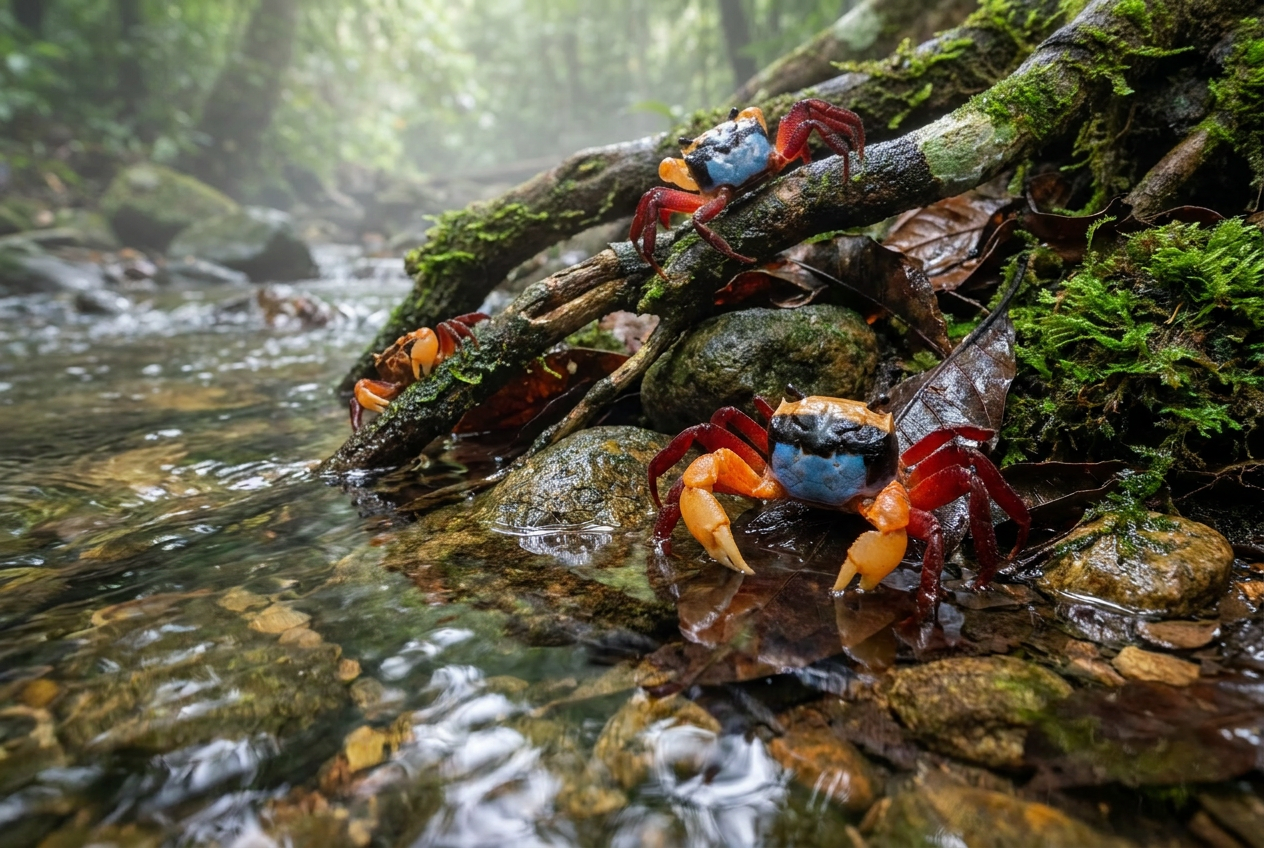
Lepidothelphusa Crabs Are Not Vampire Crabs
One of the biggest misunderstandings in the crab hobby today is the assumption that all small colorful crabs from Southeast Asia are simply “Vampire Crabs.”
This is where many hobbyists accidentally misidentify Lepidothelphusa species.
At first glance, they look similar:
- small size
- bright coloration
- semi-terrestrial behavior
- tropical rainforest origin
But once you observe them carefully, the differences become extremely obvious.
Unlike Geosesarma Vampire Crabs, Lepidothelphusa crabs are true stream-edge crabs. They are far more aquatic, significantly more peaceful, and naturally adapted to living beside highly oxygenated rainforest creeks and waterfalls throughout Borneo.
Instead of building a mostly-land enclosure, these crabs thrive in a setup that behaves more like a miniature rainforest stream ecosystem.
That single difference changes everything about how they should be kept.

The Hidden Rainforest Streams of Borneo
Lepidothelphusa crabs are entirely endemic to the island of Borneo, particularly southwestern Sarawak and Kalimantan.
In the wild, they inhabit:
- shallow forest springs
- seepages
- trickling creeks
- small waterfalls
- wet stream banks
- root-filled rainforest edges
Unlike Vampire Crabs that wander deeper onto the forest floor, Lepidothelphusa almost always remain close to water.
Their environment is permanently wet, heavily shaded, humid, and rich in flowing oxygenated water.
The entire ecosystem behaves like a transition zone between land and stream.
If you stepped into one of these habitats, you would find:
- moss-covered rocks
- tangled roots
- wet leaf litter
- soft clay banks
- shallow flowing water
- tiny aquatic insects
- biofilm-coated surfaces
- dense tropical humidity
This explains why these crabs behave so differently from most hobbyist crab species.

Why They Can Stay Underwater So Long
One of the most surprising things about Lepidothelphusa crabs is how long they can remain submerged underwater.
This often confuses hobbyists because Vampire Crabs cannot safely stay underwater for extended periods.
Lepidothelphusa are different.
They possess highly adapted gills that efficiently extract oxygen from water, allowing them to remain fully submerged for hours or even several days at a time.
However, this does not make them fully aquatic.
Over the long term, they still require access to humid land zones for:
- resting
- molting
- drying off
- reducing stress
- maintaining proper respiratory balance
A permanently submerged setup eventually weakens their immune systems and disrupts their molting cycles.
This is why the ideal enclosure is not an aquarium.
It is a true paludarium.

The 80/20 Rule That Changes Everything
Most Vampire Crab setups use roughly:
- 70–80% land
- 20–30% water
Lepidothelphusa require almost the opposite.
A healthy setup usually works best with:
- roughly 80% shallow moving water
- roughly 20% accessible land area
This is one of the biggest reasons hobbyists struggle when they treat them like Geosesarma.
The water section should not behave like a stagnant pond.
Instead, think:
- shallow stream
- trickling waterfall
- mossy creek edge
- rainforest seepage
Moving water is extremely important because these crabs naturally come from highly oxygenated environments.

Why They Rarely Kill Each Other
Many hobbyists immediately notice something unusual:
Lepidothelphusa colonies are dramatically more peaceful than Vampire Crabs.
This is not accidental.
In nature, these crabs evolved in close proximity along stream edges where individuals constantly encounter one another.
Instead of extreme territorial violence, they establish loose social hierarchies.
Dominant crabs usually:
- wave claws
- posture
- push rivals away
Subordinate crabs simply retreat.
Serious injuries are uncommon.
Their semi-aquatic nature also creates an important safety mechanism:
escape routes.
If tension develops on land, weaker crabs can dive into the water and disappear beneath rocks or roots.
This drastically reduces fatal fights.

A Tiny Ecosystem Crab, Not a Predator
Although they are peaceful, Lepidothelphusa are still opportunistic omnivores.
They will:
- scavenge leftovers
- graze biofilm
- consume algae
- eat small insects
- hunt weak prey if possible
However, they are surprisingly poor hunters.
Because of their tiny size and clumsy movement, they struggle to catch healthy fast-swimming fish.
This opens the door to one of the most exciting aspects of keeping them:
multi-species microhabitats.
Healthy adult nano fish usually coexist very well because they occupy the upper water column while the crabs remain near the substrate and shoreline.

Species Commonly Seen in the Hobby
The aquarium trade often sells these crabs under broad labels like:
- Borneo Crab
- Panda Crab
- White Scissor Crab
- Tricolour Crab
Some of the better-known species and trade variants include:
Lepidothelphusa padawan
Often called the Panda Crab due to its striking black-and-white contrast.
Lepidothelphusa menneri
Known for vibrant red legs and blue-purple accents. Frequently described as one of the more social species.
Lepidothelphusa flavochela
Famous for its bright yellow claws.
Lepidothelphusa limau
Displays citrus-orange coloration.
Lepidothelphusa sangon
Features deep reddish-orange tones.
Lepidothelphusa loi
Known for its darker shell and contrasting lighter legs.
Because exporters often hide collection locations, many imported crabs are sold simply as Lepidothelphusa sp.
Why Sustainability Matters
One uncomfortable truth behind these beautiful crabs is that most are still wild-caught.
Captive breeding remains limited because:
- females produce very small broods
- habitats are highly localized
- juveniles are delicate
- collection pressure is increasing
Some females may carry as few as 20–25 eggs.
Because these crabs come from fragile rainforest stream ecosystems, habitat destruction and overcollection remain real conservation concerns.
Whenever possible, supporting responsible breeders is strongly encouraged.

They Change How You Think About Crab Keeping
Lepidothelphusa crabs are not just “another colorful crab.”
They are tiny stream-edge ecosystem animals.
Once hobbyists stop treating them like Vampire Crabs, everything changes:
- enclosure design
- water movement
- livestock choices
- humidity management
- social dynamics
- ecosystem planning
Instead of building a territorial land enclosure, you begin building a living rainforest stream.
And that is where these remarkable crabs truly shine.
Continue Learning
In Part 2, we explore how to actually build a peaceful living Borneo stream paludarium for Lepidothelphusa crabs — including:
- water flow systems
- livestock combinations
- compatible fish and shrimp
- feeding systems
- breeding behavior
- juvenile care
- humidity management
- leaf litter ecosystems
- long-term maintenance
- creating a balanced multi-species rainforest microhabitat


