
How Often Should You Change Fish Tank Water in Singapore?
This guide is created by Green Chapter — Nature Workshop Studio, where we focus on creating living ecosystems through hands-on experience. We share practical insights across terrariums, aquascaping, plants, and natural systems to help you build and care for your own.
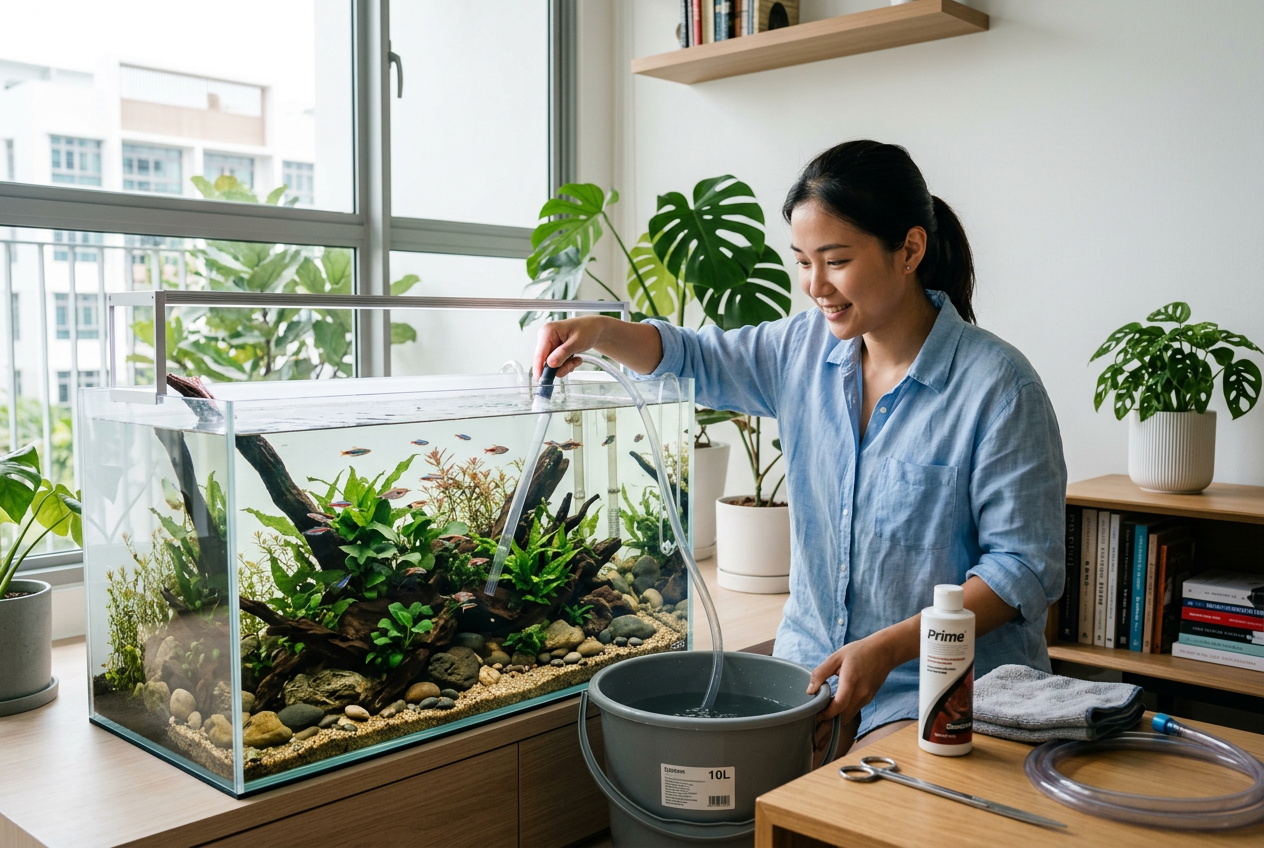
For many beginners, changing aquarium water can feel stressful.
How much water should you change?
Can you use tap water directly?
Do you need anti chlorine?
Should you remove the fish?
Why do some fish suddenly die after water changes?
In Singapore, many older fishkeeping methods are still commonly shared today — completely draining the tank, washing everything under tap water, and refilling directly from the hose. Years ago, some tanks survived this without major problems.
But modern aquariums work very differently.
Today’s freshwater aquariums rely heavily on beneficial bacteria, stable water conditions, and consistent maintenance routines. Singapore’s tap water treatment has also evolved over time, which means older methods are no longer always safe for aquarium fish and filtration systems.
The good news?
Proper water changes are actually simple once you understand the basics.
This guide explains how often you should change aquarium water in Singapore, how much to change, what to add to the water, and the correct beginner-friendly process from start to finish.
Why Water Changes Are Important
Many beginners think water changes are mainly about making the tank “look clean.”
But even crystal clear water can slowly accumulate:
- fish waste
- uneaten food
- nitrate
- dissolved organics
- excess nutrients
Over time, these build up and stress fish even if the water still looks visually clear.
Water changes help:
- dilute waste
- stabilize water quality
- replenish minerals
- improve oxygen levels
- reduce long-term stress on fish
A healthy aquarium is usually maintained through small, consistent maintenance — not massive cleaning sessions once the tank becomes dirty.

How Often Should You Change Fish Tank Water?
For most beginner freshwater aquariums in Singapore:
A 20–30% water change once a week is a good starting point.
This works well for:
- community fish tanks
- planted aquariums
- nano tanks
- beginner tropical fish setups
However, maintenance frequency also depends on:
- tank size
- fish stocking level
- feeding amount
- filtration quality
- whether the tank is planted
| Aquarium Type | Recommended Water Change |
|---|---|
| Beginner community tank | 20–30% weekly |
| Heavily stocked fish tank | 30–50% weekly |
| Planted aquarium | 20–40% weekly |
| Shrimp tank | 10–20% carefully |
| Goldfish tank | 40–60% weekly |
| Small nano aquarium | Smaller but consistent weekly changes |
The goal is stability, not aggressively replacing all the water.
Do You Need to Remove the Fish During Water Change?
Usually, no.
For regular maintenance, fish should remain inside the aquarium.
Constantly catching and moving fish can:
- create stress
- damage fins
- increase injury risk
- cause sudden temperature shock
Instead, most hobbyists simply:
- siphon water out slowly
- refill the tank gently
- leave fish inside throughout the process
Fish are generally much calmer when the environment remains stable.
Can You Use Tap Water Directly in Singapore?
This is one of the biggest beginner questions.
Singapore tap water is extremely clean and safe for human consumption. However, aquarium fish are much more sensitive to disinfectants used in municipal water treatment systems.
Modern Singapore tap water uses chloramine treatment, which is more stable than traditional chlorine alone. Unlike older methods, chloramine does not easily disappear simply by leaving water overnight.
This means untreated tap water can:
- irritate fish gills
- stress livestock
- damage beneficial bacteria inside filters
Because of this, aquarium water conditioners are now considered essential for most freshwater aquariums in Singapore.

Do You Need Anti Chlorine?
Yes — for most aquariums, the answer is absolutely yes.
A proper water conditioner helps neutralize:
- chlorine
- chloramine
- heavy metals
This makes tap water safer for:
- fish
- shrimp
- snails
- beneficial bacteria
When performing water changes, always treat new water before or during refilling according to the product instructions.
Do You Need to Add Salt?
Not always.
This is another old aquarium myth that still gets passed around frequently.
Aquarium salt is not mandatory for most freshwater tanks.
In fact, many freshwater setups do perfectly well without any salt at all.
Routine salt use is usually unnecessary for:
- tetra tanks
- planted aquariums
- shrimp tanks
- softwater fish
- community tanks
Salt is mainly used for:
- certain medication support
- temporary stress reduction
- nitrite toxicity management
- some livebearer setups
Adding salt “just because” is often unnecessary for beginners.
Should You Add Beneficial Bacteria?
Beneficial bacteria products can help support:
- new tank setups
- recently cleaned filters
- tanks recovering after medication
- newly upgraded aquariums
However, beginners should understand something important:
Most beneficial bacteria do not live freely in the water itself.
They mainly live on:
- filter media
- substrate
- hardscape surfaces
- sponge filters
This is why over-cleaning a filter under tap water can accidentally damage your aquarium’s biological stability.
The Biggest Beginner Myth: “Small Tanks Need Less Maintenance”
Many beginners assume smaller aquariums are easier to maintain.
But in reality, smaller tanks are often less stable.
A small aquarium can experience faster swings in:
- temperature
- ammonia
- oxygen
- pH
- waste concentration
This means problems appear much faster in nano tanks compared to larger aquariums.
For example:
- one missed feeding issue
- one dead leaf
- one overfeeding mistake
- one skipped maintenance session
…can affect a small aquarium very quickly.
In aquarium keeping, water volume creates stability.
This is why many experienced hobbyists often say:
Small tanks are not always beginner tanks.

Step-by-Step: How to Change Aquarium Water Properly
Step 1 — Prepare Your Equipment
Prepare:
- bucket
- siphon hose
- towel
- algae scraper if needed
- water conditioner
Step 2 — Turn Off Equipment
Switch off:
- filter
- heater
- chiller if applicable
This prevents equipment damage during low water levels.
Step 3 — Siphon Out Old Water
Use a siphon hose to remove around 20–30% of the aquarium water.
During this process, lightly vacuum debris from the substrate.
Avoid aggressively deep-cleaning the entire tank every session.

Step 4 — Add Water Conditioner
Dose the correct amount of anti chlorine according to the product instructions.
This is especially important in Singapore due to chloramine-treated tap water.
Step 5 — Refill the Aquarium Slowly
Add new water gently to avoid:
- stressing fish
- disturbing substrate
- damaging aquascaping
Try to avoid major temperature differences during refilling.
Step 6 — Restart Equipment
Turn equipment back on and check:
- filter flow
- heater water level
- circulation
- leaks
The aquarium should return to normal within minutes.
How Can You Make Aquarium Water More Stable?
Stable aquariums are usually easier to maintain.
Some ways to improve long-term stability include:
- regular weekly maintenance
- good filtration
- avoiding overfeeding
- not overcrowding fish
- consistent water changes
- healthy biological filtration
More advanced hobbyists may also use:
- RO systems
- DI filtration
- remineralized water systems
These systems provide greater control over water parameters but are usually more important for sensitive livestock, shrimp systems, or advanced planted aquariums.
For most beginners, consistency is far more important than chasing perfect numbers.
Common Beginner Mistakes During Water Change
Changing 100% of the water
Large sudden changes can shock fish and destabilize bacteria.
Washing filter media under tap water
Chlorinated water may damage beneficial bacteria.
Over-cleaning everything
Aquariums are living ecosystems, not sterile containers.
Overfeeding after maintenance
Extra food increases waste quickly.
Forgetting anti chlorine
Modern tap water treatment makes conditioners important for most aquariums in Singapore.
Water Changes Should Feel Routine, Not Stressful
Many beginners worry that aquarium maintenance is difficult.
In reality, once a routine is established, most freshwater aquarium water changes only take around 15–30 minutes each week.
The key is consistency.
A healthy aquarium is usually not maintained through dramatic cleaning sessions, but through small, regular care over time.
Modern fishkeeping is less about “washing a fish tank” — and more about maintaining a stable living ecosystem.
With proper water changes, even beginner aquariums can remain healthy, clear, and enjoyable for many years.


