
Why Mushrooms And Mold Grow In Terrariums
This guide is created by Green Chapter — Nature Workshop Studio, where we focus on creating living ecosystems through hands-on experience. We share practical insights across terrariums, aquascaping, plants, and natural systems to help you build and care for your own.
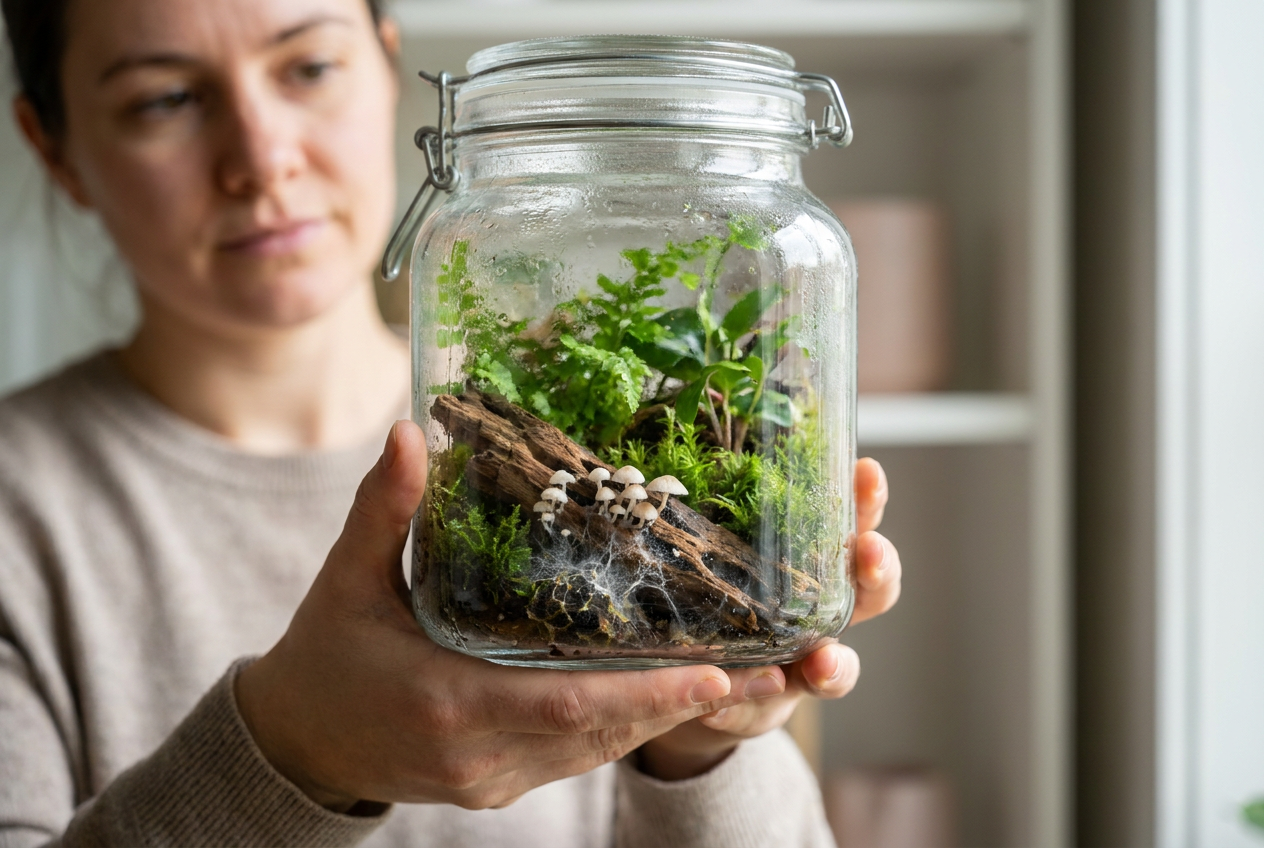
One of the most common beginner terrarium experiences goes something like this:
You build a beautiful closed terrarium.
The plants look healthy.
The moss stays green.
Everything seems perfect.
Then suddenly — white fuzzy mold appears on the wood.
A few days later, tiny mushrooms start growing from the substrate.
For many new hobbyists, this feels like disaster.
In reality, it is usually the opposite.
Most of the time, mushrooms and mold are signs that your terrarium is becoming biologically active. The problem is not that fungi exist. The problem is when the ecosystem becomes unbalanced and fungal growth overwhelms everything else.
Understanding this difference changes the way you care for terrariums completely.
What Is Actually Happening Inside Your Terrarium?

A terrarium is not just a glass container filled with plants.
It is a miniature ecosystem.
Inside the substrate and wood, countless microorganisms are constantly competing, decomposing, recycling nutrients, and reacting to moisture levels.
Fungi are part of that system from the very beginning.
The moment humidity rises and organic material becomes consistently damp, fungal spores begin colonizing surfaces like:
- Driftwood
- Moss
- Leaf litter
- Soil
- Bark
- Dead roots
- Decaying plant material
In a closed terrarium, warmth and humidity create ideal fungal conditions.
To fungi, your terrarium is basically a luxury rainforest resort.
Why New Terrariums Get Mold So Easily

New terrariums are biologically immature.
This is one of the most important things beginners often do not realize.
In the early weeks, the ecosystem has not stabilized yet. Microbial populations are still establishing themselves, moisture levels fluctuate heavily, and decomposition organisms rapidly exploit available nutrients.
This often creates what hobbyists unknowingly experience as the “fungal explosion phase.”
Common triggers include:
| Cause | What Happens |
|---|---|
| High humidity | Fungal spores activate rapidly |
| Poor airflow | Mold spreads without interruption |
| Fresh driftwood | Sugars and organics feed fungi |
| Excess moisture | Surfaces remain permanently wet |
| Dead plant matter | Decomposition accelerates |
| No clean-up crew | Nothing regulates fungal growth |
This is especially common in fully closed beginner terrariums.
The Difference Between Mold, Biofilm, And Mushrooms

Beginners often group everything together as “fungus,” but several different things may actually be happening.
White Fuzzy Mold
This usually appears on wood, moss, or decomposing material.
It looks cottony or spiderweb-like.
Most of the time, this is harmless decomposition fungus feeding on organic material rather than attacking living plants.
Biofilm
Biofilm looks slimy, translucent, or jelly-like.
It commonly appears on fresh driftwood.
This happens because wood releases sugars and organic compounds that bacteria and fungi rapidly consume.
Biofilm is extremely common in humid terrariums and aquariums.
Mushrooms
Mushrooms are simply the fruiting bodies of underground fungal networks called mycelium.
The actual fungus is usually already spread throughout the substrate long before mushrooms appear.
Tiny white mushrooms often emerge after spikes in humidity and warmth.
Are Mushrooms Dangerous?

Usually, no.
In most terrariums:
- Mushrooms do not harm healthy plants
- Fungi help break down dead organic matter
- Nutrients get recycled back into the substrate
- Microbial diversity improves ecosystem stability
In many cases, mushrooms are signs of active nutrient cycling.
However, there are still situations where intervention is necessary.
You should pay attention if:
- Mold completely blankets mosses or plants
- Mushrooms repeatedly explode in huge numbers
- Terrarium smells rotten or sour
- Plants begin melting or wilting
- Standing water accumulates excessively
- The substrate becomes swampy and anaerobic
The key idea is balance, not sterility.
Why Driftwood Gets Moldy So Often

Aquarium driftwood is naturally textured and porous.
That texture traps:
- Moisture
- Organic debris
- Spores
- Condensation
- Nutrient-rich biofilm
Even high-quality driftwood can temporarily develop mold during the early establishment phase.
This does not automatically mean the wood is rotting.
Many hobbyists panic and remove perfectly healthy hardscape unnecessarily.
Often, the terrarium simply needs time to stabilize biologically.
The Missing Piece: Clean-Up Crews

One reason fungal growth becomes excessive in beginner terrariums is the absence of microfauna.
In natural forests, fungi do not grow unchecked forever because countless tiny organisms constantly graze on them.
Terrarium clean-up crews help recreate this balance.
Springtails
Springtails are tiny harmless micro-arthropods that feed on:
- Mold
- Fungal spores
- Biofilm
- Decaying matter
They are one of the best additions for humid terrariums.
Many experienced hobbyists intentionally introduce springtails immediately after setup.
Isopods
In larger bioactive terrariums, isopods help break down decaying organic matter and reduce waste buildup.
Together, these organisms act as biological maintenance crews.
Should You Remove The Mushrooms?

That depends on your goal.
You Can Leave Them
If:
- The terrarium remains healthy
- Plants are thriving
- Mold is controlled
- No pets or children may eat them
Many mushrooms naturally disappear within a few days.
You Can Remove Them
If:
- You dislike the appearance
- You want fewer spores released
- Mushrooms become excessive
- Safety is a concern
Simply pluck them gently from the base.
Do not aggressively tear apart the substrate trying to “remove all fungus.” The underground mycelium is already widespread and usually harmless.
How To Reduce Excess Mold Naturally

Instead of trying to sterilize your terrarium, focus on improving balance.
1. Add Springtails
This is often the single best solution.
They naturally regulate fungal growth before outbreaks become visible.
2. Improve Ventilation Slightly
Open the lid briefly every few days.
Even small airflow improvements can dramatically slow fungal explosions.
3. Remove Excess Decay
Trim dying moss or rotting leaves before decomposition escalates.
4. Avoid Oversaturation
Closed terrariums should be humid, not flooded.
Constant dripping condensation and soggy substrate often indicate excessive moisture.
5. Spot Clean Problem Areas
A cotton swab with diluted 3% hydrogen peroxide can help treat localized mold outbreaks on hardscape.
Use this carefully and sparingly.
The Biggest Beginner Mistake

The biggest mistake is assuming all fungus is bad.
Many beginners continuously restart terrariums the moment mold appears.
Ironically, this often makes the problem worse because the ecosystem never gets time to stabilize.
Terrariums are not sterile decorative objects.
They are living biological systems.
A small amount of fungal activity is normal, expected, and often beneficial.
A Healthy Terrarium Is Never Completely Clean

A perfectly sterile terrarium usually becomes an unstable terrarium.
Healthy ecosystems contain:
- Bacteria
- Fungi
- Decomposers
- Microfauna
- Moisture cycles
- Nutrient recycling systems
What you are really trying to create is balance.
Once hobbyists understand this, mushrooms stop feeling like a disaster and start feeling like evidence that the ecosystem is alive.


