
Understanding the Water Cycle Inside a Closed Terrarium
This guide is created by Green Chapter — Nature Workshop Studio, where we focus on creating living ecosystems through hands-on experience. We share practical insights across terrariums, aquascaping, plants, and natural systems to help you build and care for your own.
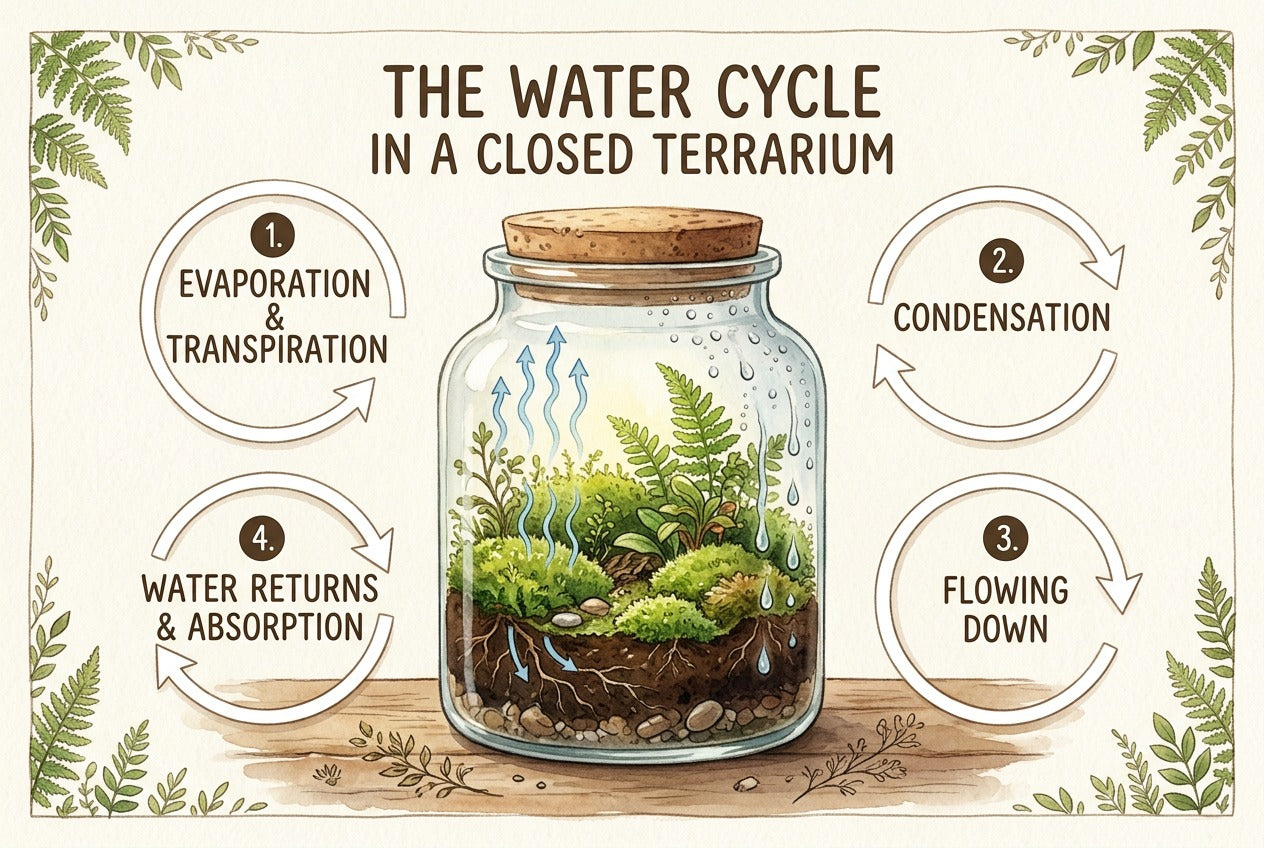
A closed terrarium creates a contained environment where moisture can circulate within the system. Water evaporates from the soil and plants, condenses on the glass, and returns back to the substrate.
Because of this internal movement, a closed terrarium behaves differently from a typical potted plant. Instead of following a fixed watering schedule, it is more reliable to observe how moisture behaves inside the container and make small adjustments when needed.
How the Water Cycle Works Inside a Closed Terrarium
Inside a sealed terrarium, water moves through a continuous cycle driven by temperature and humidity differences.
- Moisture rises from the soil, moss, and plants as the environment warms
- Water vapor forms droplets when it meets the cooler glass surface
- Droplets collect and move down the glass
- Water returns to the substrate and is absorbed again
This cycle helps distribute moisture evenly across the terrarium without requiring frequent intervention.
Signs of a Well-Balanced Terrarium

A healthy terrarium usually shows visual cues that indicate moisture is circulating properly. These signs are more useful than relying on a fixed timeline.
- Light condensation may appear on the glass at certain times of the day
- The substrate looks slightly moist but not saturated
- Moss remains soft and hydrated in appearance
- There is no visible pooling of water at the base
These indicators suggest that the internal humidity and moisture levels are within a stable range.
Reading the Conditions: Too Wet, Balanced, or Too Dry

Closed terrariums can shift between different moisture states depending on light, temperature, and initial setup. Being able to visually assess these conditions is important.
Too Wet
- Glass remains heavily fogged for extended periods
- Large droplets form continuously
- Substrate appears saturated
- Water may collect at the bottom
Balanced
- Light condensation appears and clears naturally
- Substrate looks evenly moist
- Moss appears healthy and stable
- No standing water is present
Too Dry
- Glass remains clear for long periods
- Substrate looks pale or dry
- Moss may appear thinner or less hydrated
Observing these differences allows you to adjust conditions gradually instead of overcorrecting.
When and How to Add Water

A closed terrarium may need moisture adjustment when there are consistent signs of dryness, such as lack of condensation and visibly dry substrate.
When adding water:
- Use a small amount rather than large volumes
- Apply water slowly along the inner glass wall
- Avoid pouring directly onto moss or delicate plants
- Observe changes over the next few days before adding more
The goal is to restore balance, not to fully rehydrate the entire container at once.
Common Mistakes to Avoid

Many terrarium issues come from adding too much water or reacting too quickly to changes.
Common mistakes include:
- Adding large amounts of water at one time
- Allowing water to pool at the bottom layer
- Placing the terrarium under strong direct sunlight
- Treating the terrarium like a regularly watered plant pot
- Ignoring signs of excessive moisture such as persistent fogging or mold
Making smaller, slower adjustments helps maintain a more stable environment
Conclusion
A closed terrarium operates through a continuous moisture cycle rather than a fixed watering routine. By observing condensation patterns, substrate moisture, and plant condition, you can make small adjustments only when necessary.
Over time, this approach allows the terrarium to remain in a stable range where humidity and moisture continue to circulate effectively.


