
Activated Charcoal in Closed Terrariums — What Happens Over Time?
This guide is created by Green Chapter — Nature Workshop Studio, where we focus on creating living ecosystems through hands-on experience. We share practical insights across terrariums, aquascaping, plants, and natural systems to help you build and care for your own.
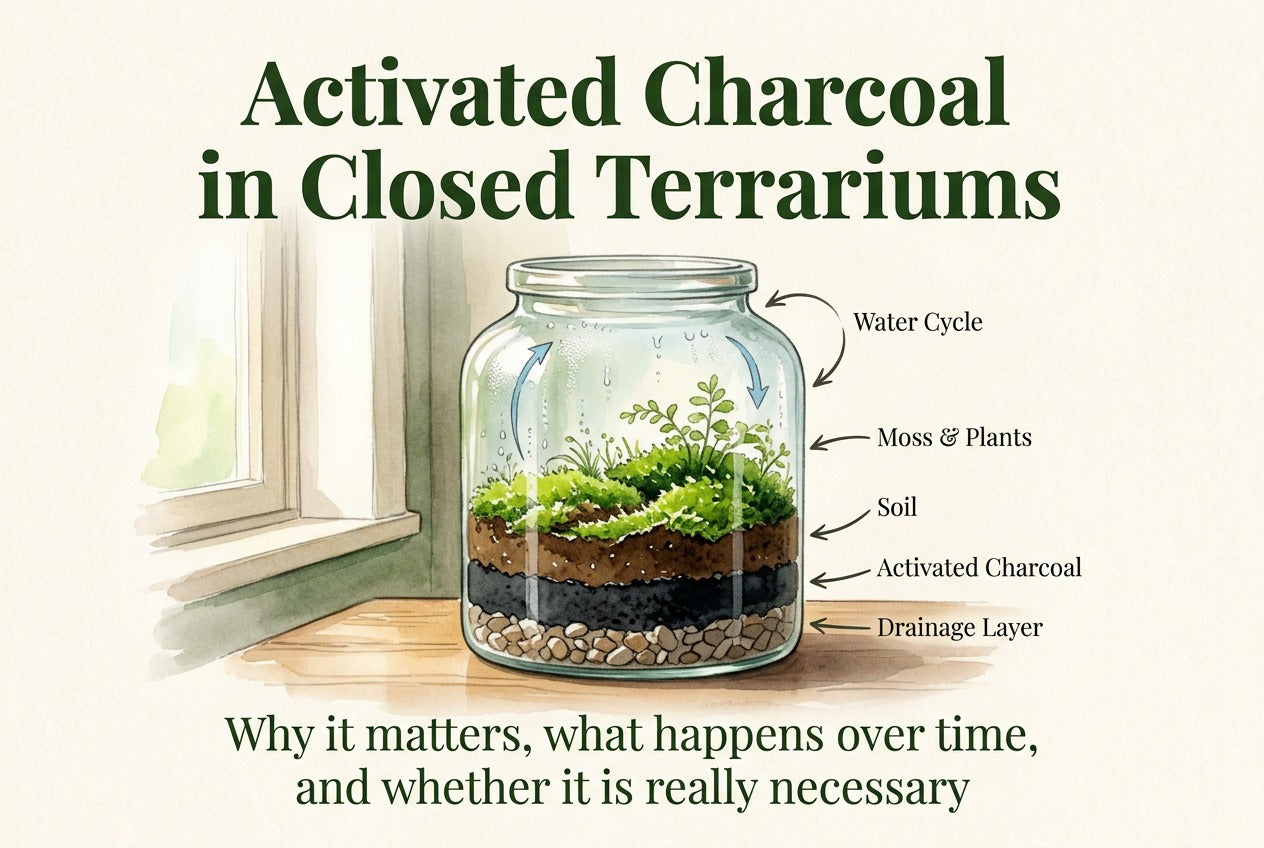
Activated charcoal is one of the most commonly recommended layers in a closed terrarium. It helps keep the environment clean, reduces odor, and improves stability — especially in the early stages.

But here’s the question many people don’t ask:
What happens when the charcoal stops working?
Does the terrarium fail? Or can it continue to function naturally?
In this guide, we’ll break down how activated charcoal works, what happens when it becomes exhausted, and why a healthy terrarium eventually relies on more than just charcoal.
What Does “Exhausted Charcoal” Mean?
Activated charcoal works through a process called adsorption, where impurities stick to its highly porous surface.
Over time:
- Its pores fill up
- Its filtering ability decreases
- Eventually, it stops absorbing new impurities
At this point, the charcoal is considered “exhausted”.
However, it does not become harmful — it simply turns into an inactive porous material rather than an active chemical filter.

Why Activated Charcoal Matters Most at the Beginning
A newly built terrarium is not yet stable.
During this phase:
- Organic matter starts decomposing
- Moisture levels fluctuate
- Microbial balance has not formed
Activated charcoal helps by:
- Absorbing excess organic compounds
- Reducing odor and impurities
- Buffering the system during setup
This makes it especially valuable for beginners or small closed terrariums.

From Chemical Support to Biological Balance
As the terrarium matures, something important happens:
The system becomes biologically stable.
Over time:
- Beneficial bacteria grow in the soil
- Fungi help break down organic matter
- Plant roots regulate moisture
- Microorganisms recycle nutrients
At this stage, the terrarium no longer depends heavily on charcoal.
Instead, it runs on a natural ecosystem cycle.

What Happens When Charcoal Is Exhausted?
When activated charcoal is fully saturated:
- It stops absorbing impurities
- It no longer acts as a chemical filter
However, this does not mean immediate failure.
Instead, you may gradually notice:
- Slight swampy or earthy smell
- Brown-tinted water in the base
- Occasional mold growth
- Moss becoming less vibrant over time
These changes are usually slow and manageable, not sudden.

Does Exhausted Charcoal Still Help?
Yes — even after it is exhausted, charcoal still plays a role.
It can still:
- Provide a surface for beneficial microbes
- Help separate drainage and soil layers
- Improve airflow in the lower layer
So while it is no longer a chemical filter, it remains part of the terrarium structure.

Is Activated Charcoal Always Necessary?
Activated charcoal is not strictly required in every setup, but it is highly recommended in certain cases.
Most useful for:
- Closed bottle terrariums
- Moss and fern terrariums
- Small decorative setups
- Beginner builds
Less critical for:
- Bioactive terrariums (with microfauna)
- Larger natural systems
- Well-balanced advanced setups
In simple terms:
The smaller and more closed the system, the more important charcoal becomes.

The Real Role of Activated Charcoal
Activated charcoal is best understood as:
A stabilizer, not a permanent solution.
It helps:
- Reduce risk during setup
- Improve early-stage success
- Buffer excess moisture and waste
But long-term success depends on:
- Plant health
- Proper moisture balance
- Microbial activity
- Overall ecosystem design
CONCLUSION
A Healthy Terrarium Is a Living System
A well-built closed terrarium evolves over time.
In the beginning, activated charcoal helps keep things stable.
But as the system matures, plants and microorganisms take over the role of maintaining balance.
So while charcoal is helpful, the true goal is to create a self-sustaining ecosystem — one that continues to thrive even after the charcoal has done its job.
QUICK SUMMARY
In Simple Terms
- Activated charcoal does get exhausted over time
- Once exhausted, it stops filtering impurities effectively
- It does not become harmful
- A mature terrarium can still function without it
- Long-term stability comes from biological balance, not charcoal alone


