
How To Grow Bromeliads In Terrariums Successfully
This guide is created by Green Chapter — Nature Workshop Studio, where we focus on creating living ecosystems through hands-on experience. We share practical insights across terrariums, aquascaping, plants, and natural systems to help you build and care for your own.
What Exactly Are Bromeliads?

Most terrarium bromeliads are epiphytes.
That means they naturally grow attached to branches, bark, rocks, or trees instead of growing directly in soil. In nature, their roots are mainly used for gripping and anchoring rather than absorbing nutrients like traditional terrestrial plants.
This is why mounted bromeliads often perform better than buried bromeliads inside terrariums.
Their natural environment is surprisingly airy. Rain wets them regularly, but wind and airflow dry them quickly afterward. Their roots cling tightly onto bark while their leaves collect moisture, debris, and nutrients from the surrounding environment.
Some species even evolved specialized leaf scales called trichomes that help absorb moisture directly from the air.
Why Bromeliads Work So Well In Terrariums

Bromeliads instantly create a layered tropical rainforest feeling.
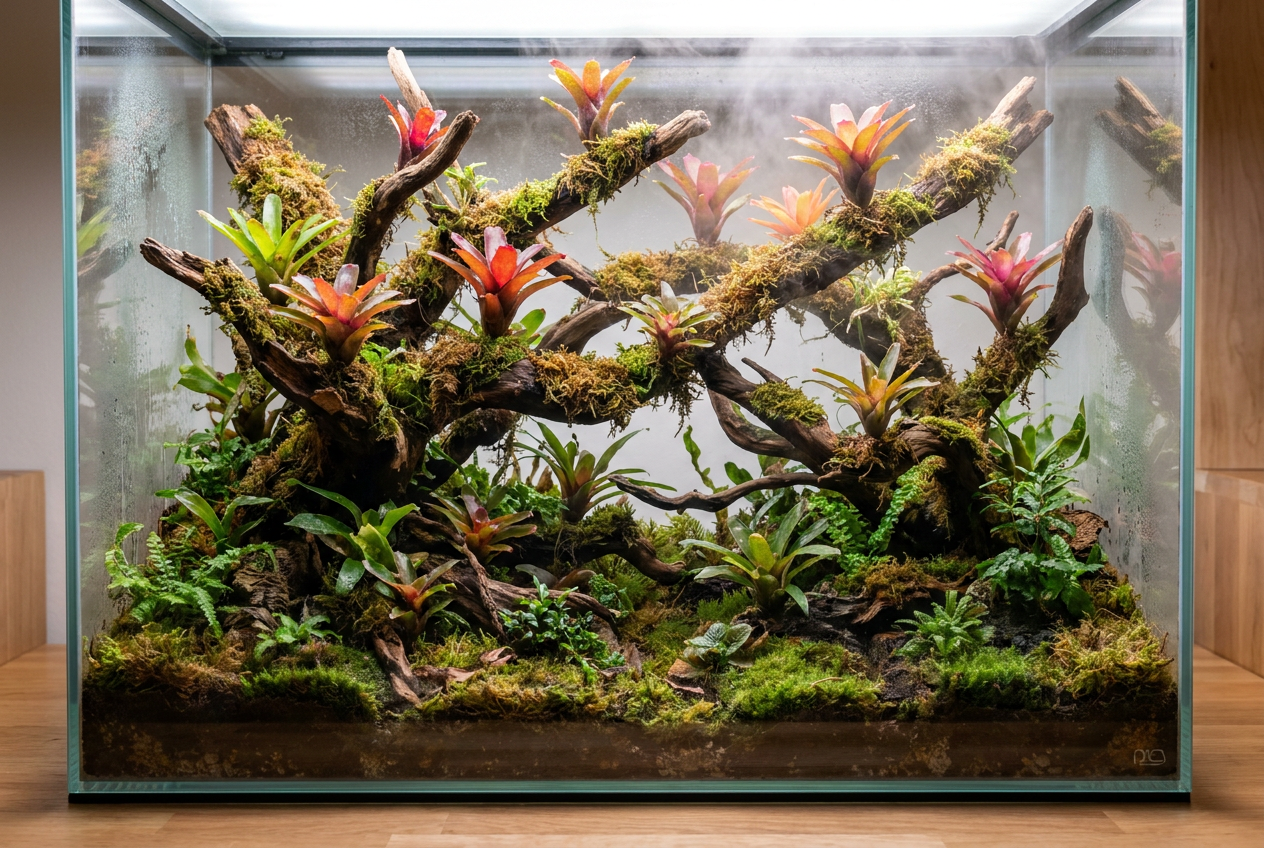
They help transform a flat terrarium into a vertical ecosystem by adding canopy structure, elevated planting zones, and strong visual contrast. Mounted bromeliads also pair beautifully with mosses, orchids, creeping plants, driftwood, and waterfall hardscape systems.
One reason designers and interiorscapers love them is because they naturally grow upward and outward without needing large amounts of substrate space.
A single mounted bromeliad can completely change the feeling of a terrarium.
Miniature species are especially useful because they fit naturally into enclosed ecosystems without overpowering the scale of the scape.
Mounted vs Potted Bromeliads

Many bromeliads can survive in pots.
But surviving and thriving are different things.
Inside humid terrariums, potted bromeliads often struggle because their base remains constantly wet. Over time, trapped moisture around the crown causes bacterial rot, fungal issues, or melting leaves.
Mounted bromeliads dry much faster and behave more naturally.
By attaching them onto wood, cork bark, background walls, or elevated branches, you recreate how these plants actually grow in the wild.
Mounted setups also improve airflow around the base of the plant — one of the most important factors for long-term success.
The Best Bromeliads For Terrariums

Not all bromeliads behave the same way.
Some absolutely thrive inside humid vivariums, while others quickly rot in enclosed wet environments.
Miniature Neoregelia species are generally considered the gold standard for terrarium use. Varieties like Neoregelia ‘Fireball’ and Neoregelia ‘Liliputiana’ tolerate humidity extremely well while maintaining strong colours under bright lighting.
These species stay compact, colourful, and adaptable in enclosed tropical systems.
Tillandsias, however, are often misunderstood.
Many silver-leafed Tillandsia species come from drier, airier environments and usually fail inside heavily misted terrariums. Constant dampness blocks airflow around their trichomes and leads to rapid rot.
Some Vriesea species can also struggle in stagnant enclosed systems where moisture constantly sits inside the crown.
How To Mount Bromeliads Properly

Mounting bromeliads is actually quite simple.
Start by gently cleaning excess soil away from the roots. Place a small amount of long-fiber sphagnum moss or peat moss around the root area to help retain slight moisture during the establishment phase.
Next, position the bromeliad into a natural crevice, fork, or nook within the driftwood or hardscape.
Secure the base firmly using:
- Fishing line
- Nylon strips
- Natural twine
- Coated wire
- Zip ties
Never use copper wire.
Copper is toxic to bromeliads and can slowly damage the plant over time.
The most important part is stability. Even slight wobbling prevents roots from attaching properly onto the mounting surface.
After several weeks to months, the roots will naturally grip onto the wood and the temporary ties can usually be removed.
The Biggest Terrarium Mistake: Too Much Moisture

This is where most beginners fail.
People assume bromeliads love constantly wet environments because they are tropical plants.
But bromeliads do not want stagnant wetness.
They want cycles.
Rain. Drying. Airflow. Evaporation.
Inside closed terrariums with automatic misters and foggers, the biggest danger becomes trapped moisture sitting on leaves and inside the central crown for too long.
This eventually causes crown rot.
The solution is airflow.
Small terrarium fans dramatically improve bromeliad health by helping moisture evaporate naturally between misting cycles. Even gentle airflow can completely change the long-term stability of a humid vivarium.
Humidity without airflow is one of the fastest ways to kill bromeliads.
Misters, Foggers & Watering

Automatic misting systems can work beautifully for bromeliads when used correctly.
The goal is light hydration — not soaking.
Short misting bursts are usually far safer than long drenching sprays. The leaves should ideally dry before the next misting cycle begins.
Try not to position misting nozzles directly above the bromeliad crown where water continuously blasts into the center.
Foggers should also be treated carefully.
Many beginners use foggers too aggressively, turning the enclosure into a constantly wet cold cloud. Dense fog tends to settle into lower areas and reduce fresh airflow.
Instead, use foggers mainly for visual atmosphere and humidity boosts rather than primary watering.
Short scheduled intervals work much better than continuous fogging.
RO or distilled water is also strongly recommended because tap water minerals eventually clog mister nozzles and leave white mineral crusts on bromeliad leaves.
Placement Matters More Than Most People Realize

Where you place the bromeliad inside the terrarium matters enormously.
The lower substrate zone is usually the wettest and most stagnant part of the enclosure. This area works better for mosses, ferns, and moisture-loving ground plants.
Bromeliads should usually be mounted higher.
Upper zones receive:
- Better airflow
- Faster drying
- Stronger lighting
- Cleaner humidity cycles
This is also closer to how they naturally grow in rainforest canopies.
A useful terrarium design mindset is:
- Upper canopy = bromeliads and epiphytes
- Mid layer = moss walls and creeping plants
- Lower zone = wet mosses and ferns
Thinking vertically helps create healthier ecosystems overall.
Lighting & Colouration

Lighting plays a massive role in bromeliad health and colour.
Weak lighting causes many species to become dull green, stretched, and leggy. Their reds, pinks, purples, and orange tones slowly fade away over time.
Strong full-spectrum LED lighting around 6000K–6500K generally produces much better growth and coloration indoors.
Mounting bromeliads higher naturally helps them receive stronger light exposure.
This is one reason bromeliads often look dramatically better near the top of professional vivariums.
Final Thoughts

Bromeliads become much easier once you stop treating them like ordinary potted plants.
They are canopy plants.
They want airflow, elevation, bright light, moisture cycles, and mounting surfaces that let them breathe naturally.
When integrated properly, bromeliads can completely transform a terrarium into a layered tropical ecosystem that feels alive from top to bottom.
The goal is not to keep them constantly wet.
The goal is to recreate a rainforest rhythm:
rain, airflow, drying, and growth.


