
DIY Living Liana Vines — Building Realistic Jungle Structures for Terrariums & Paludariums
This guide is created by Green Chapter — Nature Workshop Studio, where we focus on creating living ecosystems through hands-on experience. We share practical insights across terrariums, aquascaping, plants, and natural systems to help you build and care for your own.
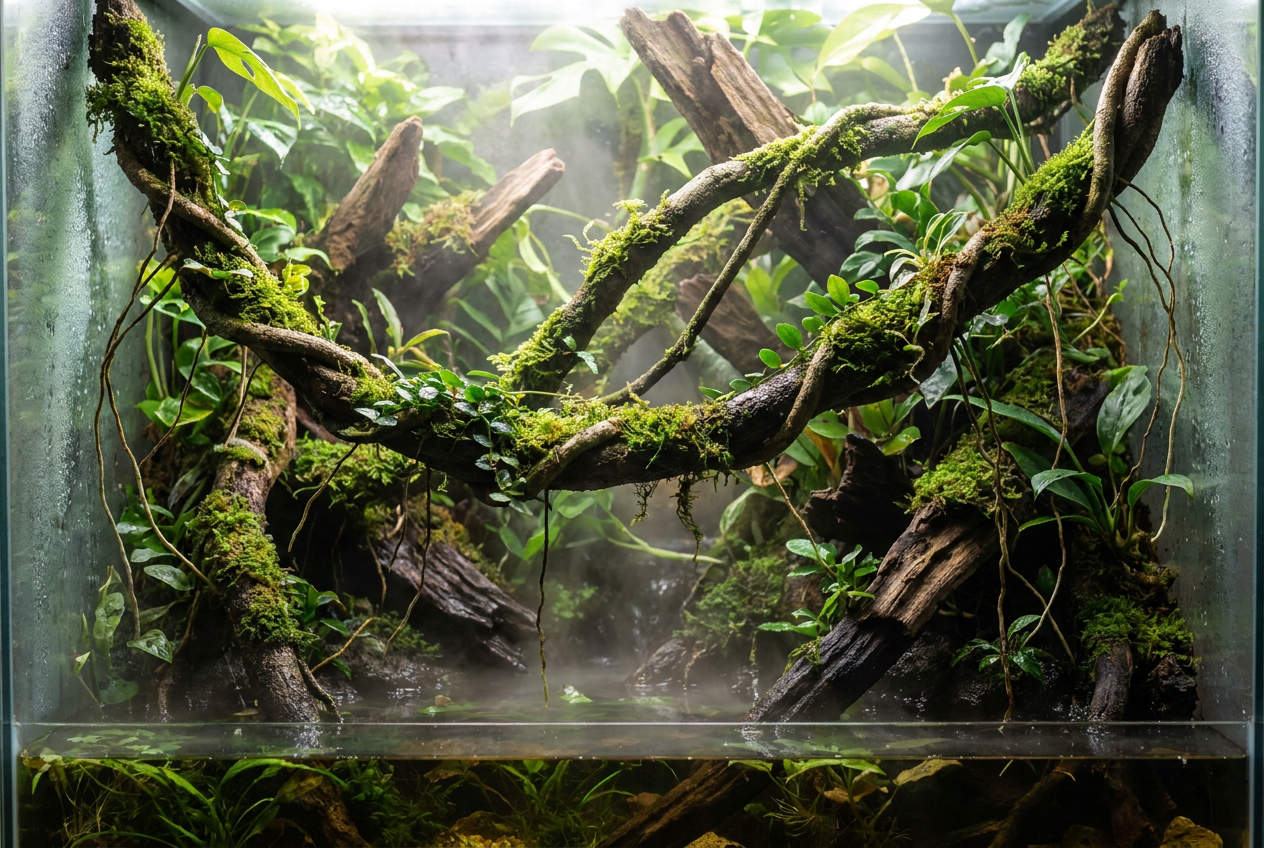
Artificial liana vines may sound complicated at first, but the truth is surprisingly simple:
You are essentially building a controlled, moisture-wicking climbing surface that behaves like rainforest bark.
Once hobbyists understand this idea, many things inside natural ecosystems suddenly start making sense.
Why does moss always grow better on rough bark?
Why do climbing plants attach themselves to certain surfaces?
Why do rainforest roots stay damp without sitting underwater?
Why do some terrariums thrive while others slowly rot?
The answer often comes down to one thing:
Moisture balance.
A well-designed synthetic liana is not meant to stay soaking wet like a sponge. Instead, it stays gently damp, breathable, oxygenated, and biologically active — very similar to how real jungle vines behave in humid forests.
The exciting part is that these structures can be built using surprisingly cheap and accessible materials that many hobbyists already have at home.
And perhaps most importantly:
There is no single “correct” design.
Some hobbyists build sleek modern climbing poles.
Others create twisted ancient rainforest roots.
Some leave exposed bark sections visible.
Others completely carpet their vines in moss.
The goal is not perfection.
The goal is experimentation, observation, and building miniature ecosystems that evolve over time.
Why Artificial Lianas Work So Well

One of the biggest beginner misconceptions in terrarium building is believing that rainforest environments must always stay extremely wet.
In reality, most tropical climbing surfaces are only lightly damp while still remaining exposed to airflow and oxygen.
Artificial lianas work because they mimic this exact condition.
The bottom section of the vine sits inside the hidden water reservoir or drainage layer. Moisture slowly climbs upward through the fabric skin using capillary action — the same physics that allows paper towels, moss, and tree bark to transport water against gravity.
The result is a climbing surface that:
- stays consistently humid
- slowly rehydrates itself
- remains breathable
- avoids becoming waterlogged
- supports mosses and aerial roots naturally
This is why climbing plants like Marcgravia, Rhaphidophora, and creeping figs attach themselves so aggressively to textured damp surfaces.
You are essentially engineering a permanent rainforest climbing surface.
The Most Beginner-Friendly Materials

One of the best parts about this project is how approachable it is.
You do not need expensive vivarium products to start experimenting.
Most DIY lianas can be built using:
- black silicone tubing
- nylon or polypropylene rope
- Hygrolon fabric
- microfiber cloth
- aquarium-safe silicone
- orchid bark
- coco coir
- mosses
- climbing plant cuttings
For many hobbyists, thick nylon rope is the easiest option because it is flexible, cheap, lightweight, and easy to pin plants into.
If you want dramatic twisting vines that hold their shape permanently, aluminum armature wire combined with foam sleeves creates excellent results.
Avoid natural cotton or hemp ropes. They may look attractive initially, but constant humidity eventually causes them to rot and collapse.
The Secret Behind Realistic Bark Texture

A plain wrapped rope rarely looks convincing by itself.
The realism comes from texture variation.
One of the most effective methods is creating a layered “forest dust” mixture using:
- crushed orchid bark
- tree fern fiber
- peat moss or coco coir
When aggressively pressed into wet black or brown aquarium-safe silicone, the varying particle sizes create realistic bark fissures and shadows that resemble aged rainforest wood.
Unlike paint or hard coatings, silicone stays permanently flexible even after curing.
This is extremely important.
Your vines should still be bendable after installation. Hard paints, epoxy coatings, or varnishes often crack over time inside humid terrariums.
The silicone method creates a flexible rubber-like bark skin that withstands misting, humidity, and movement for years.
Why Moisture Balance Matters More Than Constant Wetness

This is one of the most important lessons in terrarium building:
Healthy ecosystems are not constantly soaked.
Many beginners accidentally damage their setups by:
- over-misting
- over-fogging
- eliminating airflow
- creating permanently saturated surfaces
A good synthetic vine should feel:
slightly cool and damp — not dripping wet.
Roots still need oxygen.
Mosses still need airflow.
Even rainforest environments experience drying cycles, evaporation, and moving air.
Too much moisture can lead to:
- blackened moss
- root rot
- algae blooms
- fungal buildup
- stagnant smells
- plant detachment
The goal is controlled humidity, not flooding.
This is also why rough bark textures work so well:
they trap tiny pockets of moisture while still allowing oxygen exchange around roots and mosses.
Integrating Mist Systems & Foggers Properly

Misting systems and foggers can dramatically improve synthetic vine ecosystems when used correctly.
Misting helps:
- hydrate mosses
- reactivate climbing roots
- maintain bark humidity
- simulate rainforest rainfall cycles
Foggers help:
- increase ambient humidity
- slow dehydration
- create cloud-forest style atmospheres
- support delicate moss establishment
But moderation is important.
Heavy fog running continuously can create stagnant air and reduce oxygen exchange.
In nature, fog usually comes in cycles — often strongest during early mornings and cooler periods.
For most terrariums and paludariums:
- short misting bursts
- temporary fog cycles
- moderate airflow
- natural evaporation
…create healthier long-term ecosystems than constant saturation.
A useful observation rule:
If water is continuously dripping down the vine surface all day, the system is probably too wet.
Creating Wet Zones & Dry Zones on the Same Vine

One of the most fascinating advanced techniques is engineering multiple moisture zones within a single vine.
This allows different plants to grow on different sections naturally.
For example:
- damp upper zones can support mosses and Marcgravia
- drier lower sections can support Tillandsias or miniature epiphytes
This can be achieved by:
- stopping the fabric before the reservoir
- interrupting capillary flow using silicone barriers
- adjusting mist exposure
- positioning vines near or far from fog output
Suddenly, the hobby shifts from decoration into ecosystem design.
You are no longer simply attaching plants.
You are designing environmental conditions.
Making Floating Magnetic Jungle Vines

Magnets are one of the most elegant ways to mount synthetic lianas.
Instead of permanently gluing vines into place, strong coated neodymium magnets allow you to:
- suspend vines mid-air
- reposition structures easily
- remove vines for trimming
- clean glass without dismantling the setup
This technique feels almost magical when done properly.
Long twisting vines can appear to float naturally through the canopy without visible supports.
For humid terrariums:
- use epoxy-coated or rubber-coated neodymium magnets
- avoid standard nickel-plated magnets
- use stabilizer magnets for heavier vines
This approach is especially useful for parent-and-kid projects because structures remain adjustable and experimental instead of permanent.
The Most Exciting Part — Watching the Ecosystem Evolve

Perhaps the most rewarding part of building synthetic lianas is that they continue changing long after the initial setup is complete.
At first, the vine may look simple.
But over time:
- moss spreads
- roots attach
- textures soften
- climbing plants branch
- humidity stabilizes
- the structure begins looking increasingly natural
Eventually, the artificial framework almost disappears beneath living growth.
This transformation teaches an important lesson about ecosystems:
Nature is rarely static.
Healthy terrariums evolve gradually through observation, adjustment, experimentation, and patience.
That is why projects like this are excellent not only for hobbyists, but also for:
- students
- families
- classrooms
- workshops
- creative makers
- nature lovers
You are not simply crafting decorations.
You are building living systems.
Final Thoughts — Think Like an Ecosystem Designer

One of the most exciting realizations in terrarium and paludarium building is discovering that many natural systems can be recreated using surprisingly simple principles.
A synthetic liana is ultimately:
- moisture control
- airflow management
- texture engineering
- plant support
- ecosystem planning
Once hobbyists understand these principles, they begin seeing rainforest environments differently.
Suddenly:
- bark texture matters
- humidity gradients matter
- airflow matters
- root attachment surfaces matter
- drying cycles matter
And this is where the hobby becomes deeply rewarding.
Not because everything looks perfect immediately —
but because the ecosystem slowly teaches you how nature works over time.


