
Shrimp-Safe vs Risk Stones: How Rocks Affect Water Stability in Aquariums
This guide is created by Green Chapter — Nature Workshop Studio, where we focus on creating living ecosystems through hands-on experience. We share practical insights across terrariums, aquascaping, plants, and natural systems to help you build and care for your own.
Introduction
When designing an aquascape, most attention naturally goes to form—how rocks look, how they anchor the layout, and how they guide the eye. But in a shrimp tank, especially one built for Caridina species, the real consideration goes deeper than aesthetics.
Rocks are not just visual elements. They interact with water chemistry over time, sometimes subtly, sometimes significantly. While some stones remain completely stable, others slowly release minerals that alter pH, KH, and GH, gradually shifting the balance of your tank.
These changes are often invisible at first—but over time, they can affect shrimp health, molting, and breeding success. Understanding which stones are safe, and which carry risk, is essential for building a stable and predictable system.
Why Rock Choice Matters in Shrimp Tanks
Shrimp thrive in environments where stability is maintained over long periods. Unlike many fish, they are sensitive to even small fluctuations in water parameters.
Caridina shrimp typically require:
- Very low KH
- Soft, controlled GH
- Slightly acidic, stable pH
In such conditions, even a slow mineral release from rocks can gradually raise hardness. This weakens the buffering effect of aquasoil and shifts the system away from its intended balance.
The challenge is that this process is slow. A tank may appear stable for weeks, only to become unpredictable months later. This is why rock selection is not just a design choice—it is a long-term system decision.
The Inert vs Reactive Spectrum
All aquascaping stones fall somewhere along a spectrum based on how they interact with water chemistry.
At one end are inert stones, which have little to no measurable effect. These are the most predictable and safest for shrimp tanks. In the middle are stones that may release small amounts of minerals over time. At the far end are reactive stones, which actively influence KH and pH due to carbonate content.
Understanding this spectrum allows you to anticipate how your tank will behave—not just immediately, but over time.

As a general guideline:
- Inert stones provide stability and control
- Transitional stones require testing and monitoring
- Reactive stones introduce ongoing chemical change
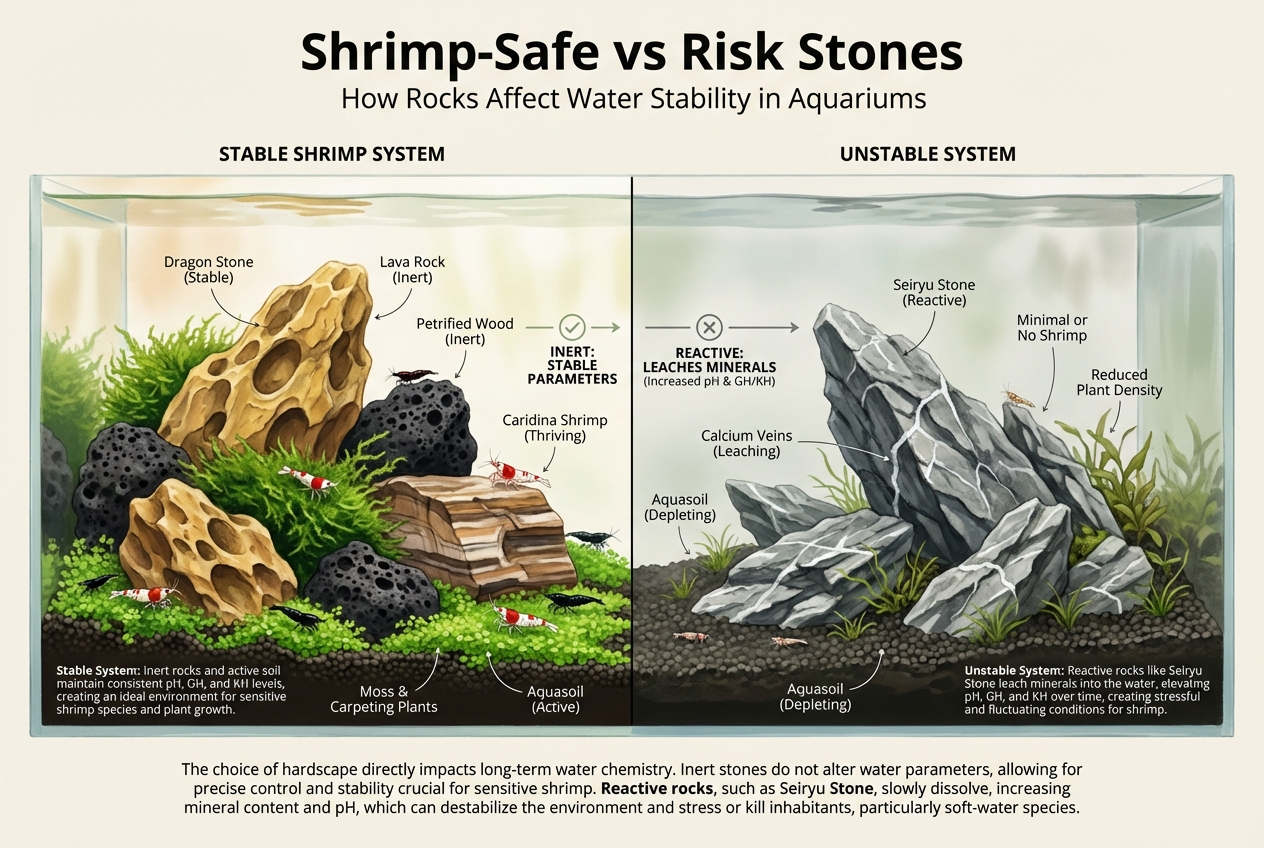
Shrimp-Safe vs Risk Stones (Quick Visual Guide)
To simplify selection, commonly used aquascaping stones can be grouped into three practical categories.
🟢 Safe for Sensitive Shrimp
These stones are widely used in shrimp tanks because they remain chemically stable. Dragon Stone, Lava Rock, Unzan Stone, Petrified Wood, and Granite or Quartz do not significantly affect pH, KH, or GH.
They work especially well in systems using RO water and buffering substrates, where maintaining consistency is critical. Over time, they allow the tank to behave predictably without unexpected shifts.
🟡 Use With Caution
Some stones sit in a grey zone. Elephant Skin Stone and Hakkai Stone are good examples of this category.
Their composition can vary depending on source, and while they may appear inert, they can sometimes release small amounts of minerals—especially in very soft water conditions. This makes testing essential before use.
These stones can still be used successfully, but they require more attention and verification.
🔴 Risk of Hardness Drift
Seiryu Stone and Ryuoh Stone are visually striking and commonly used in aquascaping, but they are chemically active.
They contain carbonate minerals that slowly dissolve in water, raising KH and gradually pushing pH upward. In shrimp tanks, this creates instability and can interfere with breeding conditions.
These stones are better suited for display tanks or setups where higher hardness is acceptable.

This visual serves as a quick reference when planning your layout or selecting materials.
How Each Stone Behaves (Practical Understanding)
Looking deeper into why stones behave differently helps build stronger intuition when designing a tank.
Inert stones such as Dragon Stone and Lava Rock are formed from materials that do not dissolve easily in water. Petrified Wood, for example, has undergone complete mineral replacement into silica, making it highly stable.
Volcanic stones like Lava Rock and Unzan Stone are not only inert but also provide additional surface area for beneficial bacteria, supporting biological stability.
On the other hand, stones like Seiryu contain visible mineral veins—these are often calcium carbonate deposits that dissolve slowly over time. Even a gradual release can accumulate and shift water chemistry.
Transitional stones fall between these extremes. Their behavior depends on subtle differences in composition, which is why direct testing is always recommended.
Why CO₂ Systems Increase the Risk
In high-tech planted tanks, CO₂ injection introduces another layer of complexity.
CO₂ lowers pH by forming carbonic acid, while reactive rocks increase KH and buffer against that drop. This creates a continuous push-and-pull effect within the system.
Over time, this leads to:
- Daily pH fluctuations
- Gradual KH increase
- Reduced system stability
For shrimp tanks, where consistency is critical, this combination can be particularly problematic. This is why inert stones are generally preferred in CO₂-injected systems designed for shrimp.
How to Test Rocks Before Adding to Your Tank
Even when a rock is labeled as aquarium-safe, it is always best to verify it yourself—especially for sensitive setups.
Step 1 — Acid Test
Apply a small amount of vinegar to the rock surface. If it produces visible fizzing or bubbling, this indicates the presence of carbonate minerals.
This is a clear sign that the rock will affect water hardness and should not be used in a shrimp tank.
Step 2 — Soak Test
Place the rock in a container filled with RO or distilled water for 7 to 14 days.
During this period, monitor:
- pH
- KH
- GH
If any of these values increase, the rock is releasing minerals into the water.
Step 3 — Stability Check
If the parameters remain stable throughout the soak test, the rock can be considered safe for use.
Taking the time to perform these checks helps prevent long-term issues that are far more difficult to correct later.

Final Takeaway
A successful shrimp tank is built on stability over time, not just initial setup.
While it is easy to focus on visual impact, the long-term behavior of your materials plays an equally important role. Choosing inert stones, testing uncertain materials, and avoiding reactive rocks in sensitive systems will help you maintain consistent conditions.
In the end, the best aquascapes are not only visually balanced—they are chemically predictable, stable, and resilient over time.


