
How Aquarium Shrimps Mate and Breed: Looking Beyond the Glass
This guide is created by Green Chapter — Nature Workshop Studio, where we focus on creating living ecosystems through hands-on experience. We share practical insights across terrariums, aquascaping, plants, and natural systems to help you build and care for your own.
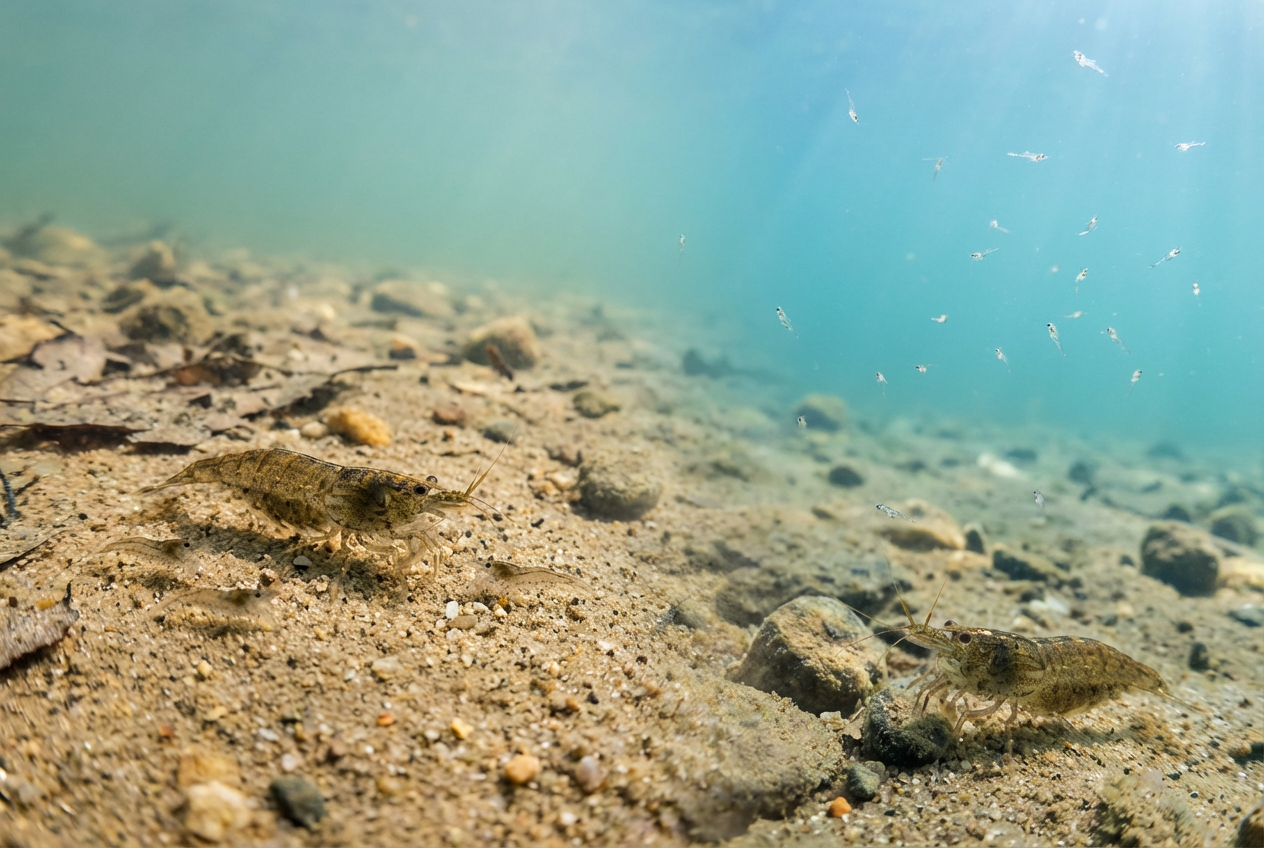
Walk into any aquarium shop and it is easy to think of shrimp as a single category. They sit in planted tanks, graze on surfaces, and are often sold as cleaners or peaceful additions to a community setup. But once we begin to look at them more carefully, that simple picture starts to break apart. The shrimps most commonly available in the hobby do not all come from the same kind of water, and they do not all live or reproduce in the same way. Some come from slow inland streams and ponds. Some are tied to mountain rivulets with soft, acidic water. Some evolved in ancient mineral-rich lakes. Others belong to river systems that connect to the sea, where the young drift away as larvae before returning inland.

This is why a useful shrimp article should not begin with colour grades or price tags. It should begin with origin, habitat, and life cycle. Once those three things are clear, many familiar hobby questions become easier to answer. Why do cherry shrimp multiply so easily in a planted tank? Why do bee shrimp need tighter control? Why are Sulawesi shrimp considered difficult even though they do not need brackish water to reproduce? And why do Amano, Red Nose, and fan shrimp so often carry eggs but almost never establish self-sustaining colonies in an ordinary freshwater aquarium? The answers all come back to where these animals come from and what their young are designed to do.
In this guide, we will look at the common shrimp groups in the hobby one by one. For each, we will consider what they are, where they come from, how they live in the wild, what kind of water they are associated with, and how they breed. After that, we will step back and examine the larger breeding patterns that tie the whole story together.
Neocaridina: the adaptable inland freshwater shrimp
Neocaridina shrimp are the most familiar entry point for many hobbyists. In the trade, this usually means the many colour forms of Neocaridina davidi — cherry, blue, yellow, orange and related lines. Beneath all the selective breeding, however, the species itself is an inland freshwater shrimp associated with East and Southeast Asia. Published sources place its native distribution across parts of China, Taiwan, Vietnam and Korea, and describe it as a shrimp of inland water bodies rather than an estuarine species. That matters, because it explains both its tolerance and its reproductive strategy.  In nature, Neocaridina-type shrimp are associated with relatively forgiving habitats: shallow streams, vegetated margins, ponds, ditches, and other inland freshwater systems where biofilm, decaying plant matter, and algae are always present. They are not animals built around a migratory larval phase in the sea. Their whole life cycle is completed in fresh water, and that inland pattern is reflected in the way they breed in captivity.
 Because of this background, Neocaridina shrimp are usually the easiest of the commonly sold shrimp to keep and breed. In aquaria, they are often comfortable somewhere around 20–28°C in neutral to slightly alkaline conditions, and they are much more forgiving of ordinary planted-tank parameters than most bee-type Caridina. Their success in the hobby is not just a matter of hardiness; it is also that their young hatch as miniature benthic juveniles rather than requiring a separate larval phase in brackish or marine water.
Bee-type Caridina: mountain-stream ancestry behind a man-made lineage
When hobbyists talk about Caridina, they often mean the bee shrimp complex — crystal reds, crystal blacks, Taiwan bees, blue bolts and related ornamental forms. These strains are strongly shaped by selective breeding, especially in Japan and later across the international shrimp hobby, but their story does not begin in the showroom. Their wild ancestry is tied to Caridina cantonensis and related southern Chinese mountain-stream shrimp. Primary and species-profile sources describe Caridina cantonensis as a shrimp of mountain streams and rivulets in Guangdong, Hong Kong, and neighbouring regions, living in clear, soft, often acidic running water.

That wild origin is important because it explains why bee shrimp are not simply “fancier cherry shrimp.” Their man-made patterns may be artificial, but the ecological template behind them is not. They come from cooler, cleaner, softer water systems with lower mineral load and less fluctuation than the average tropical community aquarium. In practice, this is why hobbyists so often pair them with active soils, remineralised RO water, and tighter parameter control. The shrimp are not fragile in an abstract sense; they are specialised for a narrower water profile.

Even so, their breeding pattern remains a true freshwater one. Bee-type Caridina are direct developers. The female carries relatively few, larger eggs, and the hatchlings emerge as small benthic juveniles rather than free-swimming marine-type larvae. So although bee shrimp are often considered difficult, the difficulty is mostly environmental rather than developmental. The challenge lies in maintaining the right water chemistry and stability, not in converting larvae through a brackish phase.
Malayan shrimp: a local and often overlooked freshwater Caridina
In Singapore and Malaysia, the shrimp commonly called Malayan shrimp is especially interesting because it reminds us that not all Caridina fit the bee-shrimp template. Local natural history sources identify the Malayan shrimp as Caridina malayensis, a species recorded from Peninsular Malaysia and Singapore, including peat-swamp and lowland freshwater habitats. In other words, this is not a cold mountain-stream specialist and not a brackish migrator, but a true Southeast Asian inland freshwater shrimp.

That origin helps explain why Malayan shrimp often feel more forgiving in the aquarium than bee shrimp. Their natural world is warmer, more organic, and often visually messier: shallow vegetated water, leaf litter, fine detritus, and surfaces rich in microbial growth. A shrimp from such an environment is adapted to constant foraging and to a habitat built around biofilm rather than pristine, rock-only flow.

Like Neocaridina and bee-type Caridina, Malayan shrimp are direct developers. Landlocked freshwater Caridina with larger eggs generally produce benthic young that remain in fresh water throughout their life cycle, and the hobby treatment of Malayan shrimp is consistent with that freshwater reproductive pattern. For practical aquarium purposes, it is best understood as a direct-developing Caridina from lowland Southeast Asian freshwater habitats rather than as a larval estuarine species.
Sulawesi shrimp: ancient-lake specialists built for stability
Sulawesi shrimp deserve to be treated as a separate group because they represent a very different ecological story. The ornamental species most people recognise — such as the cardinal shrimp, Caridina dennerli — belong to the ancient lake systems of Sulawesi, especially the Malili lakes such as Lake Matano. Scientific work on Sulawesi atyids describes these lakes as long-isolated systems that produced a remarkable radiation of endemic shrimp species. This is not a generic tropical stream environment; it is a highly stable, highly specialised freshwater system.

This ancient-lake background explains why Sulawesi shrimp can be difficult even when the tank looks visually simple. They are commonly associated with warm, alkaline, mineral-rich, very stable water, and aquaculture reports on C. dennerli culture have recorded rearing conditions around the upper tropical range with alkaline pH and moderate dissolved solids. They are not asking for brackish water, but they are asking for consistency. In many home aquaria, it is instability rather than any single wrong number that causes trouble.

Their breeding pattern is still a freshwater one. Sulawesi ornamental shrimp are grouped with the direct-developing freshwater side of the hobby, not with Amano or Red Nose shrimp. The reason they are considered advanced is therefore ecological, not developmental. They may reproduce as true freshwater shrimp, but the babies still depend on the same stable, mineralised environment that shapes the adults.

Amano shrimp: freshwater adults tied to a larval journey at sea
Amano shrimp, Caridina multidentata, are among the most famous shrimps in planted tanks because of their reputation as algae grazers. Their natural biology, however, is very different from Neocaridina or bee shrimp. Research on C. multidentata describes it as an amphidromous shrimp: adults live in freshwater river systems, but larvae are dispersed through saline conditions before juveniles return inland. Experimental larval studies show that survival and development depend on salinity, which is why berried Amano shrimp so rarely produce a lasting colony in an ordinary freshwater aquarium.

In the wild, this makes perfect sense. Amano shrimp belong to river systems, not closed inland ponds. Their life cycle assumes movement between freshwater adults and saline larval development. So when an Amano female carries eggs in a planted tank, it does not mean the species is hard to mate. Mating and egg production can happen readily. The real barrier is that the larvae are built for a different phase of life than the aquarium provides.

For aquarium care, Amano shrimp are commonly kept in ordinary freshwater planted-tank ranges, but their breeding should always be understood as a two-environment story. Adults live and mate in fresh water. Larvae do not complete development there. That single point explains most of the confusion surrounding Amano “breeding.”

Red Nose shrimp: elegant estuarine migrants in miniature form
Red Nose shrimp, Caridina gracilirostris, are often admired for their transparent body and long red rostrum, but biologically they belong on the same broad side of the divide as Amano shrimp rather than with Neocaridina. Species and larviculture sources describe C. gracilirostris as an amphidromous shrimp whose larvae develop under brackish conditions. In practical terms, that means the adults can live in fresh water, but successful rearing of the young depends on a salinity shift during larval development.

This kind of life cycle points to a habitat linked to estuaries and coastal river systems rather than isolated inland shrimp habitats. The adults may be seen by aquarists as freshwater shrimp, but the species is not evolutionarily committed to a closed freshwater loop. Its larvae are part of a drifting stage, and that is why the species remains much rarer to breed through in home aquaria than to keep alive as adults.

The lesson here is the same as with Amano shrimp, though in a different visual form. If we only look at the adult, Red Nose shrimp seem like another peaceful freshwater dwarf shrimp. If we look at the life cycle, we see that they are structured around movement and larval development beyond the standard planted-tank model.
Fan shrimp: freshwater filter feeders with a marine-linked larval phase
Fan shrimp, often sold as bamboo shrimp and represented in the hobby by Atyopsis moluccensis, are immediately recognisable because they do not graze like typical dwarf shrimp. Instead, they perch in current and use fan-like appendages to capture suspended food. Modern references and recent genomic background notes place the adults in freshwater rivers across the Indo-Pacific region, while also noting that the larvae develop in seawater and the adults inhabit fresh water.

This duality explains almost everything about fan shrimp care. Their body form, feeding posture, and habitat preference all point toward current. They are not shaped for browsing a still carpet tank in the same way as a cherry shrimp. In nature, they occupy positions where the river delivers food to them. In aquaria, that means flow is not decoration; it is part of their feeding ecology.

Breeding is correspondingly difficult in the home aquarium. Like Amano and Red Nose shrimp, fan shrimp can complete the adult phase in freshwater, but the larval phase does not simply settle down into miniature shrimp in the same tank. Their reproduction belongs to the amphidromous side of the shrimp world, even though their adult presence in aquaria may make them seem purely freshwater.

How shrimp mating begins
Once we compare the major groups, a useful pattern starts to emerge. The act of mating itself is less mysterious than many people think. In the direct-developing freshwater shrimp most hobbyists keep, the sequence usually begins when the female molts. After shedding the old exoskeleton, she releases pheromones into the water, and males become suddenly active as they search for her. This is the “shrimp frenzy” many aquarists observe without understanding what they are seeing. The actual mating event is brief. Afterward, fertilised eggs are carried beneath the abdomen on the swimmerets. In time, the female becomes what hobbyists call berried.


This basic pattern is shared more widely than beginners expect. Neocaridina, bee-type Caridina, Malayan shrimp, and Sulawesi shrimp all follow the freshwater direct-development side of this story. They mate in fresh water, carry eggs in fresh water, and hatch benthic young in fresh water. That is why they can establish self-sustaining colonies when their environment is appropriate. Amano, Red Nose, and fan shrimp do not break the mating pattern at the start; they break away later, at development. The eggs may be carried in freshwater, but the young are not designed to finish life there immediately.

The real divide: direct developers and larval migrators
This is the point that brings the whole article together. If we strip away colour forms, trade names, and hobby habits, the commonly available shrimp in the aquarium world fall into two broad reproductive pathways. The first pathway is direct development. This includes Neocaridina, bee-type Caridina, Malayan shrimp, and Sulawesi shrimp. These are species or groups whose eggs produce miniature juveniles that remain in freshwater. The second pathway is amphidromous or larval development linked to salinity. This includes Amano shrimp, Red Nose shrimp, and fan shrimp, whose young require a separate larval phase beyond the standard freshwater display tank.
That divide is more useful than a simple ranking of easy and difficult. Neocaridina are easy not merely because they are tough, but because both their environment and their development fit ordinary hobby conditions. Bee shrimp are harder because their environment is narrower, not because their life cycle is more complex. Sulawesi shrimp are harder still because their ancient-lake stability is difficult to recreate consistently. Amano, Red Nose, and fan shrimp are different again: adults may do well, but their larval pathway means successful breeding asks for another system altogether.
Final takeaway
When we look at the shrimps most commonly sold in the hobby, we are not looking at minor variations of one aquarium animal. We are looking at a set of freshwater and freshwater-linked crustaceans shaped by very different landscapes: inland ponds and streams, mountain rivulets, peat-influenced lowland waters, ancient lakes, river mouths, and current-driven tropical rivers. Once we understand that, their breeding patterns stop feeling random. Some are true freshwater colony builders. Some are specialists that reward stability. Others belong to migratory life cycles that a display tank cannot complete on its own.
A good shrimp keeper therefore does more than memorise names. He learns to read the life cycle behind the name. That is where better care starts, and that is also where breeding begins to make sense.


