
Shrimp-Friendly Fish: What Actually Works (and What Doesn’t)
This guide is created by Green Chapter — Nature Workshop Studio, where we focus on creating living ecosystems through hands-on experience. We share practical insights across terrariums, aquascaping, plants, and natural systems to help you build and care for your own.
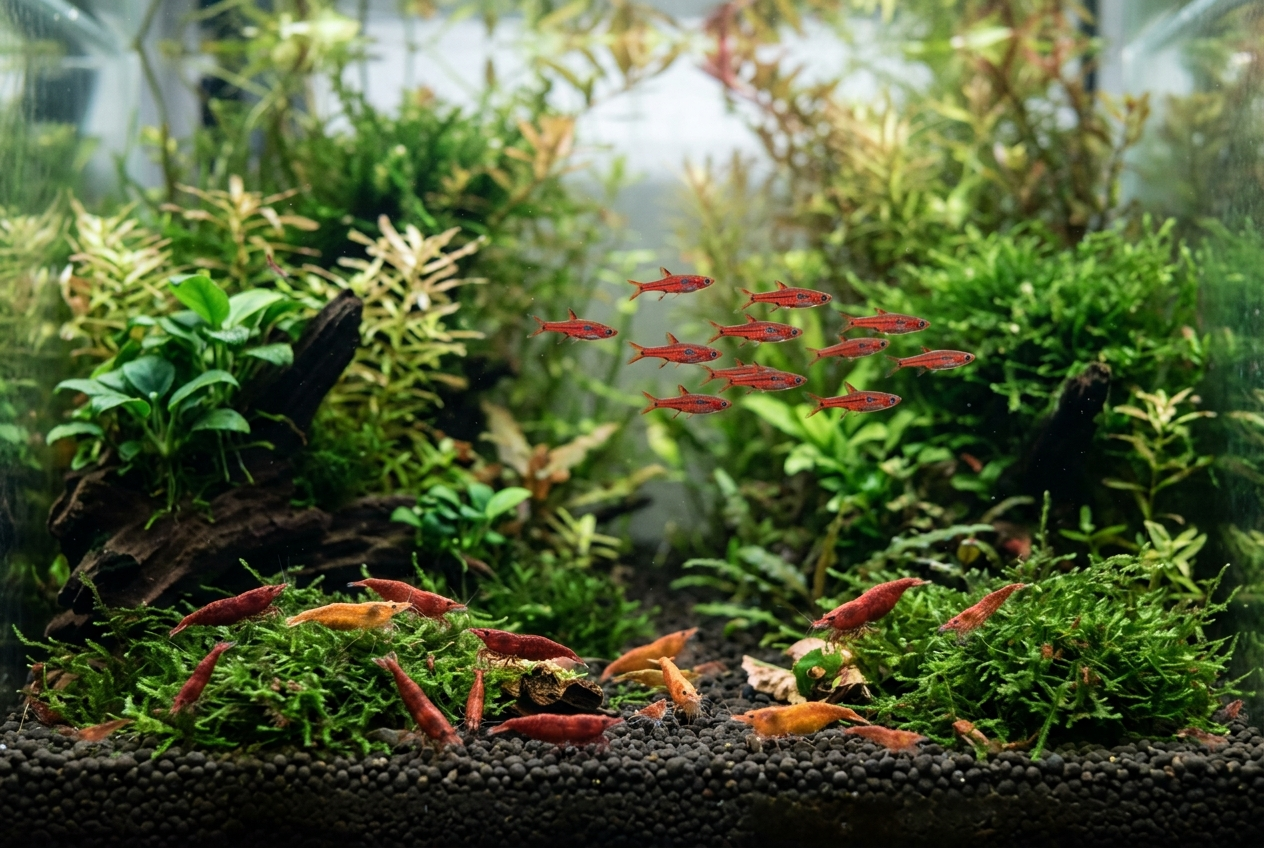
The Truth First: No Fish Is 100% Shrimp Safe
Before choosing any fish, it’s important to understand one simple reality. All fish are opportunistic feeders. If something edible fits into their mouth, they will eventually try to eat it.
Shrimp, especially shrimplets, naturally fall into that category. This means there is no such thing as a completely shrimp-safe fish. What we are really doing is managing risk, not eliminating it.
Once you understand this, the decision becomes clearer. Instead of asking “Is this fish safe?”, the better question is “How likely is it to eat my shrimp?”
Why Size Matters More Than Anything Else

The most important factor is mouth size. A fish with a very small mouth simply cannot consume most shrimp, even if it tries. On the other hand, a slightly larger fish—even if peaceful—may still eat shrimplets without hesitation.
This is why two fish of similar length can behave very differently. It’s not just about how long the fish is, but how large its mouth is relative to the shrimp.
As a rule of thumb:
👉 If the shrimp fits the mouth, it becomes food.
Low-Risk Fish That Work Well With Shrimp
Boraras (One of the Best Choices)

Species like Boraras maculata, merah, brigittae, and strawberry rasbora are among the most reliable companions for shrimp. They have extremely small mouths and tend to stay in the mid-water zone without constantly disturbing the substrate.
In a well-planted tank, they coexist very naturally with shrimp, and losses are usually minimal.
Micro Tetras

Ember tetras, ruby tetras, and hummingbird tetras are small, gentle, and non-aggressive. They generally leave adult shrimp alone and spend most of their time calmly swimming in open water.
Like most fish, they may occasionally take very small shrimplets, but overall risk remains low in a stable setup.
Nano Schooling Fish
Fish such as galaxy rasboras, microrasboras, and blue-eye rainbowfish are slightly more active but still considered shrimp-friendly. They are suitable for mixed setups, especially when keeping adult shrimp.
However, due to their activity level, some shrimplet loss over time is normal, particularly in tanks without enough cover.
Bottom Dwellers

Pygmy, habrosus, and hastatus corydoras, along with kuhli loaches and panda loaches, are generally safe additions. They spend most of their time scavenging rather than actively hunting.
Because they move along the substrate, they may occasionally disturb or consume very small shrimplets, but they do not target shrimp intentionally.
Special Case: Indostomus

Indostomus species are extremely small and often considered shrimp-compatible, but they are still micro-predators by nature. They can feed on very tiny shrimplets, so they are better suited for more controlled or species-focused setups.
How to Make It Work

Even with the right fish, success depends heavily on how the tank is set up. Shrimplets need places to hide, especially during their early stages. Dense moss, fine plants, and small gaps in hardscape create safe zones where fish cannot easily reach.
Adding fish only after the shrimp colony is established also improves survival rates. A stable population can better absorb occasional losses.
Feeding fish properly helps reduce opportunistic hunting, although it will never remove it completely.
Final Takeaway
Keeping shrimp with fish is not about finding a perfectly safe combination. It is about understanding how risk works and making informed choices.
If a shrimp fits into a fish’s mouth, it will eventually be seen as food. By choosing smaller, calmer species and designing your tank with enough cover, you can reduce that risk to a level where both shrimp and fish can thrive together.


