
Neocaridina vs Caridina — Start With Your Water
This guide is created by Green Chapter — Nature Workshop Studio, where we focus on creating living ecosystems through hands-on experience. We share practical insights across terrariums, aquascaping, plants, and natural systems to help you build and care for your own.
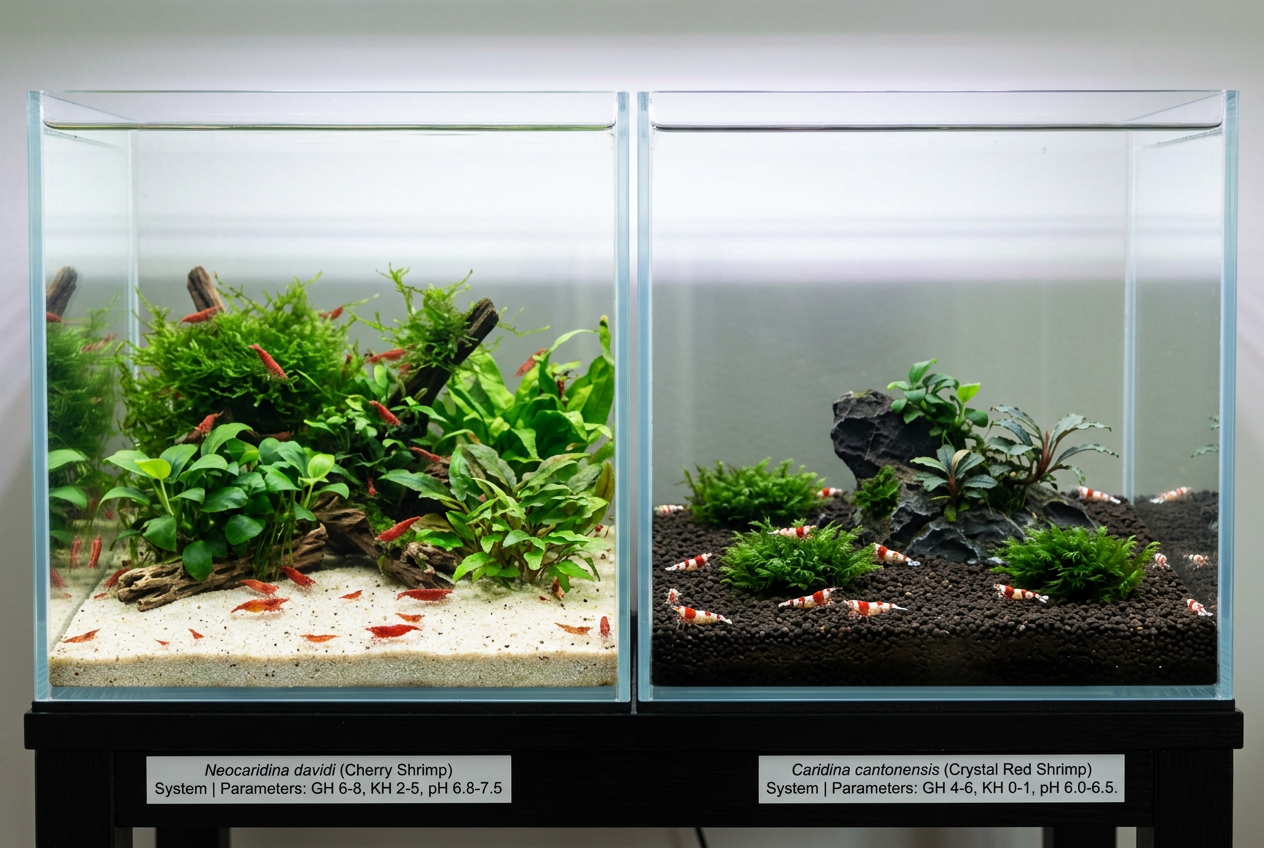
Most beginners choose shrimp based on colour. Bright reds, deep blues, or intricate patterns catch the eye—but this is not the decision that determines success.
The real question is simple:
What kind of water system are you running?
Get this right, and shrimp keeping becomes stable and predictable. Get it wrong, and even the hardiest species will struggle.
Start Here — Tap Water or RO Water?
Before comparing species, decide this first.
- If you are using tap water, you are building a Neocaridina system
- If you are using RO (Reverse Osmosis) water, you are building a Caridina system
This is not preference. It is compatibility.
Neocaridina shrimp are adaptable and thrive in mineral-rich tap water. Caridina shrimp, on the other hand, require soft, controlled water conditions that are typically only achievable with RO water and remineralisation.
| Feature | Neocaridina | Caridina |
|---|---|---|
| Difficulty | Beginner-friendly | Advanced |
| Water Type | Tap water (conditioned) | RO water (remineralised) |
| pH | 6.5 – 8.0 | 5.5 – 6.8 |
| GH | 6 – 10 dGH | 4 – 6 dGH |
| KH | 2 – 6 dKH | 0 – 1 dKH |
| TDS | 150 – 250 ppm | 100 – 150 ppm |
| Substrate | Inert (sand/gravel) | Active buffering soil |
| Stability | Forgiving | Sensitive |
Visual Differences — Colour vs Pattern

Neocaridina shrimp are known for their solid, vibrant colours—reds, blues, yellows, and oranges. They are bold and easy to appreciate even in a simple setup.
Caridina shrimp stand out for their intricate patterns. Crystal Reds, Tigers, and Taiwan Bees display stripes, gradients, and detailed markings that are often selectively bred and graded.
This visual difference is what attracts many hobbyists—but it also reflects their care complexity.
The Real Difference — System, Not Species
The distinction between these two shrimp types is not just biological. It is structural.
1. System Type
Neocaridina belong in a stable ecosystem-style tank.
They work with your environment and tolerate minor fluctuations.
Caridina belong in a controlled system.
Their survival depends on precise, stable parameters.
2. Stability vs Precision
Neocaridina can handle:
- Slight parameter swings
- Inconsistent maintenance
- Beginner mistakes
Caridina cannot.
Even small changes in:
- pH
- temperature
- TDS
can cause stress, failed molts, or sudden losses.
3. Cost and Commitment
Neocaridina setups are simple:
- Tap water
- Inert substrate
- Basic filtration
Caridina setups require:
- RO water system
- Remineralising minerals
- Active buffering soil
- Closer monitoring
This is a commitment to maintaining a controlled environment.
Can You Mix Neocaridina and Caridina?
 Technically, yes—but practically, it does not work well.
They cannot interbreed, but they do not share the same ideal conditions.
- One species will thrive
- The other will only survive
Some aquarists attempt a “middle ground” with neutral parameters, but this often leads to long-term stress and poor breeding, especially for Caridina.
There is also a natural imbalance. Neocaridina breed faster and are more adaptable, often outcompeting Caridina over time.
Special Exception
The only notable exception is
Caridina multidentata
Amano shrimp are technically Caridina, but they are highly adaptable and can live comfortably in Neocaridina-style setups. This makes them a reliable addition to most community shrimp tanks.
Which Should You Choose?
Choose Neocaridina if:
- You are using tap water
- You are new to shrimp keeping
- You want a stable, low-maintenance system
Choose Caridina if:
- You have an RO system
- You want patterned or high-grade shrimp
- You are comfortable managing precise parameters
Common Mistakes to Avoid
- Choosing shrimp based on colour alone
- Mixing both types without understanding water chemistry
- Ignoring GH, KH, and TDS
- Expecting Caridina to adapt to tap water
These mistakes often lead to slow losses that are difficult to diagnose.
Final Thought
The right shrimp is not the most attractive one.
It is the one that matches your water.
Once your system and species are aligned, everything becomes easier—shrimp settle, molt successfully, and begin to breed naturally.


