
Why Shrimp Problems Often Go Unnoticed Until It’s Too Late
This guide is created by Green Chapter — Nature Workshop Studio, where we focus on creating living ecosystems through hands-on experience. We share practical insights across terrariums, aquascaping, plants, and natural systems to help you build and care for your own.
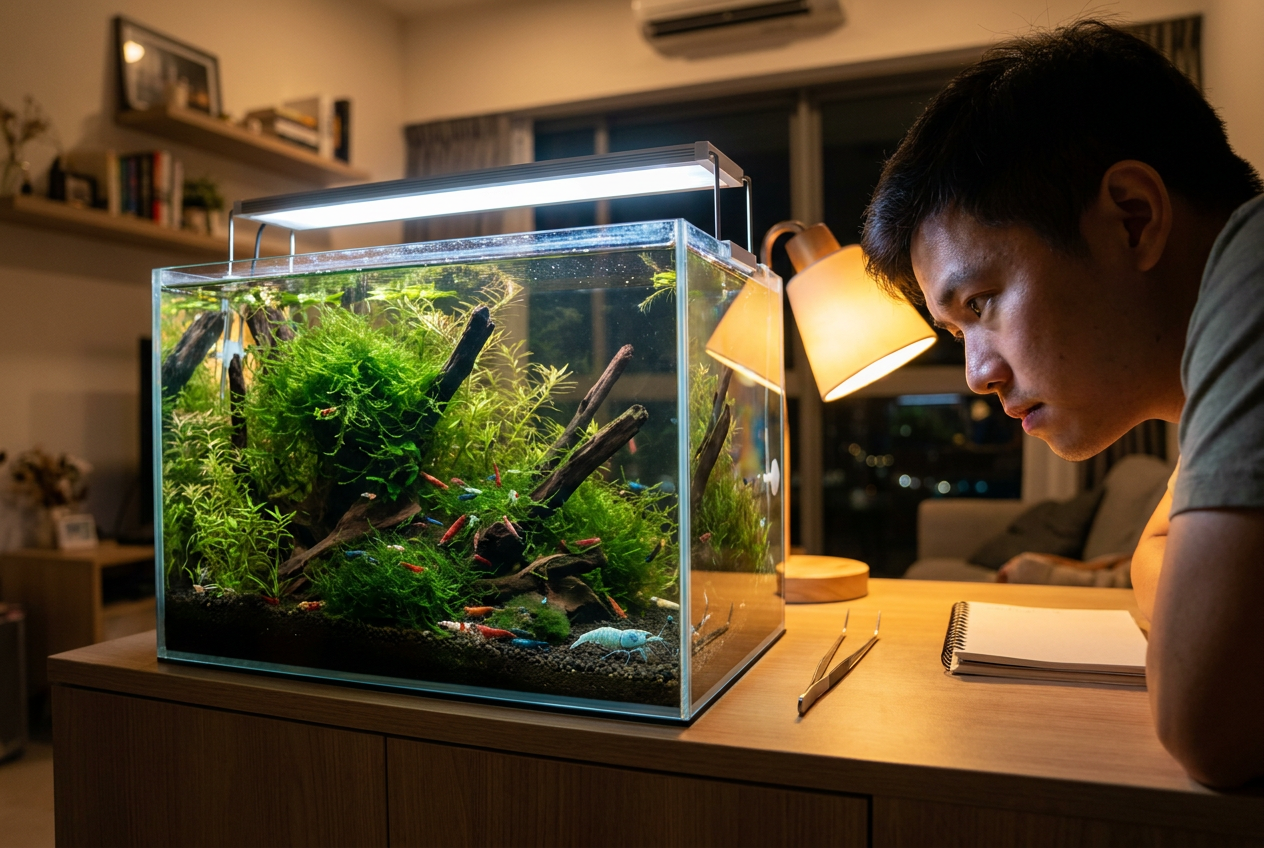
Freshwater dwarf shrimp are small, quiet, and constantly grazing. Unlike fish, they rarely show dramatic symptoms early on. Because of this, many hobbyists only realize something is wrong when they suddenly find dead shrimp every morning.
A healthy shrimp colony usually behaves very consistently:
- Shrimp constantly graze on surfaces
- They actively explore the tank
- Molting happens regularly
- Females breed consistently
- Deaths are rare and isolated
When this pattern slowly changes, it is often the first sign that the tank is becoming unstable long before a major disease outbreak appears.
For many hobbyists, the first realisation is not “my shrimp has a disease.”
It is usually:
- “Why are they hiding so much lately?”
- “Why are they not eating?”
- “Why are my shrimp suddenly dying one by one?”
- “Why does this shrimp look fuzzy?”
- “Are these eggs… or something else?”
Understanding these early warning signs is often what separates a recoverable problem from a colony crash.

Step 1 — The First Signs Something Is Wrong
Before visible diseases appear, shrimp usually change their behavior first.
The “Lethargic” Shrimp
Healthy shrimp are almost always moving and grazing.
A shrimp that sits still for hours, ignores food, or barely reacts to nearby movement is often stressed, weakened, or sick.
One inactive shrimp may not mean disaster.
But several inactive shrimp usually means:
- Water quality is deteriorating
- Oxygen levels are poor
- Internal infections may be spreading
- Molting problems are occurring
The “Drifting” or Tumbling Shrimp
One of the most alarming signs is when shrimp lose control of movement.
You may see shrimp:
- Drifting sideways in the current
- Falling over repeatedly
- Tumbling across the substrate
- Lying on their side while legs continue moving
This often appears during:
- Advanced bacterial infections
- Severe stress
- Muscular necrosis
- Sudden water parameter swings
Unfortunately, shrimp showing these symptoms are often critically ill.
The “Hiding Forever” Shrimp
Shrimp naturally hide during molting.
But if a shrimp disappears into a dark corner for several days without molting, it often means something is wrong internally.
Many beginners assume hidden shrimp are “just shy.”
In reality, prolonged isolation is commonly seen in weak or dying shrimp.
The “Morning Death Count”
A single shrimp death occasionally happens in older colonies.
But finding:
- One dead shrimp every morning
- Multiple unexplained deaths per week
- Shrimp dying after water changes
- Shrimp dying shortly after introduction
…is a major red flag.
This usually points toward:
- Water quality instability
- Internal bacterial infections
- Failed acclimation
- Mineral imbalance
- Contagious disease spreading through the colony

Step 2 — Learning to Recognize Common Shrimp Diseases
Once behavior changes appear, the next step is observing the shrimp closely.
Many diseases have surprisingly recognizable visual signs.
The “Fake Eggs” Problem — Cladogonium Infection
One of the most common beginner mistakes is confusing disease for breeding.
You may look at a female shrimp and think:
“Great, she is carrying eggs.”
But healthy shrimp eggs look:
- Round
- Smooth
- Organized neatly under the abdomen
Cladogonium infections look very different.
Instead of clean eggs, you see:
- Fuzzy growth
- Neon green or yellow-green coloration
- Moss-like texture
- Uneven clumps under the swimmerets
This is usually Cladogonium ogishimae, a parasitic algae that steals nutrients from the shrimp internally.
Affected shrimp often become:
- Weak
- Less active
- Unable to breed successfully
Unfortunately, this disease is notoriously difficult to cure completely.

The “White Mustache” — Scutariella japonica
Sometimes beginners notice tiny white hairs or worms growing on the shrimp’s face.
It may look like:
- Tiny antenna hairs
- A white beard
- Small moving spikes near the nose
- A miniature “alien horn”
These are usually Scutariella japonica, small ectoparasitic flatworms commonly introduced through unquarantined shrimp.
They typically gather around:
- The rostrum (nose)
- Head area
- Gill chambers
Light infestations are often survivable, but heavy infestations can interfere with breathing.
The good news is they usually respond well to targeted salt dips.
The “Dusty” or Fuzzy Shrimp — Vorticella
If a shrimp looks:
- Dusty
- Moldy
- Fuzzy
- Covered in white cloud-like growth
…it may have Vorticella.
Unlike Scutariella, Vorticella forms clusters of tiny protozoans attached to the shell and gills.
This usually happens when:
- Too much food is left uneaten
- Waste accumulates
- Water flow is poor
- Organic waste levels become excessive
Heavy infestations eventually suffocate shrimp by coating the gills.

The “Cooked Shrimp” Tail — Muscular Necrosis
Transparent shrimp should have clear or naturally colored muscle tissue.
If the tail suddenly becomes:
- Milky white
- Opaque
- Solid-looking internally
…it resembles cooked seafood.
This is often muscular necrosis or severe internal bacterial infection.
It progresses quickly and is usually fatal within days.
Because shrimp often eat dead colony members, infections can spread rapidly through scavenging behavior.
Dead shrimp must be removed immediately.
The “Rust Spot” or Burn Mark — Shell Disease
Some shrimp develop:
- Brown spots
- Black patches
- Pitted shell damage
- Rust-colored erosions
This is commonly called Rust Disease or Shell Disease.
It is caused by bacteria attacking the exoskeleton directly.
Poor substrate hygiene and deteriorating water conditions often trigger outbreaks.
Mild cases may disappear after a healthy molt.
Advanced cases become fatal once bacteria penetrate deeper into the body.

Step 3 — The Beginner Trap: “Is It Dead or Just Molting?”
Few things confuse new shrimp keepers more than finding a “ghost shrimp body” on the substrate.
Fortunately, molts and dead shrimp look very different once you know what to look for.
A Healthy Molt
A healthy molt is:
- Completely hollow
- Transparent
- Split open around the back
- Extremely lightweight
This is normal and healthy.
Leave it inside the tank.
Shrimp will often eat the molt to recover calcium and minerals.
A Dead Shrimp
A dead shrimp usually:
- Has solid tissue inside
- Appears pink, white, or orange
- Still contains eyes and organs
- Looks “full” rather than hollow
Dead shrimp should be removed immediately.
If other shrimp consume infected tissue, disease can spread rapidly through the colony.

Step 4 — Before Treating Disease, Check the Water First
Many shrimp diseases are not caused by the disease itself.
They are caused by stress from unstable water.
Shrimp can survive around mild pathogens for long periods — until poor water quality weakens them.
Before using treatments, always check the tank itself first.
The “Rule of Zero”
Three parameters should never be detectable:
- Ammonia: 0 ppm
- Nitrite: 0 ppm
- Nitrate: preferably under 20 ppm
If ammonia or nitrite appears at all, the tank is actively toxic.
If nitrate rises above 40 ppm, waste buildup is becoming dangerous.
The Stability Rule
Shrimp care more about stability than chasing “perfect numbers.”
A stable pH of 7.6 is safer than a pH swinging between 6.8 and 7.6 repeatedly.
General ranges:
- Neocaridina: 6.8–8.0
- Caridina: 6.0–6.8
Sudden swings are often more dangerous than slightly imperfect values.
The Mineral Envelope Rule (GH/KH)
Shrimp molt by shedding their shells.
Without proper minerals, molts fail.
This commonly causes the famous “White Ring of Death,” where shrimp partially molt but cannot fully escape the old shell.
General targets:
- Neocaridina GH: 6–12
- Neocaridina KH: 2–5
- Caridina GH: 4–6
- Caridina KH: 0–1
The TDS Safety-Net Rule
A TDS pen gives a quick snapshot of dissolved buildup in the water.
It does not identify the exact substances present.
But it warns you when the water is becoming overcrowded with:
- Minerals
- Waste
- Fertilizer residue
- Salts from evaporation
General ranges:
- Neocaridina: 150–300 ppm
- Caridina: 90–140 ppm
If TDS rises more than 50 ppm above your normal baseline, it is usually time for a water change.

Step 5 — What Should You Actually Do First?
When shrimp problems appear, beginners often panic and immediately buy medication.
This can accidentally kill shrimp even faster.
Shrimp are extremely sensitive to chemicals, especially copper-based medications.
A safer beginner response flow is usually:
1. Stop Feeding Heavily
Remove leftover food and reduce organic waste immediately.
2. Perform a Safe Water Change
Use properly dechlorinated water with stable matching parameters.
Avoid massive sudden changes.
3. Increase Observation
Watch:
- Which shrimp are affected
- Whether symptoms spread
- Whether molts are successful
- Whether deaths continue daily
4. Remove Dead Shrimp Immediately
Do not allow scavenging of infected tissue.
5. Isolate Visibly Infected Shrimp
Particularly for:
- Cladogonium
- Severe fungal infections
- Advanced bacterial issues
6. Consider Salt Dips Carefully
Salt dips can help with:
- Scutariella
- Vorticella
- Mild fungal infections
But improper dosing can also stress shrimp severely.
Final Thoughts — Most Shrimp Problems Start Quietly
The hardest part about shrimp diseases is that they rarely begin dramatically.
Usually the colony whispers before it crashes.
One shrimp hides.
One shrimp stops eating.
One shrimp develops fuzzy growth.
One shrimp dies unexpectedly.
Experienced shrimp keepers are not necessarily better because they know every disease.
They simply learn to notice tiny changes earlier.
The earlier you observe a problem, the higher the chance your colony recovers before the situation escalates into a full tank crash.


