
Freshwater Shrimp Guide: Understanding Shrimp Types, Classification and Anatomy
This guide is created by Green Chapter — Nature Workshop Studio, where we focus on creating living ecosystems through hands-on experience. We share practical insights across terrariums, aquascaping, plants, and natural systems to help you build and care for your own.
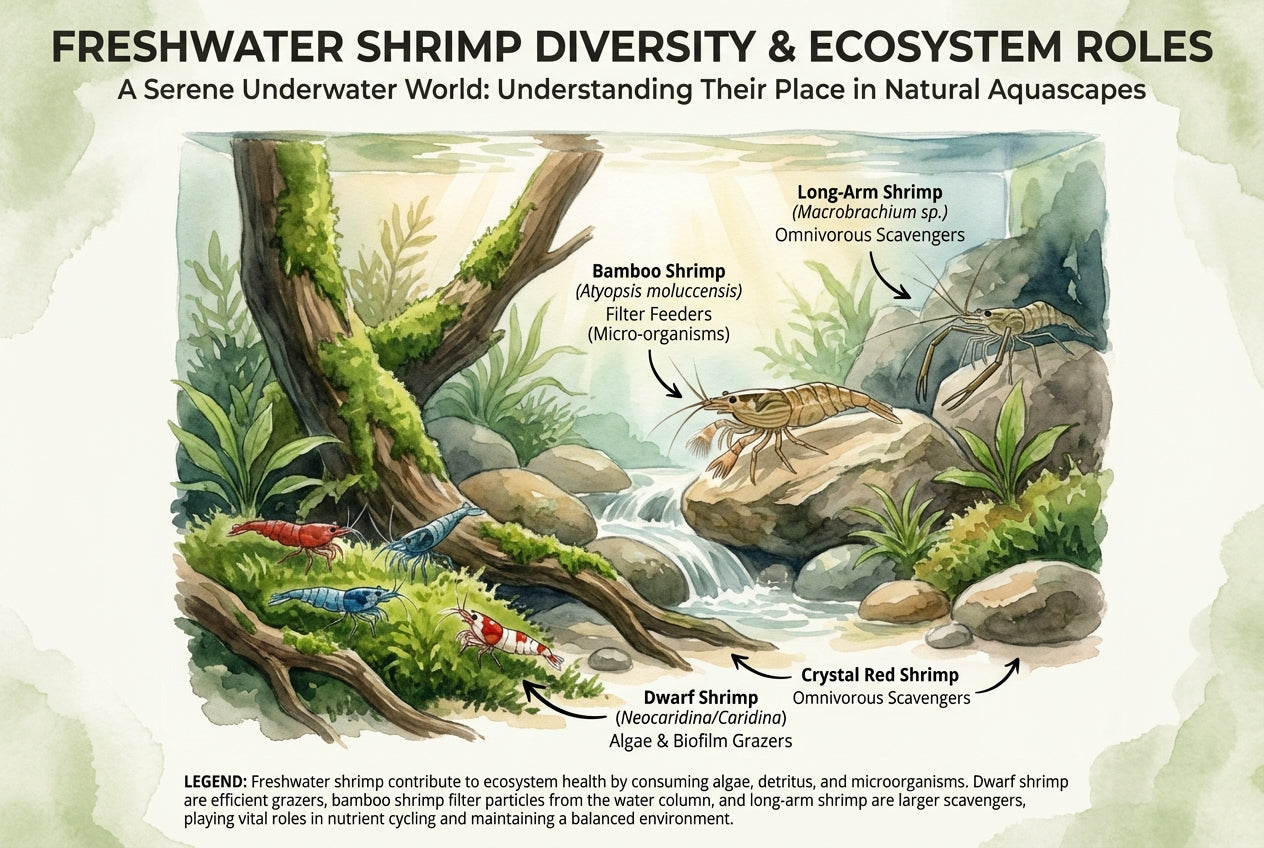
How Do We Classify Freshwater Shrimp?
Freshwater shrimp can be grouped into three main types:
| Shrimp Type | Arm Type | Feeding Style |
|---|---|---|
| Dwarf Shrimp | Small claws | Grazers |
| Filter Shrimp | Fan hands | Filter feeders |
| Long Arm Shrimp | Long claws | Hunters |
Simple Hobbyist Trick
Look at the front arms:
- Small claws → Grazer
- Fan hands → Filter feeder
- Long claws → Hunter
This instantly tells you how the shrimp behaves and feeds.

Dwarf Shrimp (Grazers)
This is the most common group in planted tanks.
Examples
- Cherry shrimp
- Crystal shrimp
- Amano (Yamato) shrimp
- Red Nose shrimp
Key Traits
- Small body
- Short arms
- Constant picking behavior
Feeding
They graze on:
- Algae
- Biofilm
- Detritus
They are excellent natural cleaners and thrive in mature planted tanks.

Filter Shrimp (Fan Feeders)
Filter shrimp are different because they do not pick food.
Examples
- Bamboo shrimp
- Vampire shrimp
Key Traits
- Larger body
- Fan-shaped hands
Feeding
They:
- Sit in water flow
- Use fans to catch floating food
They require:
- Strong water flow
- Fine particle food
Without these, they may slowly starve.

Long Arm Shrimp (Hunters)
These shrimp have long claws and stronger behavior.
Examples
- Ghost shrimp
- Macrobrachium species
Key Traits
- Long arms
- Visible claws
Feeding
They are hunters and scavengers:
- Worms
- Small fish
- Other shrimp
They are not suitable for community shrimp tanks.

Quick Summary
| Group | Feeding Style | Tank Suitability |
|---|---|---|
| Dwarf Shrimp | Grazers | Planted tank |
| Filter Shrimp | Filter feeders | High flow tank |
| Long Arm Shrimp | Hunters | Species tank |
Before adding shrimp, always ask:
Is it a grazer, filter feeder, or hunter?
Know More About the Shrimps (Anatomy)
After classification, understanding shrimp anatomy helps explain:
- How they eat
- How they move
- How they grow
Shrimp bodies are divided into:
- Cephalothorax (head + body)
- Abdomen (tail)

Head Structure
The cephalothorax contains:
- Eyes
- Antennae
- Mouthparts
- Legs
The outer shell is called the carapace, and the pointed tip is the rostrum.
Mouth Parts
Shrimp use small appendages to process food:
- Mandibles → crush
- Maxillae → move
- Maxillipeds → hold
They are constantly:
- Picking
- Bringing food to mouth
- Eating slowly

Legs
Shrimp have five pairs of legs.
The first pair differs by type:
- Dwarf → small claws
- Filter → fan hands
- Long arm → large claws
Other legs are used for walking and handling food.
Swimmerets
Swimmerets are small appendages under the tail used for:
- Swimming
- Oxygen flow
- Holding eggs
Egg Carrying
Female shrimp carrying eggs are called “berried.”
Eggs are:
- Attached under the tail
- Held by swimmerets
- Fanned for oxygen
Some shrimp hatch as:
- Mini shrimp (easy breeding)
Others hatch as: - Larvae (more difficult breeding)

Molting
Shrimp grow by molting.
Process
- New shell forms
- Old shell breaks
- Shrimp exits
- New shell hardens
During this time, shrimp are vulnerable.
Important
Shrimp need minerals:
- Calcium
- Magnesium
This supports healthy molting.

Final Conclusion
To understand shrimp properly:
Step 1 — Classify them
- Grazer
- Filter feeder
- Hunter
Step 2 — Understand anatomy
- Head
- Mouth
- Legs
- Swimmerets
- Eggs
- Molting
Once you understand these, you can:
- Keep shrimp more successfully
- Design better tanks
- Avoid common mistakes
You are no longer just keeping shrimp — you are understanding shrimp.


