
Opae Ula: The Tiny Hawaiian Shrimp That Thrives on Simplicity
This guide is created by Green Chapter — Nature Workshop Studio, where we focus on creating living ecosystems through hands-on experience. We share practical insights across terrariums, aquascaping, plants, and natural systems to help you build and care for your own.
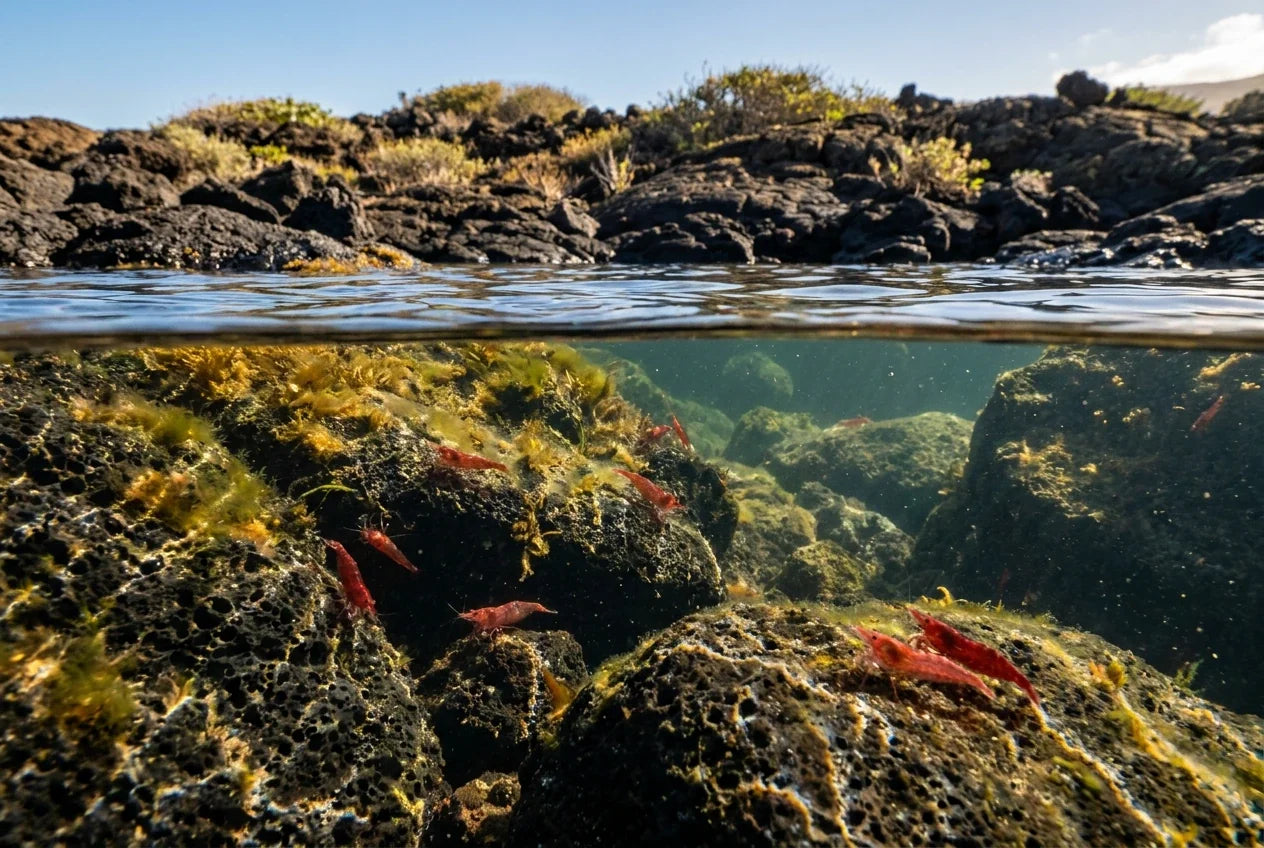
At first glance, Opae Ula look like remarkably simple aquarium animals. They are tiny, require little space, and are often kept in small brackish-water habitats with little intervention.
But their unusual resilience makes much more sense when we look at where they came from.
Opae Ula (Halocaridina rubra) are endemic to the Hawaiian Islands and are strongly associated with a rare environment known as an anchialine pool. These pools, their volcanic surroundings and the microscopic life growing within them explain much of what makes Opae Ula different from familiar freshwater aquarium shrimp.

A Shrimp From Between Freshwater and the Sea
An anchialine pool may look like an isolated freshwater pond. There may be no visible stream flowing into it and no obvious channel connecting it to the ocean.
The connection is largely underground.
Rainwater moves through the porous volcanic landscape as groundwater, while seawater can penetrate coastal rock from the opposite direction. Where these waters meet, they create pools ranging from fresh to brackish conditions. Some even rise and fall with the ocean tide despite having no visible surface connection to the sea.
Opae Ula have evolved within this unusual environment.
This is why they should not simply be thought of as either freshwater or marine shrimp. They are remarkably well adapted to brackish environments and changing salinity conditions. Field observations have recorded Hawaiian anchialine shrimp across substantial salinity gradients.

Why Volcanic Rock Matters
Black volcanic rock is visually characteristic of many Hawaiian anchialine environments, but to a tiny grazing shrimp, a rock is much more than scenery.
Look closely at volcanic rock and you will find pits, pores, cracks and an enormous amount of irregular surface area.
Once submerged, those surfaces gradually become colonised by microscopic life.
Algae grow. Bacteria establish themselves. Diatoms, microorganisms and organic particles accumulate across submerged surfaces.
Together, these form complex biological films and growth that become a food resource for Opae Ula.
Research on Halocaridina rubra describes them primarily as microphagous grazers. Their specialised appendages scrape material from surfaces, including the algal and microbial communities found on their natural pool substrates.
So when an Opae Ula repeatedly picks at a piece of rock, it may appear to be eating nothing.
It isn't.

The Invisible Food Called Biofilm
This is one of the most useful concepts for a new Opae Ula keeper to understand.
Biofilm is a thin biological community that develops on submerged surfaces.
It can contain bacteria, microscopic algae and other microorganisms together with trapped organic material. Some biological growth becomes clearly visible as green or brown coatings, while much of it may be difficult to see with the naked eye.
To us, the surface may simply look like an old rock.
To a grazing shrimp, it can be a feeding ground.
This also changes the way we think about cleanliness in a miniature ecosystem.
A perfectly scrubbed surface is not necessarily better. A little natural growth on rocks and other submerged materials can be useful biological habitat and grazing area.
Opae Ula spend considerable time continually picking and scraping these surfaces. Studies of wild populations have documented this grazing behaviour and its relationship with the algal communities of anchialine pools.

Why Do They Need So Little Food?
This is where Opae Ula husbandry can feel counterintuitive.
Many new keepers associate animal care with feeding:
If the animal is hungry, give it food. If it looks healthy, perhaps give it a little more.
That logic can work badly inside a very small aquatic habitat.
Opae Ula are adapted to grazing on naturally available microscopic food. In an established habitat with suitable surfaces, light and a modest shrimp population, biological growth continually provides material for them to investigate and consume.
Supplementary feeding therefore needs to be approached very conservatively.
The problem isn't simply whether the shrimp can eat commercial food. They can consume additional foods. The greater concern is what happens to food that isn't eaten.
In a large aquarium, a small amount of excess food may be relatively insignificant. In a tiny container containing only a small volume of water, decomposing food can place a disproportionately large biological load on the system.
For a lightly stocked, mature Opae Ula habitat, less intervention is often more appropriate than frequent feeding.

A Small Habitat Works Because It Is Stable
The success of a small Opae Ula habitat does not come from the shrimp somehow needing nothing.
Quite the opposite.
There is activity everywhere — much of it simply happens at a scale we cannot easily see.
Microorganisms colonise surfaces. Algae capture light. Organic material is processed. Shrimp graze continuously across rocks, glass and other submerged objects.
A mature miniature habitat is therefore better understood as a small biological system rather than simply a container of water with shrimp inside.
Its greatest advantage can also become its greatest weakness.
Because the volume is small, very little needs to happen to support a lightly stocked population. But the same small volume also means unnecessary intervention can change conditions quickly.
Adding food, repeatedly cleaning surfaces or frequently replacing water can interfere with the stability we are trying to establish.
The objective is not to constantly improve the habitat.
It is to allow a suitable habitat to mature.

Simple Opae Ula Care
Once an appropriate Opae Ula habitat has matured, routine care can be surprisingly simple.
Give the habitat gentle ambient light, but avoid prolonged direct sunlight or strong lighting that can heat the small volume of water or encourage excessive algae growth.
Avoid unnecessary cleaning. Some algae and biological growth are part of the grazing environment.
Routine large water changes are generally unnecessary in a stable, lightly stocked system unless there is an actual water-quality problem.
Most importantly, watch the water level.
Water evaporates.
Salt does not.
If evaporation is repeatedly replaced with brackish or salt water, the dissolved salts left behind gradually become more concentrated. Evaporated water should therefore normally be replaced with distilled or other suitably purified freshwater, returning the habitat to approximately its original level.
And when it comes to feeding, resist the instinct to constantly add something.
Observe the shrimp first.
If they are actively moving across rocks, glass and other surfaces, repeatedly stopping to pick at them, you are watching the behaviour Opae Ula have evolved to perform.
They are grazing.
Small Shrimp, Different Way of Thinking
Opae Ula are interesting not because they can somehow survive without an ecosystem, but because their ecosystem can operate at such a small scale.
Their Hawaiian anchialine habitat gives us the clues.
Brackish groundwater. Volcanic surfaces. Algae and microorganisms. Continuous grazing. Relatively little available food. And an animal adapted to living within those conditions.
Once we understand that relationship, their unusual husbandry begins to make sense.
You do not need to constantly feed, clean and change things to demonstrate good care.
Sometimes good care means creating the right conditions — and then giving the biology time to work.


