
From Wild Shrimp to a Rainbow: How Neocaridina Became an Aquarium Icon
This guide is created by Green Chapter — Nature Workshop Studio, where we focus on creating living ecosystems through hands-on experience. We share practical insights across terrariums, aquascaping, plants, and natural systems to help you build and care for your own.
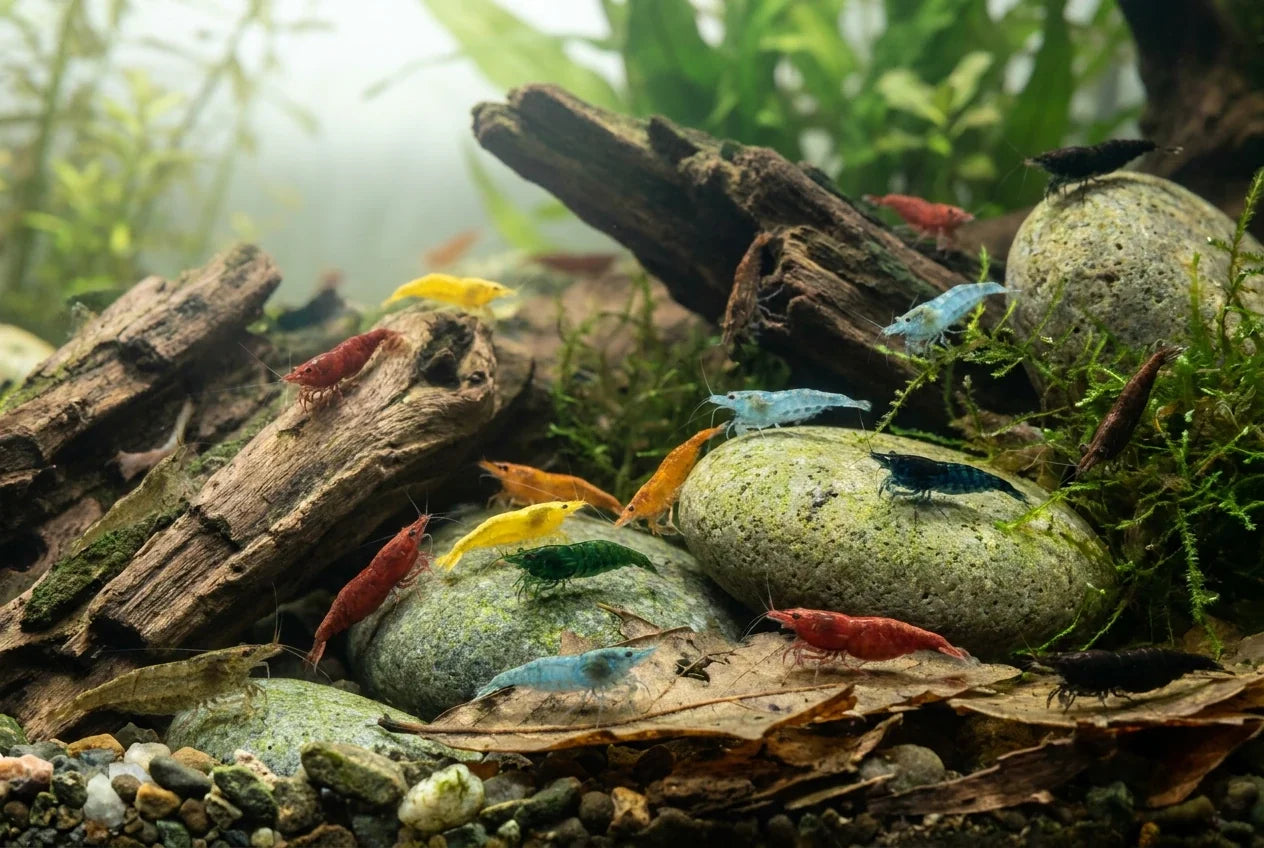
Walk into an aquarium shop today and Neocaridina shrimp can look almost impossibly colourful.
Deep red. Lemon yellow. Orange. Green. Ice blue. Navy blue. Chocolate brown. Almost black. Some are completely covered in colour; others carry transparent bands between brightly coloured heads and tails.
It is easy to imagine that somewhere in Asia, streams are naturally filled with these tiny rainbow-coloured shrimp.
They are not.
Behind almost every brightly coloured Neocaridina in the aquarium trade is a history of human selection. Breeders took a relatively inconspicuous freshwater shrimp and, generation after generation, selected particular colours, patterns and levels of pigmentation.
The result is one of the most striking transformations in the modern freshwater aquarium hobby.
It Started With a Very Ordinary-Looking Shrimp

The shrimp behind this story is Neocaridina davidi, a small freshwater shrimp native to parts of East Asia.
Older aquarium literature may use names such as Neocaridina heteropoda, which can make the early history confusing when reading older sources.
Wild Neocaridina davidi look very different from many of the animals sold in aquarium shops today.
Their bodies are typically translucent with variable brown, grey, olive or greenish pigmentation. Speckles, mottling and irregular markings help break up the shrimp's outline against stones, algae, decaying leaves and other material on the bottom.
From a survival perspective, this makes sense.
A tiny shrimp glowing bright red or electric blue against a natural riverbed would be much easier for a predator to notice.
The subdued wild coloration is not a poorer version of an ornamental shrimp. It serves a completely different purpose: camouflage.
But wild populations also contain something that would eventually become important to aquarium breeders:
variation.
Individual shrimp do not all look exactly alike. Some carry more pigmentation, some less. Colour intensity and distribution can differ between individuals, while mutation and genetic recombination introduce further variation.
In nature, those differences are filtered mainly by survival and reproduction.
In captivity, humans can become the filter instead.
And that changes everything.
Selective Breeding Changed the Rules

Imagine a population of mostly brownish shrimp in which a few individuals show noticeably stronger red pigmentation.
A breeder separates those reddish individuals.
They reproduce.
Among their offspring, some are duller and some are redder.
The breeder keeps the strongest red individuals for the next generation and removes the others from that breeding line.
Then the process repeats.
This is selective breeding.
The breeder is not adding colour to the shrimp. Instead, inherited variation already present or appearing within the population is repeatedly selected.
Over enough generations, something that was once unusual can become increasingly predictable.
The basic process is remarkably simple:
Variation → Selection → Breeding → More Selection → Greater Consistency
The difficult part is doing it repeatedly across many generations.
Without selection, there is no reason for a shrimp population to continually move toward the aesthetic preferences of an aquarium keeper.
Red Changed Everything

The development of red Neocaridina helped transform these shrimp into major ornamental aquarium animals.
By the beginning of the 2000s, Red Cherry Shrimp were entering the international aquarium hobby. They offered an appealing combination: conspicuous colour, small adult size, relative hardiness and the ability to reproduce entirely in freshwater.
Early red shrimp were not necessarily the dense crimson animals we now associate with premium red Neocaridina.
Many were relatively translucent, with red appearing as speckles, patches or uneven coverage.
But breeders had something they could work with.
They kept selecting.
Over successive generations, increasingly intense and complete red pigmentation became available. This eventually produced the grading terminology familiar to shrimp keepers today.
At the lighter end is what is commonly called Cherry.
More complete red coverage is generally described as Sakura.
Still denser and more opaque animals may be sold as Fire Red, with intensely pigmented examples commonly marketed as Painted Fire Red.
These boundaries are not universal. They are hobby and commercial grading conventions rather than scientifically regulated classifications. One breeder's Fire Red may resemble another seller's high-grade Sakura.
But the progression demonstrates something important.
Aquarists were no longer simply keeping a naturally colourful animal.
They were deliberately making a particular appearance more consistent across generations.
Then One Colour Became Many

Once breeders demonstrated how dramatically Neocaridina appearance could be changed through selection, red was no longer the end of the story.
Different breeding programmes pursued different characteristics.
Yellow shrimp appeared.
Orange lines were developed.
Dark brown and almost black animals were selected.
Blue strains became increasingly prominent.
Green shrimp entered the market.
Even the distribution of colour across the body became something breeders could select.
Today the commercial names can sound almost like a paint catalogue:
Red Cherry. Sakura. Fire Red. Bloody Mary. Yellow. Golden Back. Orange Sakura. Blue Jelly. Blue Dream. Blue Velvet. Green Jade. Chocolate. Black Rose.
And then there are the Rilis.
The transformation is extraordinary when these animals are placed beside their wild ancestors.
Yet this is also where the history becomes much less tidy.
It is tempting to draw one colourful family tree with Wild Type at the top and every modern variety branching neatly beneath it.
Real breeding history is more complicated.
A Colour Name Is Not a Genetic Passport
Two shrimp can both be blue without necessarily sharing the same breeding history.
This is one of the most important things to understand about modern Neocaridina.
Names such as Blue Dream, Blue Velvet, Blue Diamond and Blue Sapphire are breeder or commercial names. They are useful within the hobby, but there is no international registry governing the pedigree behind every shrimp carrying those labels.
Different breeders may maintain different lines.
Names can also shift as shrimp move between farms, breeders, exporters, wholesalers and retailers.
This helps explain why Neocaridina lineage charts found online often disagree.
Some relationships have reasonably strong consensus within the breeding community. Others are histories passed between breeders rather than formally documented genetic pedigrees. Still others become difficult to trace after years of commercial breeding.
Blue Jelly, for example, is generally associated in the hobby with Rili/red-derived breeding stock.
Much darker Blue Dream-type shrimp are commonly associated with different, darker breeding lines.
Both are blue.
That does not make them the same strain.
This distinction becomes especially important when breeding them.
Rili: When Less Colour Became Desirable

Not every breeder was trying to produce more pigment.
Sometimes the interesting trait was where the colour disappeared.
Rili shrimp demonstrate this beautifully.
A typical Red Rili may carry strong red pigmentation around the head and tail while the middle portion of its body remains largely transparent.
Instead of treating that transparent section as a defect, breeders selected it.
Repeated breeding strengthened the pattern.
The result was a shrimp valued not simply for colour intensity, but for where that colour appeared.
This represents an important development in ornamental breeding.
Once breeders could select both colour and pattern, the number of possible appearances expanded dramatically.
Rili-derived breeding is also commonly associated with pale blue forms such as Blue Jelly, illustrating how an established breeding population can become the starting material for another direction of selection.
Colour Genetics Are More Complicated Than a Family Tree
It would be convenient if Neocaridina colour worked through a few simple genetic switches.
One gene makes red.
Another makes blue.
Another makes yellow.
Cross two colours and one simply dominates the other.
Research into shrimp pigmentation points to something considerably more complicated.
Visible coloration involves pigments, pigment-containing cells, pigment-binding proteins and multiple biological pathways controlling how pigmentation is produced and expressed.
Appearance can also be influenced by factors such as diet, physiological condition and environment.
Genetics still matter enormously. Generations of selective breeding would not work if these characteristics were not heritable.
But this does not mean every commercial colour can be reduced to one dominant or recessive "colour gene."
For the everyday aquarist, there is a more useful way to understand it:
A stable strain is the result of breeders repeatedly selecting inherited traits that produce a predictable appearance.
And that explains what happens when those carefully selected populations are mixed.
What Happens If We Mix the Rainbow?

A tank containing red, yellow, blue, orange and other Neocaridina can look spectacular.
These mixed colonies are often called Skittles tanks.
There is nothing inherently wrong with keeping one if the objective is simply to enjoy colourful shrimp.
The misunderstanding begins when we expect their offspring to remain equally predictable.
Different ornamental varieties of Neocaridina davidi can interbreed.
When independently selected lines reproduce with one another, the inherited traits that breeders spent generations separating and stabilising are recombined.
The offspring can therefore become much more variable.
Some may resemble one parent.
Some may remain beautifully coloured.
Others may display intermediate or unexpected appearances.
And some may become increasingly translucent, mottled, brownish or wild-type-like.
So the familiar statement:
"Mix the colours and all the babies turn brown."
is too simplistic.
They do not necessarily turn brown immediately, and different colour genes do not simply cancel each other out.
What disappears first is predictability.
Generations of selective breeding narrowed variation toward particular appearances. Crossing independently maintained colour lines opens that variation again.
Without continued selection, the characteristics defining those strains can gradually become less consistent.
Why Shrimp Breeders Need So Many Tanks
This explains something that can initially seem excessive about serious shrimp breeding.
Why maintain multiple separate aquariums?
Why remove a perfectly healthy shrimp from a breeding colony simply because its colour is slightly weaker?
Because maintaining a strain requires continued selection.
Suppose a breeder is maintaining an intensely coloured blue population.
Among the offspring, some show the desired deep blue.
Others are paler.
Some develop uneven pigmentation.
The breeder chooses which animals will contribute to the next generation.
Shrimp that do not fit the breeding objective are culled from the breeding line.
In aquarium terminology, culling does not necessarily mean killing the shrimp. They may simply be moved to another aquarium, sold as a lower grade or otherwise excluded from that particular breeding population.
The selected animals reproduce.
Their offspring are evaluated again.
The process continues.
This is why the real achievement of an ornamental strain is not producing one spectacular shrimp.
It is producing that appearance reliably, generation after generation.
When Colour Became an Industry
As ornamental shrimp became more popular, selective breeding also became commercial.
Colour intensity could affect value.
Pattern could affect value.
Consistency could affect value.
Rarity could affect value.
Grades helped sellers communicate quality, even when those grading systems were not universally standardised.
Names helped distinguish new appearances and breeding lines.
Breeders and farms—particularly across the Asian ornamental shrimp industry, but increasingly around the world—continued developing and refining populations while international trade carried them into aquarium shops far beyond their original range.
A small freshwater shrimp had become a specialised ornamental animal.
And commercial success introduced another complication.
Names became valuable.
An attractive new blue shrimp might acquire a memorable name. Similar-looking shrimp from another breeding population might later be sold under the same or a closely related label.
Over time, appearance, breeding history and marketing can become difficult to separate.
This is why buying two groups labelled "Blue Dream" from unrelated sources does not guarantee that they will breed as though they came from one carefully maintained line.
For someone who simply wants an attractive display aquarium, that may not matter.
For someone trying to preserve a strain, it matters considerably.
There Is No Perfect Neocaridina Family Tree
Colourful diagrams showing the supposed ancestry of every Neocaridina variety are common online.
They can be useful as breeder references.
But they should not be mistaken for a scientifically established evolutionary tree.
Some pathways have strong and long-standing support within the breeding community.
Others are disputed.
Historical documentation can be incomplete.
Commercial naming adds further confusion.
And similar-looking shrimp may not always have identical breeding histories.
This is why asking:
"What colour did this shrimp come from?"
can sometimes have a straightforward answer—and sometimes not.
Rather than weakening the story, that uncertainty tells us something important about the ornamental shrimp industry.
Much of this transformation happened during the modern aquarium era, through breeders working with relatively small populations and pursuing particular appearances.
The process has not stopped.
Breeders continue to notice unusual offspring, isolate interesting traits and attempt to make them increasingly consistent.
The family tree is still being written.
From Camouflage to Colour
Return to the wild shrimp we started with.
Its translucent brown, grey and olive body is exactly what we might expect from a tiny animal trying not to be noticed among stones, algae and fallen leaves.
Place it beside a Painted Fire Red, Blue Dream or Green Jade and the difference can be extraordinary.
Yet that contrast captures the entire story of ornamental Neocaridina.
Nature provided variation.
Humans changed the selection pressure.
Generation after generation, breeders chose which shrimp would produce the next generation.
A little more red.
A deeper blue.
A cleaner transparent band.
A darker shell.
A more consistent population.
Eventually those choices became the colours, grades, strains and names filling aquarium shops today.
The wild shrimp evolved to disappear into its surroundings.
We bred its descendants to be impossible to miss.


