
What Is Wabi-Kusa — And How You Can Use It in Your Space
This guide is created by Green Chapter — Nature Workshop Studio, where we focus on creating living ecosystems through hands-on experience. We share practical insights across terrariums, aquascaping, plants, and natural systems to help you build and care for your own.
A Simpler Way to Experience Living Plants
Most planted setups feel like something you need to build, manage, and maintain.
Lighting, filtration, CO₂, trimming—
it can feel overwhelming, especially for beginners.
Wabi-Kusa offers a different starting point.
Instead of building a full system, you begin with something small and self-contained.
A living piece that grows and changes over time, without needing complex equipment.
Rooted in the philosophy of Wabi-sabi and popularised by Takashi Amano, Wabi-Kusa focuses on something simple:
Letting nature take its course.
What Exactly Is Wabi-Kusa

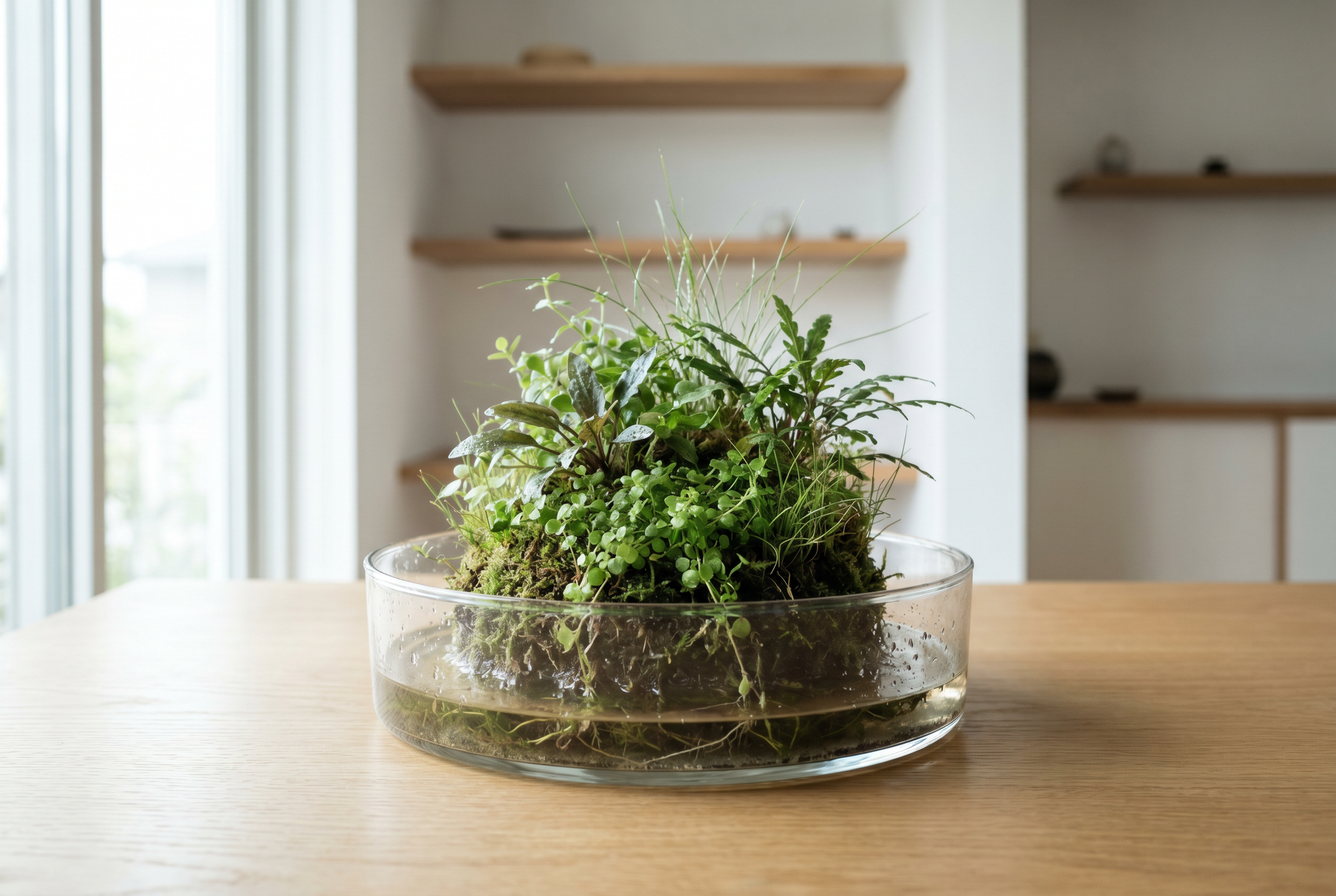
Wabi-Kusa is a compact ball of substrate planted with aquatic plants that grow above water.
These plants are not fully submerged.
They grow in their “emersed” form, where leaves are exposed to air while roots stay moist.
In this form, plants tend to:
- Grow faster
- Develop fuller shapes
- Show stronger textures and colour
The setup itself is minimal.
It usually sits in a shallow layer of water, inside a simple container like a glass bowl or dish.
There is no need for filters or CO₂ systems.
What you get is a small, living environment that continues to evolve on its own.
Why Wabi-Kusa Works So Well for Beginners

For someone new, the biggest barrier is often complexity.
Wabi-Kusa removes that.
There is no need to:
- Set up full aquarium systems
- Manage water flow or filtration
- Fine-tune CO₂ levels
Instead, the focus shifts to something more natural.
You provide:
- Light
- Moisture
- Time
And the plants respond.
Because the plants are grown above water, they also adapt more easily and grow more vigorously.
This makes Wabi-Kusa not just simple, but also forgiving.
It becomes less about getting everything right—and more about observing how it grows.
How You Can Use Wabi-Kusa in Your Space
One of the biggest strengths of Wabi-Kusa is how flexible it is.
The same piece can be used in different ways depending on your space, your preference, and how involved you want to be.
1. A Minimal Desk Piece
The simplest way to use Wabi-Kusa is in a small glass bowl.
With just a shallow water base and some light, it becomes a quiet, living presence on a desk or shelf.
It does not take up much space, but it changes over time—
which makes it far more engaging than a static decoration.

A Natural Display on a Dish
Wabi-Kusa can also be placed on a ceramic plate or shallow tray.
Without a visible container, it feels more organic—almost like a piece of landscape brought indoors.
This format highlights:
- Shape
- Texture
- Natural asymmetry
It works well as a centrepiece or accent in living spaces.

A Hybrid Bowl (Water + Growth)
When placed in a bowl with a slightly higher water level, part of the Wabi-Kusa sits in water while the plants grow above it.
This creates a layered effect:
- Water below
- Growth above
It feels like a miniature ecosystem, showing both aquatic and terrestrial elements together.

Extending an Aquarium (Hanging or Edge Placement)
If you already have an aquarium, Wabi-Kusa can be used to extend the environment beyond the tank.
Placed at the edge or slightly above:
- Roots can interact with tank water
- Plants grow outward into open air
This adds height and depth, making the entire setup feel more natural and less confined.

Inside a Planted Tank (Advanced Use)
Wabi-Kusa can also be placed directly inside an aquarium.
In setups with stronger lighting or CO₂, it can:
- Provide instant plant density
- Help establish layouts quickly
This approach is often used by more experienced hobbyists, but it shows how adaptable the concept can be.

What It’s Good For
Wabi-Kusa fits into many roles at once.
It can be:
- A starting point for beginners exploring planted setups
- A decorative piece for homes and workspaces
- A compact way to observe plant growth up close
- A bridge between aquariums and terrariums
Because it does not rely on a fixed system, it adapts easily to different environments.
📸 IMAGE 9 — Lifestyle Placement
How to Start (Without Overthinking It)
Starting with Wabi-Kusa is intentionally simple.
At a basic level, it needs:
- Light (natural or artificial)
- A small amount of water to keep the base moist
- Occasional misting, especially in dry conditions
In the beginning, some changes are normal.
You may see:
- Leaves adjusting or melting
- New growth forming in different shapes
Over time, the structure becomes fuller and more stable. The key is to avoid over-correcting. Let it adjust gradually, and it will settle into its own balance.

Which Setup Should You Start With
If you are deciding how to begin, a simple approach helps:
- Want something easy → start with a desk bowl
- Prefer a decorative piece → use a dish display
- Want something more dynamic → try a hybrid bowl
- Have an aquarium → explore edge placement
- More experienced → integrate it into a tank
Each approach offers a slightly different experience, but all begin the same way.
Let It Grow Into Something Yours
Wabi-Kusa is not meant to stay the same. It changes with time, light, and environment.
No two pieces will ever grow in exactly the same way.
And that is what makes it meaningful. It is not just something you place in your space— it is something that evolves within it.
Start with a simple piece, and let it grow into something of your own.


