
What Is Iwagumi? The Art of Simplicity in Aquascaping
This guide is created by Green Chapter — Nature Workshop Studio, where we focus on creating living ecosystems through hands-on experience. We share practical insights across terrariums, aquascaping, plants, and natural systems to help you build and care for your own.
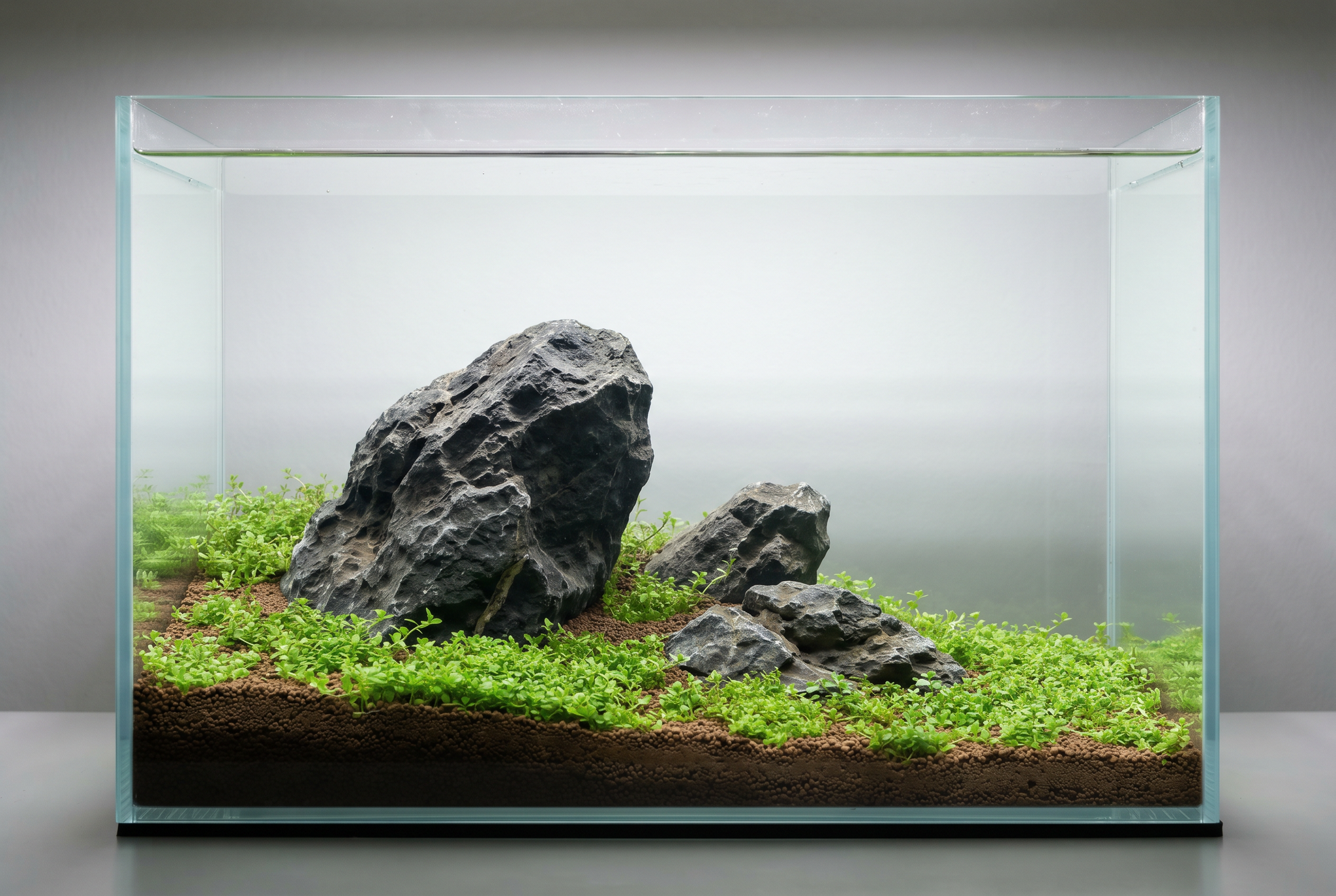
Iwagumi is often one of the first aquascaping styles people notice. It looks calm, clean, and almost effortless — just a few stones placed across an open space, supported by a low carpet of plants.
But that simplicity is deceptive.
Iwagumi is one of the most difficult styles to execute well because there is nothing to hide behind. Every decision becomes visible — the angle of a stone, the spacing between elements, even the slope of the substrate. Where other styles build complexity, Iwagumi removes it. What remains is a composition that depends entirely on balance and intention.
Origins — From Zen Gardens to Aquarium Design
The foundation of Iwagumi comes from traditional Japanese rock gardens, where stones are arranged to represent mountains, islands, or natural forces. These gardens are not decorative. They are designed to express stillness, balance, and the idea that nature is complete without excess.
When Takashi Amano brought this philosophy into aquascaping, he transformed simple stone placement into a living system. Instead of static arrangements, Iwagumi became something that grows, evolves, and matures over time.

The Core Idea — Less, But With Intention
Iwagumi is not about using fewer materials. It is about removing everything that does not contribute to the composition.
In many aquascapes, variety is used to create interest — different plants, textures, and colours layered together. In Iwagumi, interest comes from precision. A slight imbalance in placement or proportion can change the entire feeling of the layout.
This is why Iwagumi is often described as a discipline rather than just a style. It forces you to think carefully about every element, because every element matters.

The Rule of Stones — Understanding the Structure
At the heart of every Iwagumi layout is its stone composition. Each stone has a role, and together they form a balanced structure.
- Oyaishi — the main stone and focal point
- Fukuishi — the supporting secondary stone
- Soeishi — additional supporting stones
- Suteishi — smaller stones that enhance realism, sometimes partially hidden
One key principle is the use of an odd number of stones. Three, five, or seven stones create a more natural rhythm, while even numbers tend to feel too symmetrical.

Composition — Balance Without Symmetry
A common mistake is trying to make the layout feel “even.”
Iwagumi avoids symmetry. Instead, it uses controlled imbalance. The main stone is usually placed slightly off-center, often following the rule of thirds. Supporting stones align with its direction, creating a sense of flow as if shaped by the same natural force.
When done correctly, the layout feels stable, but never rigid.

Negative Space — The Power of Empty Areas
In many aquascapes, empty space feels like something to fill. In Iwagumi, it is part of the design.
This idea, often referred to as “Ma” in Japanese aesthetics, describes the space between elements. It allows the layout to breathe and gives the viewer a sense of scale.
Without negative space, an Iwagumi layout quickly becomes crowded and loses its calm presence.

Planting — Supporting, Not Competing
Plants in Iwagumi are intentionally restrained. They exist to support the stones, not to compete with them.
Most layouts use a single carpeting plant to create a clean and consistent base. Occasionally, a secondary plant may be introduced sparingly, but variety is kept minimal so the focus remains on the structure.

Building an Iwagumi — Step-by-Step Concept
Creating an Iwagumi layout follows a clear sequence.
First, select a single type of stone. This ensures visual consistency. The main stone is placed first, slightly off-center, setting the direction of the entire layout. Supporting stones are then added to reinforce that direction, followed by shaping the substrate to create depth.
Only after the structure feels right should planting begin. The carpet is planted evenly across the foreground and midground, allowing the stones to remain the focal point.

Why Iwagumi Is Difficult (and Rewarding)
Iwagumi leaves no room for shortcuts.
A slightly incorrect angle, uneven spacing, or inconsistent planting can disrupt the entire composition. At the same time, this difficulty is what makes it rewarding.
When everything comes together, the result is something few styles achieve — a layout that feels calm, natural, and complete.

Conclusion — A Style That Teaches Discipline
Iwagumi is more than just a layout style. It is a way of thinking.
It teaches you to observe how nature arranges itself, to remove what is unnecessary, and to focus on what truly matters. For beginners, it can be challenging. For experienced aquascapers, it becomes a process of refinement.
And for anyone willing to slow down and study it, Iwagumi offers something rare — a sense of stillness in a living system.
Explore More Aquascaping Styles
- Nature Aquarium — Natural, landscape-inspired layouts
- Dutch Style — Plant-focused, structured aquascapes
- Ryuboku — Driftwood and forest-inspired designs


