
Aquascaping Rocks Explained: Inert vs Reactive Stones, Water Chemistry & Safe Selection
This guide is created by Green Chapter — Nature Workshop Studio, where we focus on creating living ecosystems through hands-on experience. We share practical insights across terrariums, aquascaping, plants, and natural systems to help you build and care for your own.
Introduction: Why Rock Choice Is a Long-Term Decision
In aquascaping, rocks are often chosen for their shape and visual impact—but their chemical behaviour is just as important.
In many setups across Singapore, hobbyists rely on:
- RO water (low KH)
- Aquasoil (active buffering)
- CO₂ injection (controlled pH)
This creates a system that is precise—but sensitive.
👉 Even small amounts of mineral release from rocks can:
- Gradually increase KH
- Change how CO₂ affects pH
- Create instability weeks later
The key challenge is that these effects are slow and subtle, making them easy to overlook.
Understanding how different rocks behave is what allows you to build a tank that doesn’t just look good—but remains stable over time.
The Inert vs Reactive Spectrum (Understanding Rock Behaviour)

Rather than classifying rocks as simply “safe” or “unsafe,” it’s more useful to think of them as existing along a spectrum of reactivity.
🔴 Reactive Stones (Active Chemical Influence)
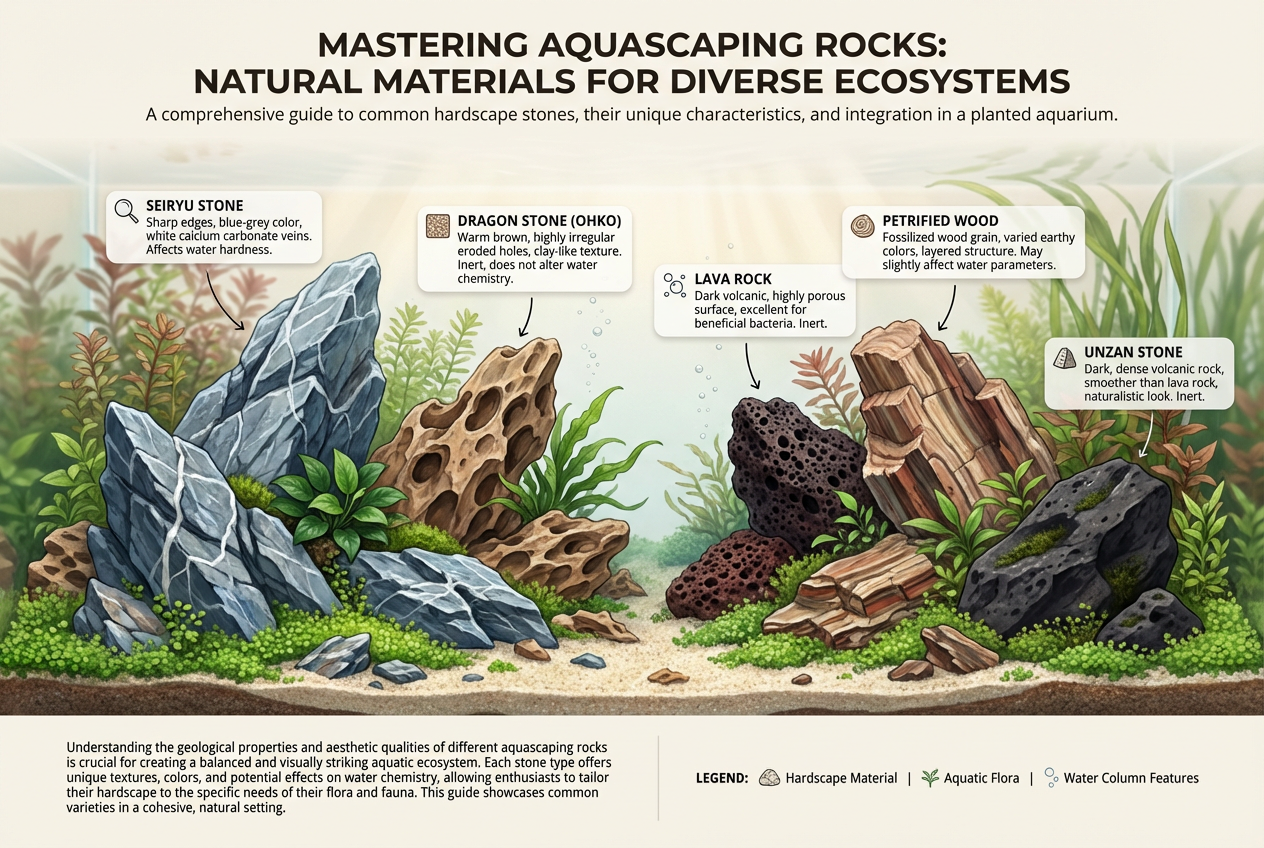
Stones like Seiryu and Ryuoh contain calcium carbonate.
Over time, they:
- Release carbonate into the water
- Increase KH
- Push pH upward through buffering
💡 Important detail:
This process happens gradually, meaning the tank may appear stable at first, but drift later.
🟠 Moderately Reactive Stones (The “Delayed Effect”)
Hakkai Stone and Elephant Skin Stone are less obvious.
They:
- Often pass initial testing
- Contain trace minerals
- Slowly increase KH over time
👉 This leads to a common scenario:
- Early stability
- Gradual chemical drift after a few weeks
This category is often responsible for hard-to-diagnose instability.
🟢 Inert Stones (Stable and Predictable)
Stones such as:
- Dragon Stone
- Lava Rock
- Unzan Stone
- Petrified Wood
- Granite / Quartz
Do not release carbonates and remain chemically stable.
👉 These allow:
- Full control over KH
- Predictable pH behaviour
- Consistent long-term conditions
How Rocks Affect pH, KH and GH (Simplified Mechanism)

To understand why rock choice matters, it helps to break down what happens chemically.
🧪 The Core Process
When carbonate-based rocks are present:
- Calcium carbonate dissolves slowly
- It releases:
- Calcium → increases GH
- Carbonate → increases KH
- KH acts as a buffer:
- Resists pH drops
- Keeps water more alkaline
💡 Why This Matters
In planted tanks, CO₂ is used to lower pH.
So your system becomes:
- CO₂ → pushing pH down
- Rocks → pushing pH up
👉 This creates a conflict, not balance
🎯 Practical Insight
- Low KH = flexible system, easy to adjust
- High KH = resistant system, harder to control
👉 Reactive rocks increase KH, reducing your ability to fine-tune pH.
CO₂ Systems: Where Instability Starts to Show

High-tech planted tanks depend on predictable CO₂ behaviour.
⚠️ What Happens with Reactive Rocks
When reactive stones are used:
- KH gradually rises
- CO₂ becomes less effective
- pH fluctuates more than expected
👉 You may notice:
- Inconsistent drop checker readings
- Uneven plant growth
- Increased algae presence
- Stress in sensitive livestock
❌ Avoid for CO₂ Systems
- Seiryu Stone
- Ryuoh Stone
- Hakkai Stone (especially with RO water)
- Unverified Elephant Skin Stone
✅ Best Choices for Stability
- Dragon Stone
- Lava Rock
- Unzan Stone
- Petrified Wood
- Granite / Quartz
💡 These stones allow your CO₂ system to operate predictably and consistently.
Iwagumi Principles: Composition with Intention

In Iwagumi layouts, rocks are not just decoration—they define the entire structure of the aquascape.
🏔️ Oyaishi (The Main Stone)
- Largest and most important stone
- Positioned off-centre (golden ratio)
- Sets direction and visual flow
👉 This stone anchors the entire composition
🪨 Supporting Stones
- Fukuishi → secondary support
- Soeishi → reinforces direction
- Suteishi → adds subtle realism
These stones should feel naturally connected, not artificially placed.
🎯 Creating Depth and Scale
A commonly used professional technique:
- Larger, rough stones → foreground
- Smaller, smoother stones → background
👉 This creates a natural sense of depth, even in small tanks.
Rock Testing Protocol (Essential for Stability)

Before adding any rock into your aquarium, testing is critical—especially for controlled systems.
🧪 Step 1: Acid Test
Apply vinegar to the rock surface.
- Fizzing → indicates carbonate presence
👉 Not suitable for sensitive setups
🧪 Step 2: Soak Test (7–14 Days)
Place the rock in RO water and monitor:
- KH (most important)
- pH
- GH
👉 Even small increases indicate chemical influence
🧪 Step 3: Cleaning
- Scrub thoroughly
- Rinse well
- Optional boiling (if safe)
🚨 Why This Matters
For shrimp and sensitive setups:
- Stability is more important than “ideal numbers”
Unstable conditions can lead to:
- Molting issues
- Reduced breeding
- Long-term decline
Choosing Rocks in Singapore: Practical Decision Framework
In Singapore, rock sources are often imported and may vary between batches.
💡 What Experienced Aquascapers Do
- Test rocks when using RO systems
- Avoid mixing reactive and inert stones
- Prioritise consistency over appearance
🎯 Simple Decision Guide
Shrimp Tanks (Caridina)
→ Use only inert stones
High-Tech CO₂ Tanks
→ Strongly prefer inert stones
Low-Tech or Hard Water Tanks
→ Reactive stones can be used more safely
Final Takeaway: Stability Is Designed, Not Accidental
A successful aquascape is not just about how it looks on day one—it’s about how it behaves over time.
Rocks are one of the most influential variables in your system:
- They can stabilise your tank
- Or slowly destabilise it
👉 The difference comes down to understanding their chemical behaviour
If your goal is a predictable, thriving aquascape, the safest approach is simple:
Choose rocks that support your system—not fight against it


