
CO₂ vs KH vs pH — The Relationship Explained
This guide is created by Green Chapter — Nature Workshop Studio, where we focus on creating living ecosystems through hands-on experience. We share practical insights across terrariums, aquascaping, plants, and natural systems to help you build and care for your own.
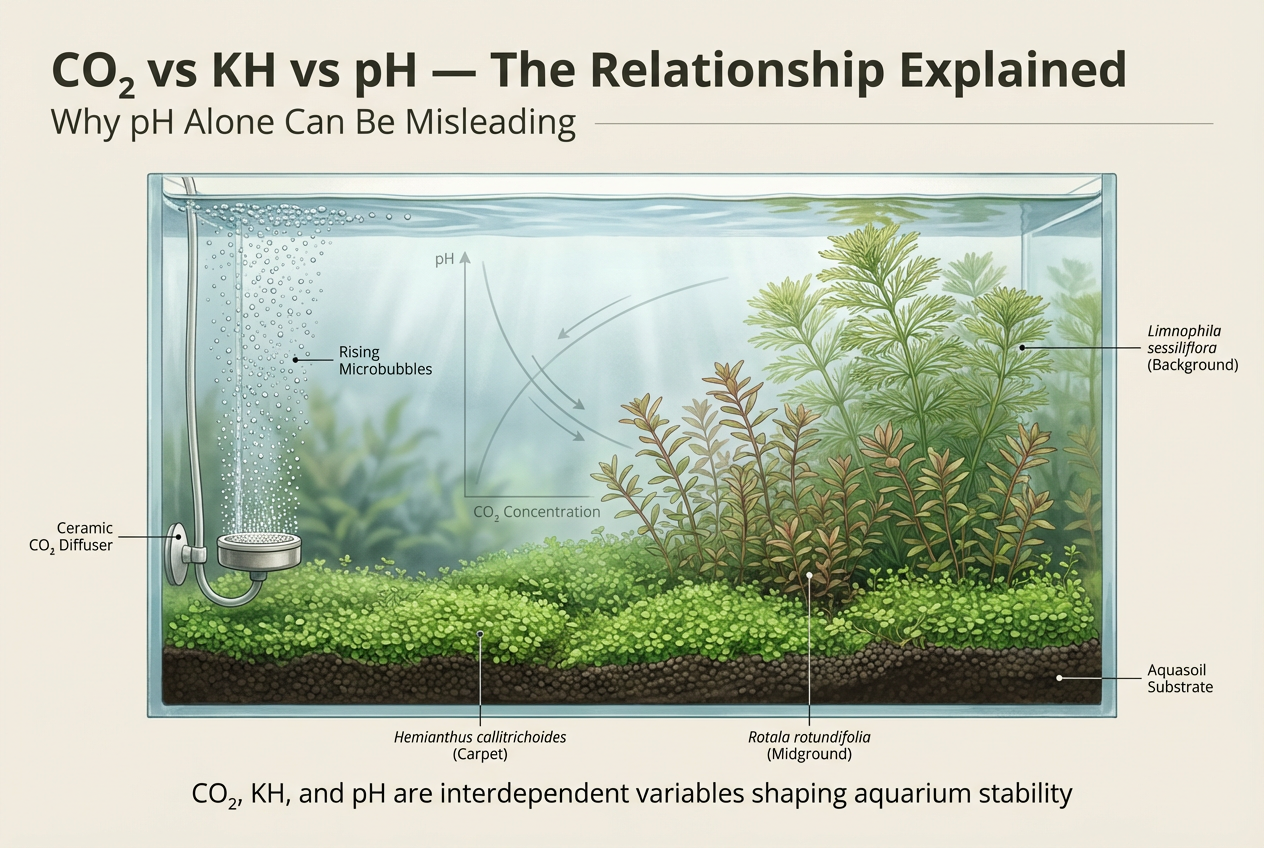
Introduction — Why pH Alone Can Be Misleading
If you’ve ever tried to “dial in” CO₂ using only pH, you’ve probably noticed something strange—two tanks can show the same pH, yet behave completely differently.
That’s because pH is not just controlled by CO₂. It is also influenced by KH (carbonate hardness), which acts as a buffer in your water. Together, these two variables determine how acidic or stable your tank actually is.
Understanding this relationship is one of the biggest turning points in aquascaping. Once you see how CO₂, KH, and pH interact, you stop guessing—and start making controlled, predictable adjustments.
The Core Relationship: CO₂, KH, and pH
At the center of this interaction is a widely used approximation:
This equation reveals three key truths:
- CO₂ increases rapidly as pH drops
- KH resists changes in pH (buffering effect)
- pH is the result of both CO₂ and KH—not a standalone value
In other words, pH alone doesn’t tell you how much CO₂ is in your tank. It only tells you how those variables are interacting at that moment.

Why the Same pH Can Mean Different CO₂ Levels
This is where many aquarists get caught off guard.
Let’s take three tanks, all at the exact same pH: 6.6
- With KH 2, CO₂ is about 15 ppm
- With KH 4, CO₂ rises to about 30 ppm
- With KH 6, CO₂ reaches around 45 ppm
Same pH. Completely different CO₂ levels.
What changed? Only KH.
This means pH without KH is incomplete—and relying on it alone can lead to underdosing or overdosing CO₂ without realizing it.

How to Read the CO₂–KH–pH Graph
Once you understand the relationship, the graph becomes a powerful tool rather than a confusing chart.
Each curve on the graph represents a different KH level. As KH increases, the curve shifts upward—meaning more CO₂ is present at the same pH.
To use it effectively:
- Measure your KH
- Measure your pH
- Find the matching curve
- Read across to estimate CO₂
It’s not meant to be exact—but it gives you a reliable working range when used correctly.

Understanding Safe CO₂ Ranges
Not all CO₂ levels are equal, especially when livestock is involved.
As a general guide:
- Below 10 ppm → CO₂ is usually too low for strong plant growth
- 15–30 ppm → Ideal working range for most planted tanks
- Above 35 ppm → Higher risk zone, requires careful observation
Different species react differently, so these are not hard limits—but they are a useful reference.
The goal is not to chase a number, but to maintain a stable and safe range.
CO₂ Injection and Daily pH Swings
In CO₂-injected tanks, pH doesn’t stay constant—and that’s completely normal.
- When CO₂ turns on, pH gradually drops
- When CO₂ turns off, pH rises again
This daily swing is part of a healthy system.
Rather than chasing a fixed pH, experienced aquascapers focus on consistency of the drop. A common guideline is a ~1.0 pH reduction from the degassed baseline.

When the Model Breaks (And Why It Matters)
The CO₂–KH–pH relationship assumes that carbonate buffering is the only thing affecting pH.
But in real aquariums, that’s often not the case.
Many planted tanks include:
- Aquasoil
- Driftwood (tannins)
- Organic acids
These introduce non-carbonate buffers, which can lower pH without increasing CO₂.
This is where the calculation becomes misleading.
A tank might appear to have high CO₂ based on pH—but in reality, the drop is caused by something else.

Best Practices for Managing CO₂ Accurately
Instead of relying on a single number, it’s better to use a layered approach.
Use pH and KH as a guide—but also observe:
- Drop checker color trends
- Fish and shrimp behavior
- Plant growth and health over time
When all three align, you know your CO₂ is in the right place.
Conclusion — Understand the System, Not Just the Number
CO₂, KH, and pH are not separate measurements—they are part of the same system.
- pH tells you what is happening
- KH controls how stable it is
- CO₂ drives the changes
Once you understand how they interact, you stop reacting to numbers—and start controlling the environment.
That’s when aquascaping becomes consistent, predictable, and much more rewarding.


