
What Do I Need to Start a Planted Tank?
This guide is created by Green Chapter — Nature Workshop Studio, where we focus on creating living ecosystems through hands-on experience. We share practical insights across terrariums, aquascaping, plants, and natural systems to help you build and care for your own.
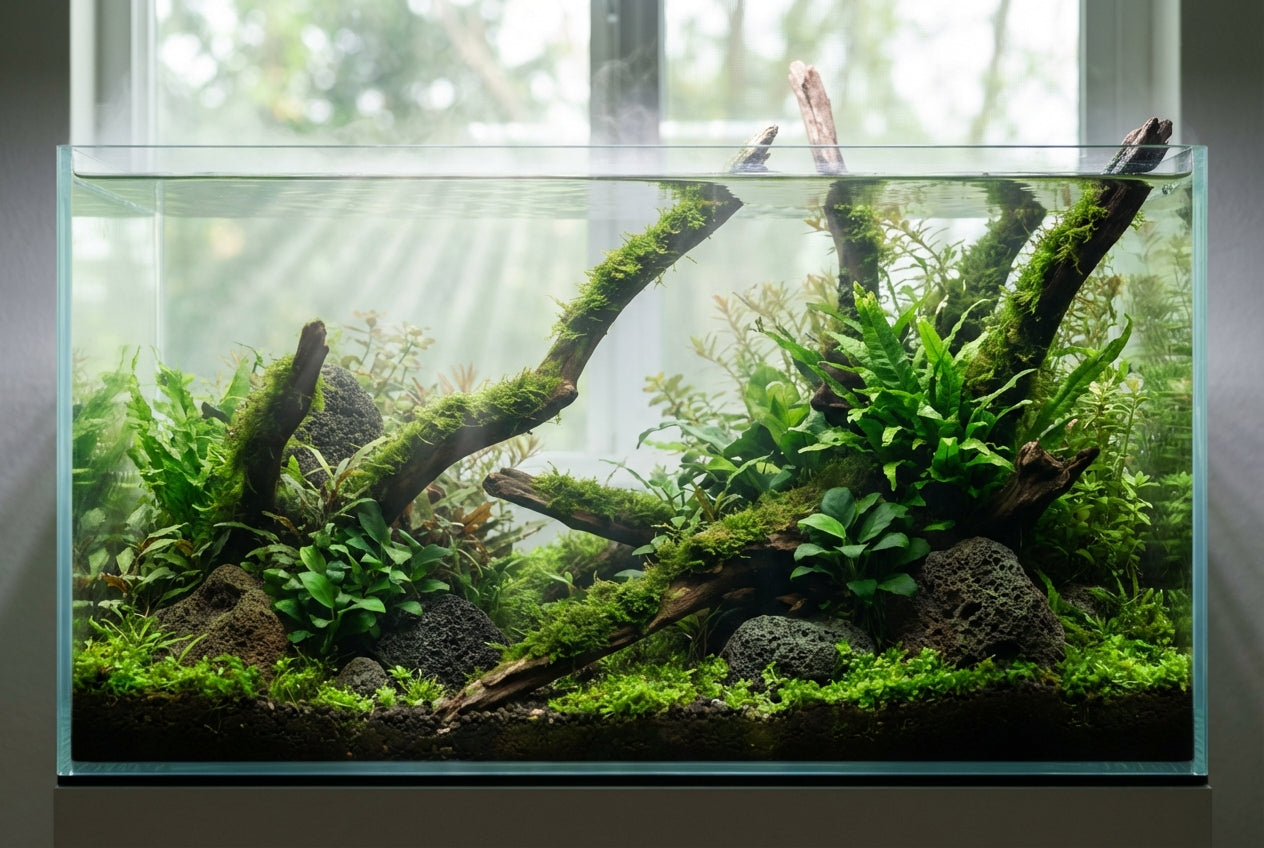
A Planted Tank Is a System, Not Just Plants
A planted tank is more than placing plants inside an aquarium. It is a balanced system where light, carbon, nutrients, and water flow work together to support healthy plant growth.
When this balance is achieved, plants grow steadily, water stays clear, and maintenance becomes easier. When it is not, plants struggle and algae quickly take over.
Understanding this balance is the first step to building a proper planted tank.
The 4 Foundations of a Successful Planted Tank
Every planted tank is built on four core elements: light, CO₂, nutrients, and flow.
Light provides the energy plants need to grow. CO₂ supplies carbon for plant development. Nutrients feed the plants through the substrate and water column. Flow ensures that all of these elements are distributed evenly throughout the tank.
Most of the equipment you will use supports one or more of these functions. Once you understand this, choosing what to buy becomes much clearer.
Lighting — The Engine of Growth
Lighting is one of the most important components in a planted tank because it drives photosynthesis. Without enough light, plants grow weakly or melt. With too much light and insufficient support from CO₂ and nutrients, algae often appears.
Modern planted tanks commonly use app-controlled LED lights because they allow precise control over brightness and timing. This helps maintain a consistent daily cycle, which is critical for plant health. It also allows you to adjust intensity as your tank matures.
Strong lighting should always be paired with proper CO₂ and nutrient support. For beginners, consistency is more important than intensity.

CO₂ System — The Key to Healthy Plant Growth
In an aquarium, CO₂ is quickly used up and is not naturally replenished at a sufficient rate. Without enough CO₂, plant growth becomes slow and limited.
Adding a CO₂ system significantly improves plant health. Plants grow fuller, develop better color, and recover faster after trimming. It also allows you to grow more demanding plants such as carpets and red species.
A proper CO₂ setup includes a cylinder, regulator, bubble counter, and diffuser. This provides stable and precise control, which is essential for maintaining balance.
DIY CO₂ systems are often inconsistent and difficult to manage. For a proper planted tank, a pressurized system offers much better long-term results.

Filtration — Why Canister Filters Are Preferred
Filtration maintains water stability by removing waste and supporting beneficial bacteria. These bacteria break down harmful substances and help keep the environment healthy.
Canister filters are widely used in planted tanks because they provide strong filtration while keeping the tank visually clean. Since they are external, they allow for more filtration media without cluttering the layout.
They also produce smooth and consistent flow, which helps distribute CO₂ and nutrients evenly.
Hang-on filters tend to create surface agitation, which causes CO₂ to escape. Sump systems are more complex and usually unnecessary for most planted setups.
For beginners, a canister filter provides the best balance between performance and simplicity.

Surface Skimmer — A Small Upgrade That Makes a Big Difference
Over time, planted tanks often develop a thin layer of organic film on the water surface. This can make the tank look dull and reduce gas exchange.
A surface skimmer removes this layer, keeping the surface clean and improving oxygen exchange. The result is clearer water and a more polished appearance.
Although small, this is one of the most effective upgrades for improving both the look and function of a planted tank.

UV-C Sterilizer — Optional but Useful
A UV-C sterilizer helps eliminate free-floating algae and microorganisms by exposing them to ultraviolet light.
It is especially useful for clearing green water and improving clarity. While it is not essential for every setup, it can be helpful for maintaining a clean and stable display tank.
Used correctly, it adds an extra layer of control to the system.

Chiller — Maintaining Stable Temperature
Temperature plays an important role in plant health. Most aquatic plants thrive between 22°C and 26°C. In warmer climates, aquarium water can easily exceed this range.
Higher temperatures can stress plants, reduce oxygen levels, and encourage algae growth. A chiller helps maintain a stable temperature, improving overall plant health and system stability.
For tanks in warm environments, temperature control is an important consideration.

Substrate — The Foundation of Plant Growth
Substrate provides a place for plants to anchor their roots and absorb nutrients. A good substrate supports strong root development and stable growth.
Aquasoil is commonly used because it contains nutrients and is easy to plant into. Some setups include additional layers or decorative sand for visual effect.
Substrate also helps create depth by allowing you to build slopes and contours within the tank.

Hardscape — Building the Structure
Hardscape refers to the wood and rocks used in the tank. It forms the structural foundation of the aquascape and defines the layout.
Driftwood creates a natural and flowing appearance, while rocks add contrast and strength. Together, they create focal points and guide plant placement.
A well-planned hardscape makes the entire tank look balanced and intentional.

Plants — Choosing the Right Ones
Different plants have different requirements. Some are easy and grow well without CO₂, while others require stronger lighting and additional support.
It is important to match your plant selection to your setup. Low-tech tanks are better suited for hardy plants, while high-tech tanks allow for more variety and faster growth.
Choosing the right plants from the start leads to a more stable and successful tank.

Flow — The Invisible Factor
Flow ensures that CO₂, nutrients, and oxygen reach all areas of the tank. Without proper circulation, some areas may become stagnant, leading to poor plant growth and algae.
A good flow pattern keeps conditions consistent and prevents waste from accumulating.
In a planted tank, flow should be steady and controlled rather than overly strong.

What You Need to Start
To start a planted tank, you will need a tank, a suitable LED light, a canister filter, a planted substrate, hardscape materials, and plants.
For better results, adding a CO₂ system and a surface skimmer is strongly recommended. Optional upgrades such as a UV sterilizer and chiller can further improve stability and clarity.
Final Thoughts
A successful planted tank is built on balance, not just equipment.
When light, CO₂, nutrients, and flow work together, plants grow naturally and the tank becomes easier to maintain. When one part is missing or unbalanced, problems quickly appear.
By focusing on the fundamentals and building your system correctly from the start, you can create a planted tank that is both beautiful and stable over the long term.


