
Root Tabs vs Liquid Fertiliser — Which Do Your Plants Actually Need?
This guide is created by Green Chapter — Nature Workshop Studio, where we focus on creating living ecosystems through hands-on experience. We share practical insights across terrariums, aquascaping, plants, and natural systems to help you build and care for your own.
One of the most common questions in planted aquariums is:
“Should I use root tabs or liquid fertiliser?”
The answer is simple, but often misunderstood:
They are not substitutes — they serve different roles.
Aquatic plants absorb nutrients in two main ways:
- Through their roots
- Through their leaves
Understanding this difference will help you:
- Grow healthier plants
- Avoid nutrient deficiencies
- Prevent algae issues

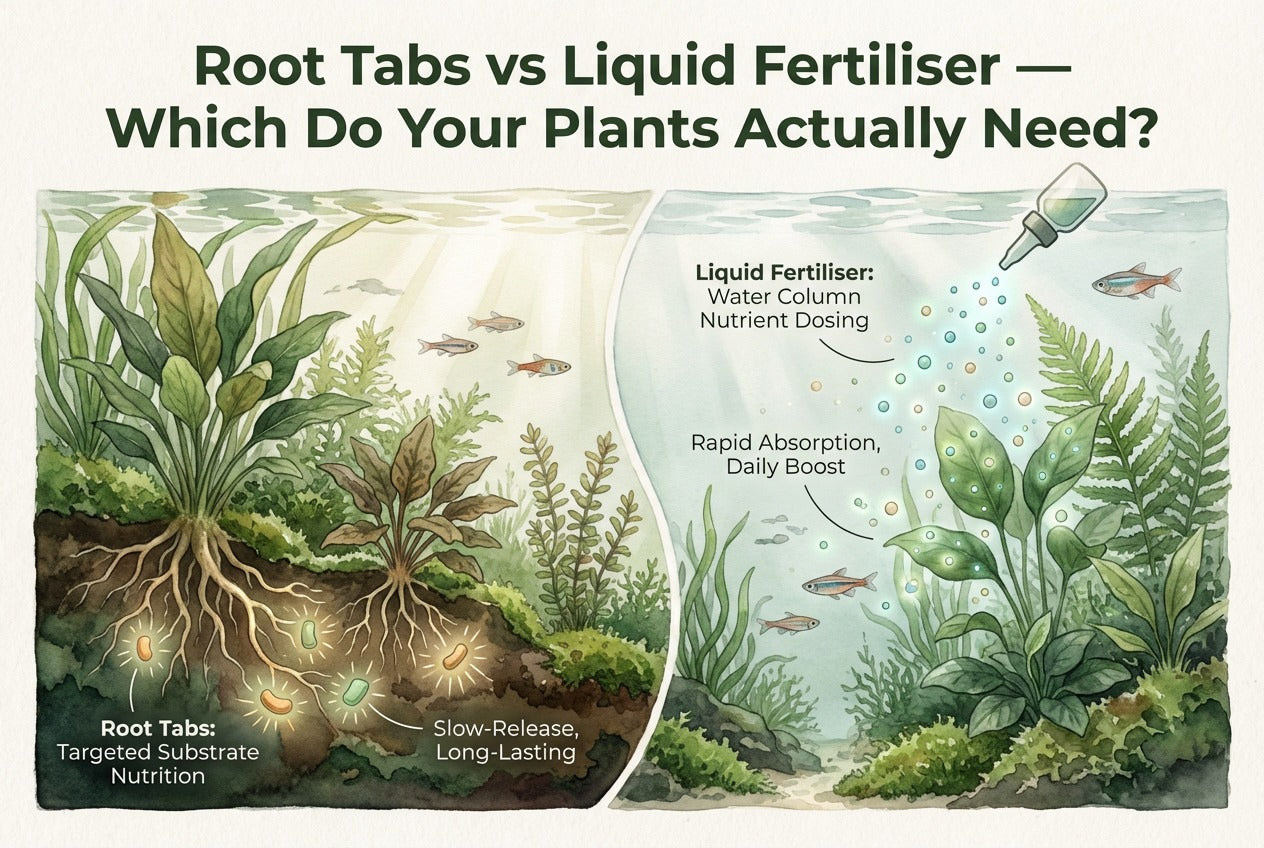
Root tabs and liquid fertilisers serve different purposes in a planted aquarium. Root tabs deliver nutrients directly into the substrate for root-feeding plants like crypts and swords, while liquid fertilisers supply nutrients in the water column for stem plants, moss, and floating plants. Most planted tanks require both to support balanced plant growth.
How Aquatic Plants Absorb Nutrients
Aquatic plants are unique because they can absorb nutrients from both:
- The substrate (through roots)
- The water column (through leaves)
However, different plants rely more heavily on one method over the other.
| Feeding Type | Source | Best Supported By |
|---|---|---|
| Root feeding | Substrate | Root tabs |
| Water column feeding | Water | Liquid fertiliser |
The key is knowing which plants you have in your tank.
What Are Root Tabs?
Root tabs are slow-release fertiliser capsules placed into the substrate.
They deliver nutrients directly to plant roots over time.
Best for:
- Heavy root feeders
- Tanks with sand or gravel
- Nutrient-poor substrate
Common root-feeding plants:
- Amazon swords
- Cryptocoryne
- Vallisneria

Key Benefits:
- Direct nutrient delivery to roots
- Long-lasting effect
- Supports strong root development
What Is Liquid Fertiliser?
Liquid fertiliser is added directly into the water.
Plants absorb these nutrients through their leaves and stems.
Best for:
- Stem plants
- Mosses
- Floating plants
Examples:
- Rotala
- Ludwigia
- Java moss
- Frogbit / floaters

Key Benefits:
- Fast nutrient absorption
- Even distribution across tank
- Ideal for fast-growing plants
Root Tabs vs Liquid Fertiliser — Key Differences
| Feature | Root Tabs | Liquid Fertiliser |
|---|---|---|
| Location | Substrate | Water |
| Feeding method | Roots | Leaves |
| Speed | Slow release | Fast |
| Coverage | Localised | Whole tank |
| Best for | Root feeders | Stem & moss plants |

Why Most Planted Tanks Need Both
Most aquariums contain a mix of plant types:
- Root feeders (e.g. crypts, swords)
- Stem plants (e.g. rotala)
- Moss and epiphytes
If you only use one fertiliser type:
| If You Only Use | Result |
|---|---|
| Root tabs | Stem plants struggle |
| Liquid fertiliser | Root feeders weaken |
| Both | Balanced growth |
A balanced system supports all plant types.

How CO₂ Changes Nutrient Demand
CO₂ injection increases plant growth speed significantly.
This means:
- Plants consume nutrients faster
- Deficiencies appear quicker
- Fertilisation becomes more important
Comparison:
| Tank Type | Fertiliser Strategy |
|---|---|
| Non-CO₂ Tank | Light dosing, occasional root tabs |
| CO₂ Injected Tank | Regular liquid dosing + root tabs |
Faster growth = higher nutrient demand.

Common Mistakes to Avoid
❌ Using only one fertiliser type
→ Leads to imbalanced plant growth
❌ Overdosing liquid fertiliser
→ Can trigger algae
❌ Ignoring substrate nutrients
→ Root feeders suffer
❌ Expecting instant results
→ Plant growth takes time
Simple Recommendation (Beginner-Friendly)
If you're starting out:
- Add root tabs near root-feeding plants
- Dose liquid fertiliser 2–3 times per week
- Observe plant response and adjust
Conclusion
Root tabs and liquid fertilisers are not competing products.
They are complementary tools:
- Root tabs feed the substrate
- Liquid fertiliser feeds the water column
The healthiest planted tanks use both — in balance.
Final Thought
A successful planted aquarium is not about adding more fertiliser.
It is about understanding:
- How plants absorb nutrients
- What your tank provides
- What your plants actually need


