
Root Tabs vs Liquid Fertiliser vs Aquasoil — Which Should You Use in a Planted Tank?
This guide is created by Green Chapter — Nature Workshop Studio, where we focus on creating living ecosystems through hands-on experience. We share practical insights across terrariums, aquascaping, plants, and natural systems to help you build and care for your own.
Introduction
If you’re setting up a planted aquarium, you’ve probably come across three common nutrient options:
- Aquasoil
- Root tabs
- Liquid fertiliser
This often leads to confusion:
“Do I need all three, or can I just use one?”
The key thing to understand is this:
They are not substitutes — they work at different levels of your tank.
Once you understand how each one functions, it becomes much easier to build a stable, healthy planted aquarium without guesswork.
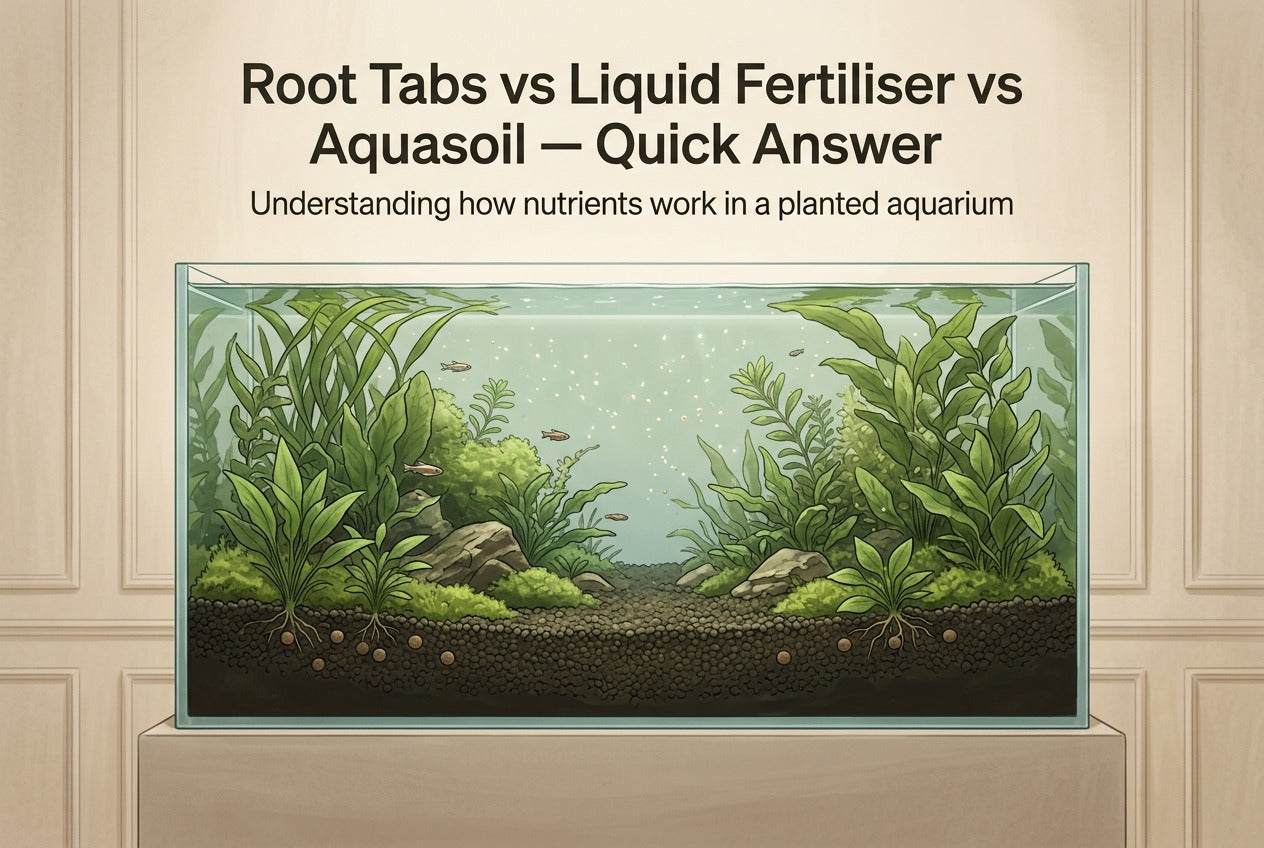
Root Tabs vs Liquid Fertiliser vs Aquasoil — Quick Answer
Aquasoil, root tabs, and liquid fertilisers all provide nutrients in different ways. Aquasoil acts as a nutrient-rich foundation in the substrate, root tabs replenish nutrients in that substrate over time, and liquid fertilisers supply nutrients directly in the water column for plants that feed through their leaves. Most planted tanks benefit from using a combination of these depending on plant type and setup.
What Each One Does (Simple Breakdown)
At a glance, each plays a different role in your tank:
| Product | Where It Works | Main Role |
|---|---|---|
| Aquasoil | Substrate | Nutrient foundation |
| Root Tabs | Substrate | Nutrient refill |
| Liquid Fertiliser | Water column | Immediate nutrient supply |
A simple way to think about it:
- Aquasoil = Foundation
- Root Tabs = Refill system
- Liquid Fertiliser = Daily nutrition

What Is Aquasoil?
Aquasoil is a specially designed substrate packed with nutrients that support plant growth right from the start.
It provides essential elements such as nitrogen, phosphorus, potassium, and trace minerals. It also improves root development and helps stabilise water parameters in new tanks.
This makes aquasoil ideal for:
- New planted tank setups
- Aquascaping layouts
- Tanks with many plants
However, aquasoil is not permanent.
Over time, its nutrients get used up — usually within a few months.
This is why additional fertilisation becomes necessary as the tank matures.

What Are Root Tabs?
Root tabs are slow-release fertiliser capsules inserted into the substrate.
They work by releasing nutrients directly into the root zone, making them especially useful for plants that feed heavily through their roots.
Root tabs are ideal for:
- Root-feeding plants (crypts, swords, vallisneria)
- Tanks using sand or gravel
- Older aquasoil setups that have depleted nutrients
Think of root tabs as a way to recharge your substrate.
They extend the life of your tank’s nutrient base without needing a full reset.

What Is Liquid Fertiliser?
Liquid fertiliser is added directly into the water, where nutrients are absorbed through plant leaves and stems.
This makes it especially effective for:
- Stem plants
- Mosses
- Floating plants
Because it is immediately available in the water column, it supports faster plant growth and helps maintain overall nutrient balance.
Liquid fertiliser is the fastest way to correct nutrient deficiencies.

Key Differences Explained
Although all three provide nutrients, they function very differently:
| Feature | Aquasoil | Root Tabs | Liquid Fertiliser |
|---|---|---|---|
| Placement | Substrate | Substrate | Water |
| Role | Base layer | Refill | Immediate supply |
| Duration | Months | Weeks–months | Daily–weekly |
| Coverage | Whole substrate | Localised | Whole tank |

Do You Need All Three?
Not always — it depends on your tank setup and goals.
Scenario 1 — Beginner Low-Tech Tank
- Aquasoil provides enough nutrients initially
- Light liquid fertiliser may be added
- Root tabs can be introduced later
Scenario 2 — Sand or Gravel Tank
- No built-in nutrients
- Root tabs become essential
- Liquid fertiliser supports plant growth
Scenario 3 — CO₂ Injected High-Tech Tank
- Plants grow rapidly
- Nutrients are consumed quickly
- All three are typically needed for balance
The more you push plant growth, the more nutrients your tank will require.

Common Mistakes to Avoid
Even experienced hobbyists make these mistakes:
- Using only one fertiliser type and expecting full results
- Assuming aquasoil lasts forever
- Ignoring substrate nutrients in sand-based tanks
- Overdosing liquid fertiliser and triggering algae
A planted tank works best when nutrients are balanced, not excessive.
Simple Recommendation (Beginner-Friendly)
If you’re unsure where to start, follow this approach:
- Use aquasoil for new setups
- Add liquid fertiliser regularly in small amounts
- Introduce root tabs after a few months
Observe your plants and adjust gradually — every tank behaves differently.
Conclusion
Aquasoil, root tabs, and liquid fertilisers are not competing choices.
They are parts of a complete nutrient system:
- Aquasoil builds the foundation
- Root tabs maintain the substrate
- Liquid fertiliser feeds the water column
The healthiest planted tanks use the right combination based on plant type and setup.
Quick Summary
- Aquasoil = base nutrient layer
- Root tabs = substrate nutrient refill
- Liquid fertiliser = water column nutrients
- Most planted tanks = use a combination
Final Thought
A successful planted aquarium is not about adding more products.
It is about understanding:
- Where nutrients come from
- How plants absorb them
- How to maintain balance over time


