
How to Build an Underwater Sand Waterfall (Airlift System Guide)
This guide is created by Green Chapter — Nature Workshop Studio, where we focus on creating living ecosystems through hands-on experience. We share practical insights across terrariums, aquascaping, plants, and natural systems to help you build and care for your own.
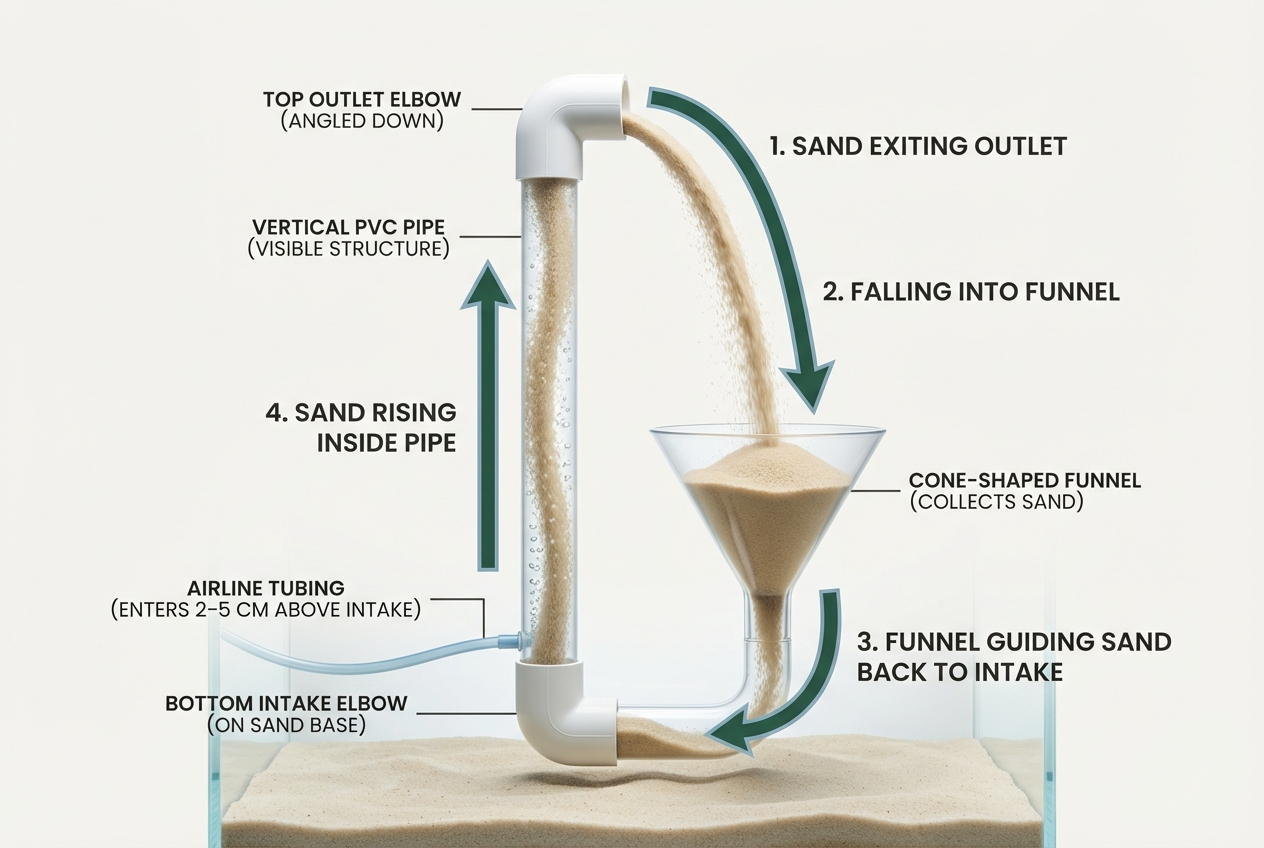
There’s something incredibly calming about watching sand flow like water inside an aquarium. A well-built underwater sand waterfall creates a continuous, looping motion that feels almost hypnotic — but achieving that effect is not just about aesthetics.
Behind that smooth movement is a carefully balanced system of airflow, pipe geometry, and gravity-driven return.
In this guide, we’ll walk through:
- How sand actually moves underwater
- How to construct a reliable airlift system
- How to power it correctly using an external air pump
PART 1 — Understanding How Sand Moves Underwater

Before building anything, it’s important to understand one key idea:
You are not just moving sand — you are managing the interaction between water, air, and solid particles.
The Three Forces Behind Sand Movement
Every grain of sand responds to three constant forces:
- Gravity, pulling it downward
- Water flow, pushing it sideways or upward
- Drag and buoyancy, determining how easily it lifts
The goal is not to overpower these forces, but to balance them just enough to create controlled motion.
Suspension vs Rolling Movement
Sand behaves differently depending on flow strength.
- In low flow, sand rolls or slides along the base (bed load)
- In higher flow, sand lifts into the water column (suspension)
A sand waterfall works by combining both:
- Inside the pipe → sand is lifted (suspension)
- Outside the pipe → sand falls naturally (gravity)
That transition is what creates the waterfall illusion.
Why the Airlift Method Works
Instead of pushing sand with a mechanical pump, we use air to generate movement.
When air is injected into a pipe:
- It forms bubbles that reduce water density inside the pipe
- Surrounding water pushes upward
- This creates a steady vertical current
This method is:
✔ Simple
✔ Energy efficient
✔ Stable when tuned correctly
Choosing the Right Sand
Sand selection directly affects performance.
- Very fine sand lifts easily but becomes unstable
- Coarse sand is too heavy to move consistently
- Medium grain sand (0.3–0.8 mm) offers the best balance
This range gives you:
✔ Smooth lift
✔ Controlled waterfall
✔ Minimal clogging
PART 2 — Building the Airlift Sand Waterfall System


With the fundamentals in place, we can now build the system.
This design uses a simple PVC airlift loop, where each component plays a specific role in maintaining continuous movement.
Core Components
The system consists of five essential parts:
- A vertical lift pipe that carries sand upward
- A bottom intake elbow where sand enters
- A top outlet elbow where sand exits
- A funnel catchment that collects falling sand
- An airline injection point that powers the system
Together, these form a closed-loop system.
Pipe Layout & Flow Direction
The structure is simple, but proportions matter.
- Use a vertical pipe (20–25 mm diameter)
- Keep it straight to maintain stable flow
- Add a 90° elbow at the bottom for intake
- Add a 90° elbow at the top, angled slightly downward
That slight downward angle (around 10–20°) ensures the sand flows smoothly instead of scattering.
Air Injection Placement (Critical Detail)
This is the most important part of the build.
The airline should be inserted:
- 2–5 cm above the intake elbow
- Slightly angled upward
This positioning creates:
✔ Strong upward lift
✔ Smooth sand transport
✔ Minimal backflow
If placed too low, sand may clog the system.
If placed too high, the lift becomes weak and inconsistent.
Funnel Catchment Design
The funnel is what keeps the system running continuously.
Its role is to:
- Catch falling sand
- Guide it back into the intake
For reliable performance:
- Funnel slope should be 40–50°
- Opening should be wide enough to catch sand
- Exit should align directly with intake
If the slope is too shallow, sand will stall.
If too steep, the flow becomes unstable.
Common Build Issues
Most issues come from imbalance rather than lack of power.
- Weak lift → insufficient airflow
- Clogging → poor intake alignment
- Messy waterfall → outlet angle too steep
- Inconsistent flow → pipe size mismatch
Small adjustments usually restore stability.
PART 3 — Installation Method (External Air Pump System)

To power an airlift sand waterfall, the system should always use an external air pump.
This keeps the display clean while providing consistent airflow to drive the system.
Why External Air Pumps Are Preferred
Using an external air pump allows you to:
- Keep all mechanical equipment outside the aquarium
- Maintain a clean, natural visual presentation
- Easily adjust airflow without disturbing the setup
It also provides better long-term reliability and control.
Airflow Connection Path
The airflow path is straightforward:
- Air pump sits outside the aquarium
- Airline tubing runs into the tank
- Airline connects to the vertical pipe
- Air enters 2–5 cm above the intake elbow
- Rising bubbles create the lift that moves sand
This setup ensures:
✔ Stable upward flow
✔ Continuous sand movement
✔ Minimal clogging risk
Important — Check Valve Placement
Because the pump is external, a check valve is essential.
It prevents water from flowing backward into the pump during power loss.
Install it:
- Along the airline
- Outside the aquarium
- Between the pump and injection point
Clean Airline Routing
To keep the system visually clean:
- Route tubing along the back or edge of the tank
- Avoid crossing the main viewing area
- Keep lines tight and unobtrusive
The goal is simple:
Only the flowing sand should draw attention — not the system behind it.
Performance Tuning
For most setups:
- Use an air pump rated 3–5 L/min
- Ensure steady, non-pulsing airflow
- Fine-tune with a control valve if needed
Once properly tuned, the system becomes:
✔ Continuous
✔ Stable
✔ Self-sustaining
Final Thoughts
An underwater sand waterfall is not about forcing movement — it’s about creating a system where movement happens naturally.
When everything is balanced:
- Airflow lifts sand efficiently
- Gravity returns it smoothly
- The loop continues without interruption
The result is a feature that feels alive — calm, fluid, and endlessly satisfying to watch.


