
The First Fish, Shrimp & Snails To Add Into a New Planted Aquarium
This guide is created by Green Chapter — Nature Workshop Studio, where we focus on creating living ecosystems through hands-on experience. We share practical insights across terrariums, aquascaping, plants, and natural systems to help you build and care for your own.
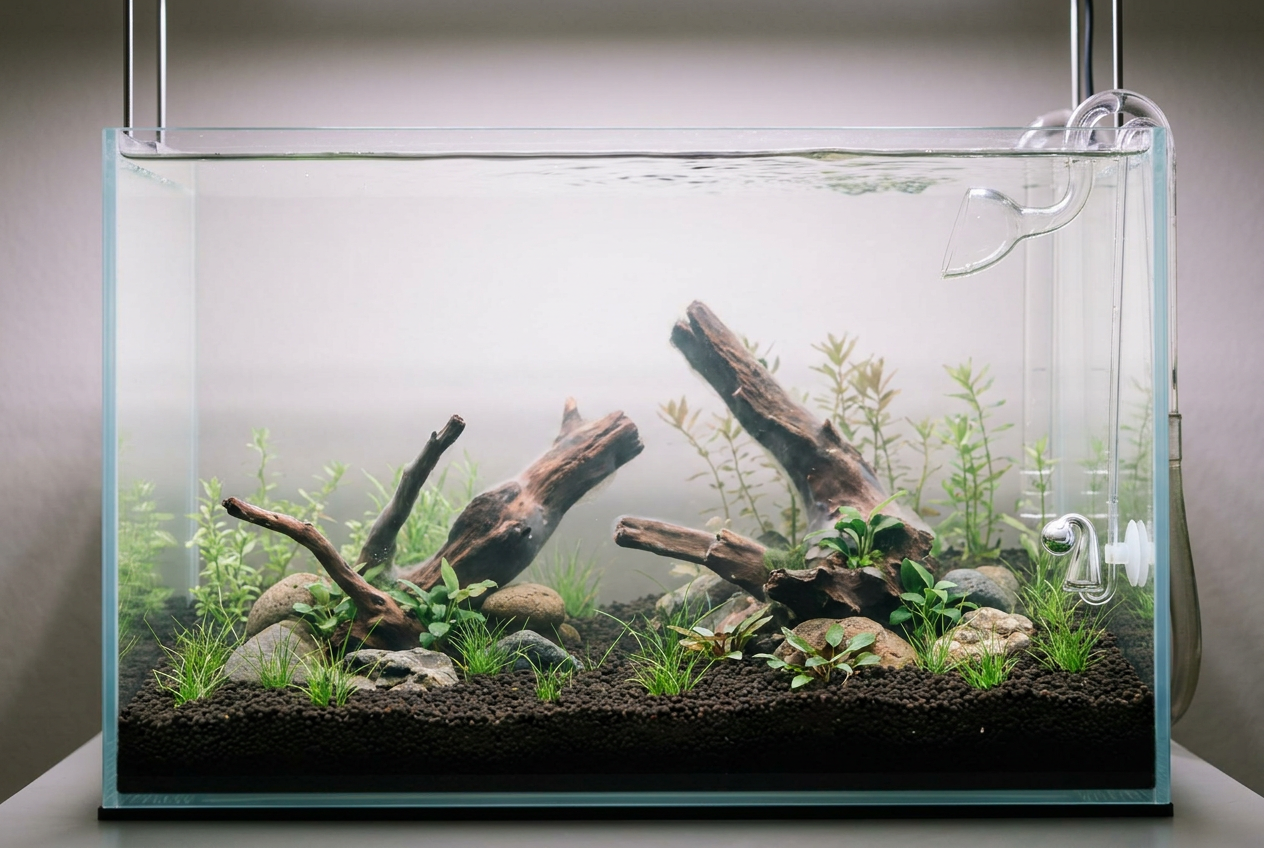
In our previous guide about knowing when an aquarium is ready for fish, we explored how to determine whether a tank is chemically safe by monitoring ammonia, nitrite, and nitrate levels.
But even after a tank is technically “cycled,” experienced aquascapers rarely add every animal at once.
A new planted aquarium is not simply empty water waiting for livestock. It is a developing ecosystem. Different animals enter at different stages because each one plays a different role in stabilizing that environment.
This is why many experienced planted tank keepers gradually introduce snails, shrimp, algae eaters, and finally their main fish over several weeks instead of all at once.
The process is less about patience for the sake of patience — and more about allowing the ecosystem to mature in layers.
Why Livestock Are Added In Stages
During the first few weeks of a planted aquarium, multiple invisible processes are happening simultaneously:
-
Beneficial bacteria are colonizing filter media
-
Aquasoil releases ammonia and nutrients
-
Tissue culture plants begin transitioning underwater
-
Driftwood develops biofilm
-
Algae spores respond to unstable nutrients and light
-
Oxygen and CO2 levels fluctuate daily
Even when water appears crystal clear, the aquarium may still be biologically unstable underneath.
Different livestock types help stabilize different parts of this ecosystem.
Stage 1 — The Empty Aquarium
For the first 1–2 weeks, most planted aquariums should remain completely empty.
Fresh aquasoil commonly releases ammonia into the water column, especially in high-tech planted tanks using nutrient-rich substrates. During this period, plants are also adapting to submerged growth conditions and may experience melting or leaf loss.
Many beginners become worried because the aquarium looks lifeless during this stage.
In reality, this is one of the most important phases of ecosystem development.
The filter bacteria responsible for processing toxic ammonia are slowly establishing themselves. Adding livestock too early places biological stress on a system that has not yet stabilized.
Water changes during this stage help:
-
reduce excess ammonia,
-
prevent severe algae blooms,
-
and stabilize nutrient levels while bacteria establish.

Stage 2 — The First Residents: Snails
Once ammonia and nitrite begin stabilizing, hardy snails are often the first animals introduced into the aquarium.
Species like Nerite Snails or Ramshorn Snails are commonly used because they tolerate minor fluctuations better than many fish or shrimp.
More importantly, they immediately begin contributing to ecosystem cleanup.
In new aquariums, biofilm naturally develops on:
-
driftwood,
-
rocks,
-
glass,
-
and decaying plant tissue.
This thin white or translucent film is completely normal in young aquariums. Snails help consume this material before it accumulates excessively.
They also function as surprisingly useful biological indicators.
If snails:
-
climb persistently above the waterline,
-
remain sealed for long periods,
-
or become unusually inactive,
it may indicate unstable water conditions, poor oxygenation, or remaining toxicity issues.
Stage 3 — Amano Shrimp & The Algae Management Phase
Around Weeks 3–5, many planted aquariums begin entering what hobbyists commonly call “New Tank Syndrome.”
This is the period where:
-
brown diatom algae,
-
green dust algae,
-
or green hair algae
often begin appearing as nutrients, lighting, and biological stability struggle to balance themselves.
This is where Amano shrimp become extremely valuable.
Unlike many ornamental shrimp, Amano shrimp are exceptional ecosystem workers. They constantly graze on soft algae, decaying material, leftover food, and biofilm throughout the aquarium.
In heavily planted aquascapes, they often help prevent early algae blooms from overwhelming delicate carpeting plants.
Amano shrimp are particularly useful because they:
-
tolerate moderate fluctuations relatively well,
-
remain active cleaners throughout the day,
-
and target soft nuisance algae before outbreaks become severe.
This is also the stage where many aquascapers begin considering algae-eating fish like Otocinclus catfish.
However, Otocinclus should not be treated as beginner algae cleaners.
Despite their peaceful appearance, Otocinclus depend heavily on stable mature surfaces containing biofilm, microorganisms, and soft grazing material. In extremely new aquariums, many slowly starve despite the tank appearing visually clean.
Experienced aquascapers usually introduce Otocinclus only after visible algae and stable microbial surfaces have already developed.

Stage 4 — The Main Schooling Fish
By Weeks 5–6, the aquarium ecosystem is usually becoming far more stable.
The biological filter is now capable of processing a larger and more consistent waste load, while plants have begun adapting to submerged growth.
This is typically when aquascapers introduce their main display fish:
-
Neon Tetras
-
Harlequin Rasboras
-
Ember Tetras
-
Endlers
-
Betta fish
-
or other community species
Even at this stage, experienced hobbyists usually avoid adding all fish at once.
Adding a full school immediately can suddenly overwhelm the bacterial colony, triggering:
-
ammonia spikes,
-
cloudy water,
-
oxygen instability,
-
or secondary algae outbreaks.
Instead, fish are often introduced in smaller batches over time.
This allows the ecosystem to scale naturally alongside increasing biological demand.
Stage 5 — Sensitive Species & Mature Ecosystems
Some livestock should only enter aquariums after the ecosystem has matured significantly beyond basic cycling.
Sensitive species include:
-
Crystal Red Shrimp
-
delicate Caridina shrimp
-
wild-caught fish
-
Sulawesi shrimp
-
certain algae eaters
-
and highly sensitive nano fish
These animals are often affected not only by ammonia or nitrite, but by the invisible instability common in immature aquariums:
-
fluctuating microorganisms,
-
unstable biofilm development,
-
inconsistent oxygenation,
-
bacterial imbalance,
-
and rapidly shifting nutrients.
This is why many advanced aquascapers wait several months before introducing their most delicate livestock.

Common Beginner Mistakes
A New Aquarium Is A Developing Ecosystem
One of the biggest mindset shifts in planted aquarium keeping is understanding that a tank does not become “finished” once water is added.
A planted aquarium matures gradually.
The first few weeks are less about decorating a glass box with fish and more about establishing:
-
bacterial stability,
-
nutrient balance,
-
oxygen consistency,
-
plant adaptation,
-
microbial life,
-
and ecosystem resilience.
The animals introduced during each stage are not simply decorations.
They become part of the biological succession process that slowly transforms a sterile aquarium into a stable living ecosystem.

Continue Exploring
If you are still cycling your aquarium or unsure whether your tank is chemically safe yet, we recommend reading:
-
When Is Your Tank Ready For Fish?
-
Why New Planted Aquariums Get Cloudy Water
-
Understanding New Tank Syndrome In Planted Aquariums
-
Beginner Guide To Amano Shrimp In Planted Tanks
A stable planted aquarium is rarely built in a single week. Most successful aquascapes are developed gradually through small ecosystem decisions made over time.


