
Why Fish Need Aeration in an Aquarium
This guide is created by Green Chapter — Nature Workshop Studio, where we focus on creating living ecosystems through hands-on experience. We share practical insights across terrariums, aquascaping, plants, and natural systems to help you build and care for your own.
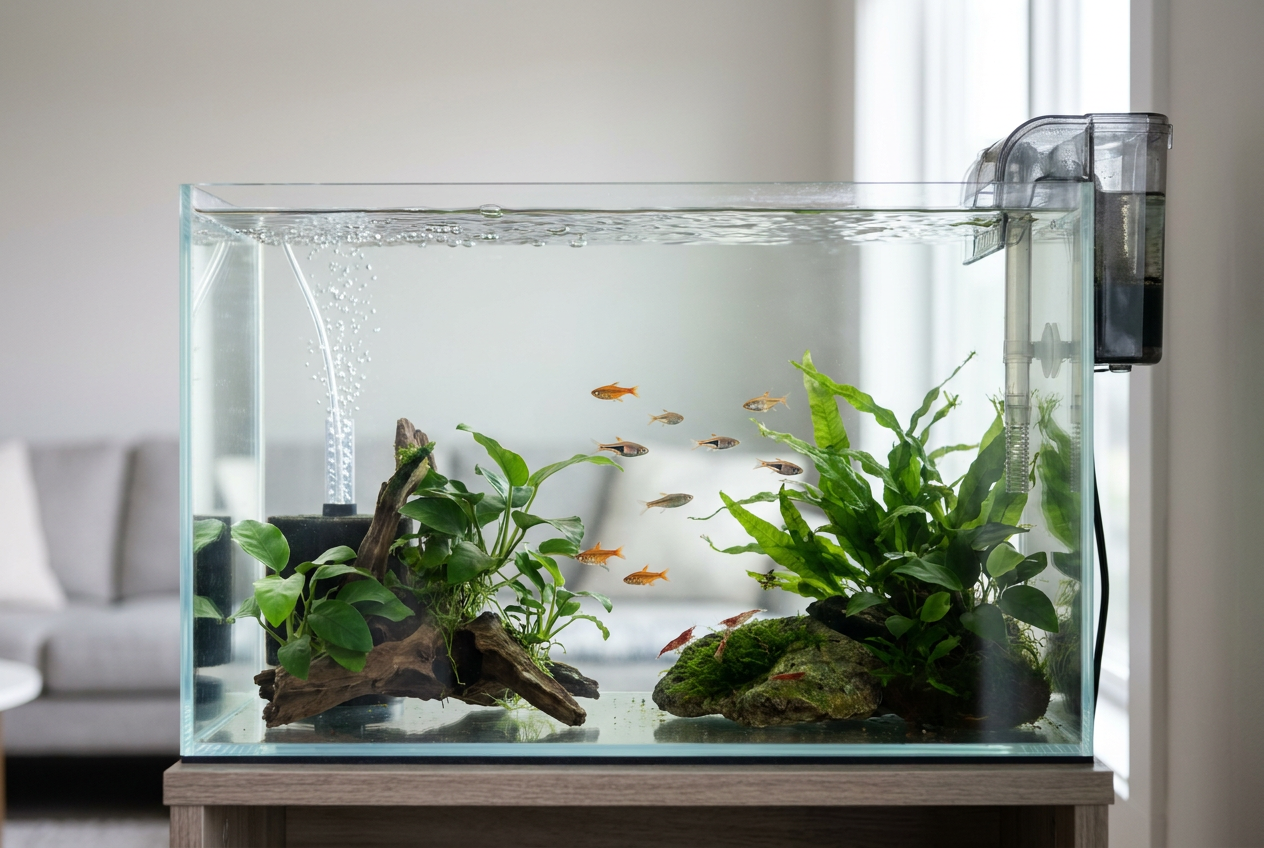
Many beginners think aquarium aeration is simply about adding bubbles into the water.
But in reality, aeration is about keeping the aquarium biologically alive.
Fish, shrimp, beneficial bacteria, plants, and even decaying waste all consume oxygen inside the aquarium ecosystem. Without enough oxygen exchange, the tank slowly becomes stressed, unstable, and unhealthy.
Understanding how aeration works helps beginners build healthier aquariums with better fish behavior, stronger biological filtration, and fewer sudden problems.
Fish Need Oxygen to Survive

Fish breathe dissolved oxygen through their gills.
Unlike humans, fish cannot breathe directly from the air. They rely entirely on oxygen dissolved inside the water itself.
As fish swim, digest food, grow, and move around, they constantly consume oxygen from the aquarium.
But fish are not the only organisms using oxygen.
The following also consume oxygen:
- Beneficial filter bacteria
- Aquatic plants during nighttime
- Shrimp and snails
- Decaying fish waste
- Uneaten food
- Organic debris trapped in substrate
This means an aquarium is constantly using oxygen every hour of the day.
When oxygen becomes too low, fish may begin showing stress signs such as:
- Gasping near the water surface
- Staying near filter flow
- Slow movement or lethargy
- Shrimp climbing upward
- Sudden deaths during hot weather or nighttime
Low oxygen problems are especially common in overcrowded tanks, small aquariums, or systems with poor water movement.
Aeration Is Actually About Gas Exchange

Many people believe the bubbles themselves are what provide oxygen.
Actually, the real source of oxygen comes from gas exchange happening at the water surface.
When the water surface moves or ripples:
- Oxygen from the air dissolves into the water
- Carbon dioxide escapes from the aquarium
- Fresh oxygen spreads throughout the tank
This is why water movement is extremely important.
The bubbles from an air stone mainly help by disturbing and circulating the water surface. The oxygen itself mostly enters through the moving surface layer.
A tank with strong filter circulation and good surface ripple may already have excellent oxygen levels even without visible bubbles.
Meanwhile, a completely still aquarium can slowly become oxygen-poor despite looking calm and beautiful.
Plants Also Consume Oxygen at Night

A very common beginner misunderstanding is:
“My planted aquarium already makes oxygen, so I do not need aeration.”
Aquatic plants only produce oxygen when light is available for photosynthesis.
At night, plants behave differently.
Without light, plants also consume oxygen just like animals.
In heavily planted aquariums, oxygen levels can sometimes drop significantly during darkness, especially when:
- Plant density is extremely high
- Water movement is weak
- Fish stocking is heavy
- CO2 injection is used
- The aquarium is tightly covered
This is why some planted tank hobbyists increase surface movement or run air pumps during nighttime.
Healthy planted aquariums still need balanced circulation and oxygen exchange.
Beneficial Bacteria Need Oxygen Too

The aquarium filter is not only for removing dirt.
Inside the filter lives beneficial bacteria that process toxic fish waste.
These bacteria convert:
- Ammonia → Nitrite
- Nitrite → Nitrate
This process is called the nitrogen cycle.
But beneficial bacteria are highly oxygen-demanding organisms.
Without enough oxygen-rich water flowing through the filter:
- Biological filtration weakens
- Ammonia may rise
- Fish become stressed
- Water quality becomes unstable
- The aquarium may eventually crash
Good water circulation helps deliver oxygen continuously into the filter media where these bacteria live.
This is one reason why healthy flow is important even in planted aquariums.
Warm Water Holds Less Oxygen

Temperature plays a major role in aquarium oxygen levels.
Warm water naturally holds less dissolved oxygen than cooler water.
This means oxygen problems become more dangerous during:
- Hot weather
- Tropical afternoons
- Overheated aquariums
- Crowded tanks
- Large fish systems
- Heavy feeding periods
This is why fish sometimes suddenly gasp near the surface during heat waves even though the aquarium previously looked normal.
Cooler moving water usually carries oxygen more effectively than warm stagnant water.
Do All Aquariums Need an Air Pump?

Not necessarily.
Many aquariums already receive enough oxygen through:
- Filter outflow
- Surface ripple
- Water circulation
- Open-top tank design
However, additional aeration becomes very useful when:
- Keeping large fish
- Keeping high fish density
- Running sponge filters
- During medication treatment
- During hot weather
- During power outages
- In shrimp breeding systems
- In heavily planted aquariums at night
Air pumps are especially useful because they improve circulation stability and help maintain oxygen exchange during stressful conditions.
Fish Can Also Be Stressed by Excessive Flow
More bubbles does not always mean better.
Most fish do not become “over-oxygenated” under normal aquarium conditions.
However, extremely aggressive water turbulence may stress certain species.
For example:
- Bettas prefer calmer water
- Small shrimp dislike violent current
- Slow-water species may struggle against strong flow
Good aeration is about balance.
The goal is not violent bubbles everywhere.
The goal is:
- Stable oxygen levels
- Gentle circulation
- Healthy gas exchange
- Strong biological stability
A Healthy Aquarium Is Always Moving

A healthy aquarium is never completely stagnant.
Even peaceful aquariums usually contain subtle invisible movement:
- Surface ripple
- Water circulation
- Oxygen exchange
- Flow through filter media
This invisible movement keeps fish, shrimp, plants, and beneficial bacteria alive together as one balanced ecosystem.
Aeration is not simply about bubbles.
It is about keeping the aquarium biologically alive.
Continue Learning
You may also enjoy exploring:
- Beginner Aquarium Nitrogen Cycle Guide
- Why Aquarium Filters Matter
- Sponge Filter vs Hang-On Filter
- Why Fish Gasp at the Surface
- Beginner Planted Tank Water Flow Guide
- Aquarium Temperature and Oxygen Stability
- How Beneficial Bacteria Actually Work
- Choosing the Right Filter for Your Aquarium


