
Why Is My Planted Tank Water Cloudy?
This guide is created by Green Chapter — Nature Workshop Studio, where we focus on creating living ecosystems through hands-on experience. We share practical insights across terrariums, aquascaping, plants, and natural systems to help you build and care for your own.
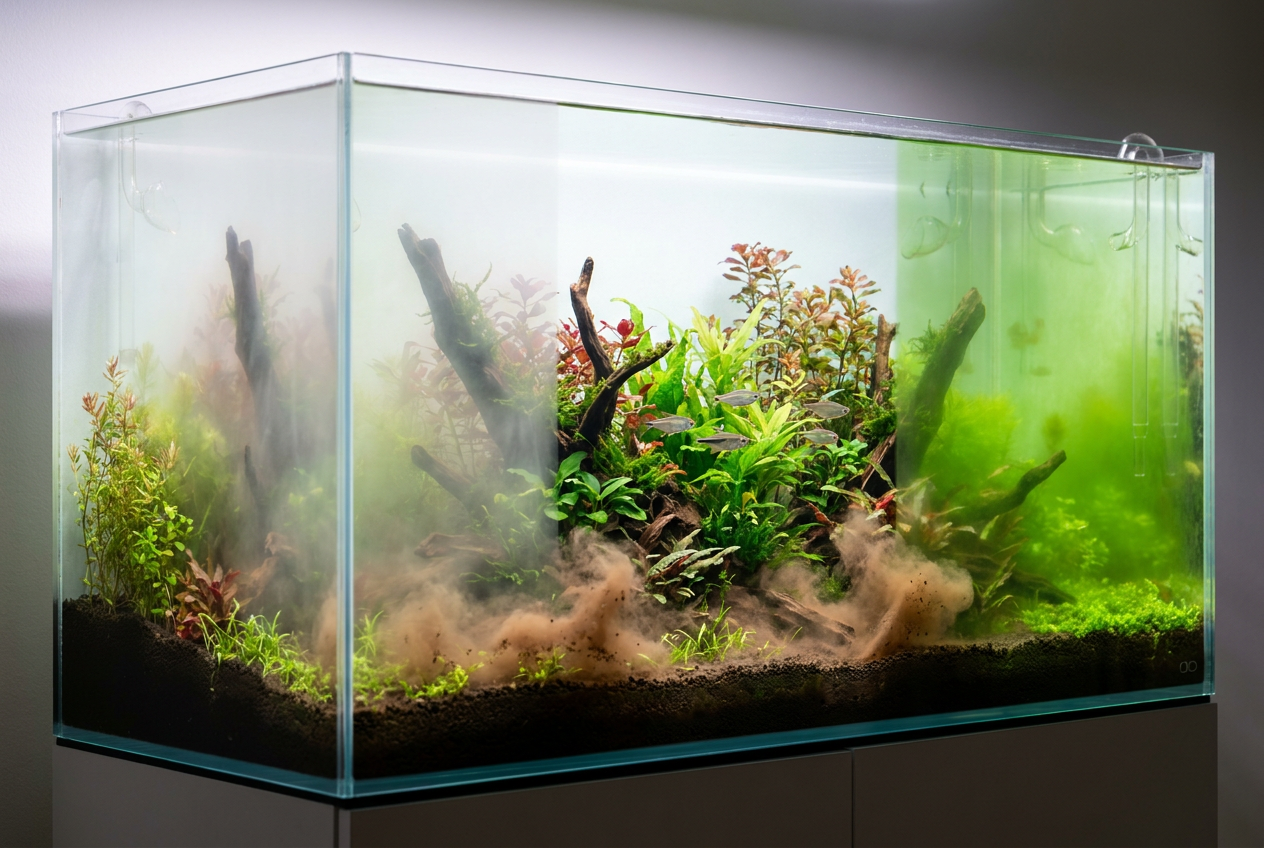
Cloudy water is one of the most common experiences in planted aquariums, especially during the early stages of a tank’s life. For many beginners, the first reaction is panic — the aquarium suddenly turns white, blurry, dusty, or even bright green overnight.
But cloudy water is usually not random.
In most cases, your aquarium ecosystem is reacting to instability, excess nutrients, microbial shifts, disturbed substrate, or environmental imbalance.
A planted aquarium is not a sterile glass box. It is a living biological system filled with bacteria, algae, microorganisms, dissolved organics, plant matter, and microscopic particles constantly interacting with one another.
Understanding what is floating in your water is the key to solving cloudy water properly.

The 4 Main Types of Cloudy Water
Different types of cloudiness usually point toward completely different ecosystem problems.
Milky White Cloudiness — Bacterial Bloom

Milky white water is one of the most misunderstood planted tank issues.
Many beginners assume the tank is becoming “dirty,” but in reality, this is often a bacterial bloom — a massive explosion of free-floating beneficial bacteria.
These bacteria are usually feeding on excess dissolved organics in the water.
This commonly happens:
- in newly cycling aquariums
- after adding too much fish food
- after disturbing substrate deeply
- after large plant melt events
- when filters are immature
- after replacing too much filter media
The water often appears:
- foggy
- whitish
- translucent
- smoky or mist-like
Unlike substrate dust, bacterial bloom water usually looks evenly cloudy throughout the entire aquarium.
What Is Actually Happening?
Your aquarium is going through microbial succession.
Beneficial bacteria are trying to establish stable colonies across:
- filter media
- substrate surfaces
- hardscape
- plant roots
- aquarium glass
Until stable colonies form, many bacteria remain suspended in the water column temporarily.
This is especially common in nutrient-rich aquasoil setups.

How To Fix A Bacterial Bloom
The most important thing is usually:
do not panic.
In many cases, bacterial blooms resolve naturally within several days to one or two weeks.
Recommended actions:
- reduce overfeeding
- remove decaying leaves
- avoid disturbing substrate repeatedly
- maintain stable filtration
- allow bacterial colonies time to mature
- ensure good water circulation
What NOT to do:
- replace all filter media
- deep clean the entire aquarium repeatedly
- perform huge daily water changes unnecessarily
- constantly add random chemicals
Many hobbyists accidentally prolong bacterial blooms by continuously destabilizing the system.
Green Water — Free Floating Algae Bloom

Green water is caused by massive populations of microscopic free-floating algae suspended throughout the aquarium.
Unlike bacterial blooms, green water is usually linked more strongly to:
- excessive light
- unstable nutrients
- ammonia spikes
- immature ecosystem balance
Green water often appears:
- bright green
- neon green
- pea soup-like
- fluorescent under strong lighting
This problem commonly occurs when:
- lighting is too intense for a new tank
- photoperiods are too long
- tanks receive direct sunlight
- ammonia becomes available to algae
- plant mass is insufficient
Why Algae Blooms Happen
Plants and algae compete for nutrients and light.
In immature tanks, algae often win temporarily because:
- plants are still adapting
- roots are undeveloped
- bacterial systems are unstable
- nutrient uptake is inconsistent
Free-floating algae can reproduce extremely quickly when conditions favor them.

How To Fix Green Water
The goal is ecosystem stabilization — not simply “killing algae.”
Recommended actions:
- reduce lighting to 6–8 hours daily
- avoid direct sunlight
- increase healthy plant mass
- reduce excess feeding
- stabilize nutrient dosing
- improve filtration maturity
A temporary blackout can also help.
A proper blackout involves:
- completely blocking light
- covering the aquarium fully
- maintaining filtration and aeration
- lasting around 2–3 days
However, blackouts only solve symptoms temporarily if the underlying imbalance remains unresolved.
Dusty Brown Water — Suspended Particulates

Dusty or brown cloudy water is usually mechanical rather than biological.
This type of cloudiness comes from:
- disturbed aquasoil
- mulm
- loose substrate particles
- detritus
- decaying debris
- aggressive gravel vacuuming
This frequently happens after:
- rescapes
- large water changes
- uprooting rooted plants
- moving hardscape
- poor filter maintenance
Unlike bacterial bloom water, particulate cloudiness often appears:
- grainy
- dusty
- heavier near substrate
- visibly particle-based under light
How To Clear Suspended Debris
Mechanical filtration is the main solution here.
Fine filter floss or filter wool can trap micro-particles effectively.
Recommended actions:
- add filter floss temporarily
- reduce excessive substrate disturbance
- clean filters gently
- improve circulation flow patterns
- siphon loose debris carefully
Most particulate cloudiness settles naturally within several hours to several days.
Tea-Colored Water — Tannins

Not all colored water is unhealthy.
Yellow or tea-colored water is often caused by tannins released from:
- driftwood
- botanicals
- leaf litter
- seed pods
Tannins are natural organic compounds commonly found in rainforest streams and blackwater ecosystems.
In many cases, tannins can actually benefit:
- shrimp
- bettas
- blackwater fish
- softwater species
Tannin water is usually:
- transparent
- amber
- tea-like
- not truly cloudy
Some hobbyists remove tannins for aesthetic reasons using:
- Purigen
- activated carbon
- water changes
But tannins themselves are usually not dangerous.
Using Equipment To Help Clear Cloudy Water

Sometimes cloudy water cannot be solved immediately through patience alone.
In these situations, certain filtration tools and polishing equipment can help stabilize or temporarily improve water clarity while the ecosystem recovers.
However, it is important to understand that most equipment treats symptoms — not the underlying ecosystem imbalance itself.
A planted aquarium becomes sustainably clear when:
- biological filtration matures
- nutrients stabilize
- plant growth becomes healthy
- waste production balances naturally
Equipment can assist this process, but usually cannot replace it entirely.
UVC Sterilizers — Why They Work So Well On Green Water

UVC sterilizers are one of the most effective tools for treating severe green water blooms.
This is because free-floating algae physically pass through the sterilizer chamber where ultraviolet radiation damages the algae cells suspended in the water column.
Over time, the algae population collapses and water clarity improves dramatically.
This is why UVC systems are commonly used in:
- large display aquariums
- high-bioload fish systems
- koi ponds
- aquascaping galleries
- temporary algae outbreak control
However, UVC does not solve the root ecosystem imbalance that allowed the algae bloom to happen in the first place.
If excessive lighting, ammonia spikes, or unstable nutrients remain unresolved, the algae may eventually return once the sterilizer is removed.
UVC is usually most effective as:
- a temporary stabilization tool
- a polishing aid
- an outbreak-management system
rather than the sole long-term solution.
Filter Floss & Mechanical Water Polishing

For dusty or particle-filled cloudy water, mechanical filtration is often the fastest solution.
Fine filter floss, polishing pads, or filter wool physically trap suspended particles before they can continue circulating through the aquarium.
This is especially useful after:
- uprooting carpeting plants
- major rescapes
- substrate disturbance
- hardscape repositioning
- aggressive cleaning sessions
Many aquascapers temporarily add extra polishing floss for several days after maintenance work to rapidly restore water clarity.
However, mechanical polishing works best when:
- water circulation is good
- filters are not clogged
- debris sources are minimized
- substrate disturbance is reduced
Water Clarifiers — Helpful But Often Misunderstood

Water clarifiers do not magically “clean” aquarium water.
Instead, they cause tiny suspended particles to clump together into larger masses that filters can physically trap more easily.
This can temporarily improve cloudy water appearance quite quickly.
Clarifiers are often useful for:
- fine dust clouds
- suspended substrate particles
- post-rescape haze
- temporary polishing
However, they do not remove the underlying cause of instability.
If:
- overfeeding continues
- dead plant matter accumulates
- filtration remains immature
- nutrients stay unstable
the cloudiness will usually return.
Crystal Clear Water Does Not Always Mean Healthy Water

One of the most important things beginners can learn is that clear water and healthy water are not always the same thing.
An aquarium can appear visually crystal clear while still suffering from:
- ammonia spikes
- unstable nutrient balance
- poor oxygen circulation
- biological instability
- unhealthy substrate conditions
Similarly, some cloudy phases — especially bacterial blooms during cycling — are temporary ecosystem transitions rather than disasters.
Many experienced planted tank hobbyists focus less on achieving perfectly sterile-looking water and more on creating long-term ecosystem stability.
In mature planted aquariums, water clarity is usually a side effect of balance rather than aggressive intervention.
What Beginners Accidentally Do Wrong

One of the biggest planted tank mistakes is trying to force the aquarium to become “sterile.”
Many beginner reactions accidentally destabilize the ecosystem further.
Why New Tanks Go Through “Ugly Phases”

New planted aquariums often experience several temporary instability phases before becoming stable ecosystems.
This is normal.
A new aquarium is still developing:
- bacterial colonies
- nutrient balance
- plant root systems
- microbial diversity
- substrate stability
During this period, the aquarium may experience:
- bacterial bloom
- diatoms
- green dust algae
- cloudy water
- melting plants
This does not automatically mean the tank is failing.
When Cloudy Water Becomes Dangerous

Cloudy water itself is not always harmful.
However, some situations can indicate serious ecosystem stress.
Warning signs include:
- foul rotten smell
- fish gasping at the surface
- oily suffocating surface film
- sudden livestock deaths
- ammonia spikes
- severe plant decay
- oxygen depletion
If these occur, testing water parameters becomes important.
Particularly:
- ammonia
- nitrite
- nitrate
In healthy aquariums:
- ammonia should remain at 0 ppm
- nitrite should remain at 0 ppm
Cloudy water combined with ammonia spikes can indicate biological filtration collapse.
How To Achieve Truly Clear Water
IMAGE 16 INSERT:
Crystal-clear mature planted aquarium ecosystem with healthy plants, balanced lighting, stable filtration flow, natural aquascape, realistic water clarity, premium editorial planted tank photography.
Clear water is usually the result of ecosystem stability — not aggressive cleaning.
Stable planted aquariums typically share:
- mature biological filtration
- balanced lighting
- healthy plant growth
- controlled feeding
- stable circulation
- minimal unnecessary disturbance
- consistent maintenance habits
In many cases, the best solution to cloudy water is patience combined with stability.
A planted aquarium is constantly evolving biologically.
The goal is not to sterilize the ecosystem.
The goal is to stabilize it.


