
The Hidden World of Begonia
This guide is created by Green Chapter — Nature Workshop Studio, where we focus on creating living ecosystems through hands-on experience. We share practical insights across terrariums, aquascaping, plants, and natural systems to help you build and care for your own.
A Botanical Deep Dive into Evolution, Ecology, and Global Distribution
Begonia is often appreciated for its striking foliage—but in nature, it represents something far more intricate.
This is a genus shaped by precision and specialization, thriving not by spreading widely, but by adapting deeply to very specific environments. Across tropical regions, Begonia has evolved into thousands of species by occupying microhabitats that many other plants cannot tolerate.
From limestone cliffs to misty cloud forests, Begonia tells a story of how plants evolve when conditions are stable, humid, and fragmented.
Global Biogeography — Where Begonia Lives
Begonia is distributed across tropical regions worldwide, but its diversity is concentrated in three major zones.
🌎 Neotropics (South & Central America)
This is the largest center of diversity. Begonias here are commonly found along Andean mountain slopes, river valleys, and rainforest understories. The dramatic changes in elevation create many ecological niches, allowing species to diversify rapidly.
🌍 Tropical Africa
Africa hosts fewer Begonia species, but they are often highly specialized. These plants typically grow in stable rainforest environments, including West Africa and Madagascar, where conditions remain consistently humid.
🌏 Southeast Asia (Malesia)
This region shows the highest level of micro-endemism. In places like Borneo, Sulawesi, and the Philippines, species are often restricted to extremely small areas—sometimes just a single limestone hill.
What drives this pattern is geographic isolation. Islands, mountains, and karst formations act as natural barriers, allowing species to evolve independently over time.
Begonia is a clear example of how biodiversity increases when environments are fragmented but stable.

Morphology & Growth Forms — How Begonia Adapts Structurally
Begonia is not defined by a single form. Instead, it displays a range of growth structures, each adapted to a specific environment.
Rhizomatous Forms
These grow along horizontal stems that creep across the surface. Leaves emerge at intervals, allowing the plant to spread efficiently across moist, shaded forest floors.
Tuberous Forms
These species develop underground storage organs. During dry or unfavorable periods, the plant retreats into the tuber and re-emerges when conditions improve.
Cane-like Forms
With upright stems and visible nodes, these Begonia grow vertically to access filtered light in dense vegetation.
Trailing / Scandent Forms
These spread across rocks, logs, and slopes. Their flexible structure allows them to anchor and expand in unstable or vertical environments.
Thick-Stemmed Forms
These have compact, water-storing stems, allowing survival in environments where moisture is present but not consistently available.
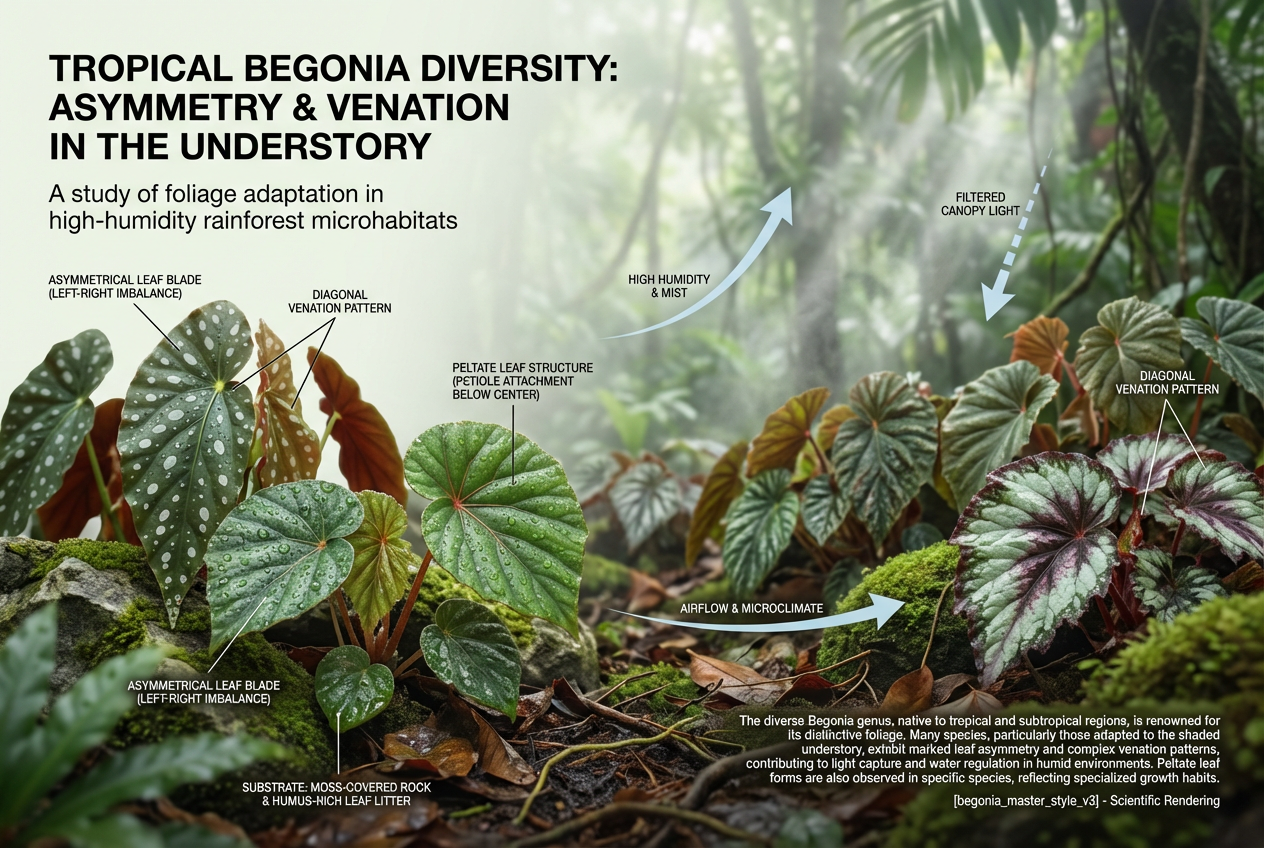
Peltate Leaves — A Subtle but Powerful Adaptation
Some Begonia species develop peltate leaves, where the leaf stalk attaches beneath the leaf instead of at the edge.
This design:
- Improves structural balance
- Enhances light capture
- Allows water to flow off efficiently in humid environments
👉 A small structural change that reflects a highly refined adaptation strategy.

Niche Ecological Habitats — Where Begonia Thrives
Begonia thrives in environments that are consistently humid, shaded, and well-drained. Rather than competing broadly, it specializes in very specific niches.
🪨 Lithophytic Begonia (Rock-Dwelling)
These species grow directly on rock surfaces, especially limestone (karst).
- Roots anchor into cracks
- Soil is minimal
- Many species are adapted to calcium-rich conditions
These habitats are often isolated, contributing to the high number of unique species.
Epiphytic Begonia
Some Begonia grow on tree trunks instead of soil.
- Roots attach to bark
- Nutrients come from organic debris
- Survival depends on humidity and rainfall
Forest Floor & Cloud Forest Begonia
Most Begonia species are found in:
- Shaded rainforest understories
- Moist leaf litter
- Cloud forests with constant mist
These environments provide stable humidity, low light, and well-drained organic substrate.
Micro-Pioneer Behavior
Begonia can also colonize disturbed environments such as landslides or riverbanks. These plants act as early stabilizers, taking advantage of newly exposed but humid surfaces.

Abiotic Constraints — The Limits That Shape Begonia
Begonia distribution is tightly controlled by environmental conditions. Even slight changes can determine whether a species survives.
Altitude
- Lowland species: warm, humid environments below ~800m
- Montane species: cooler, mist-rich environments above ~1000m
Higher elevation species are generally smaller and more dependent on stable humidity.
Substrate & Soil
Two main ecological strategies exist:
Forest Floor Species
- Grow in leaf litter and humus
- Prefer slightly acidic, organic-rich conditions
- Require excellent drainage
Limestone Specialists
- Grow on calcium-rich rock
- Often restricted to karst environments
- Highly specialized and localized
Temperature & Humidity
Begonia thrives in:
- Stable temperatures
- High humidity
- Low to moderate light
They are highly sensitive to:
- Dry air
- Waterlogged roots
- Direct sunlight
👉 This explains their strong association with protected rainforest environments.

Reproductive Biology — How Begonia Sustains Itself
Begonia uses a highly efficient reproductive strategy suited for dense forest ecosystems.
Monoecious Structure
Each plant produces both male and female flowers. However, they mature at different times, reducing the chance of self-pollination.
Pollination Strategy
Begonia is primarily pollinated by bees using buzz pollination.
- Flowers produce pollen instead of nectar
- Female flowers often resemble male flowers to attract pollinators
👉 This strategy ensures efficient pollination even in low-light environments.
Seed Dispersal
Begonia produces extremely fine seeds that are easily dispersed by wind or water.
This allows the plant to colonize new microhabitats—even across fragmented landscapes.

Conclusion — A Genus Defined by Precision
Begonia does not thrive everywhere—it thrives where conditions are exactly right.
Its diversity is the result of:
- Geographic isolation
- Structural adaptation
- Environmental specialization
From limestone cliffs to cloud forests, Begonia represents a powerful ecological principle:
👉 Success in nature comes from being perfectly adapted to a specific niche.


