
Leaf Propagation in Tropical Plants: A Technical Guide to Begonia, Sonerila, Labisia, and Primulina
This guide is created by Green Chapter — Nature Workshop Studio, where we focus on creating living ecosystems through hands-on experience. We share practical insights across terrariums, aquascaping, plants, and natural systems to help you build and care for your own.
Leaf propagation feels almost magical at first. A single leaf, when placed in the right conditions, can transform into a completely new plant. But as many growers quickly discover, success is not guaranteed—and not all plants behave the same way.
Some genera, like Begonia, are naturally adapted to regenerate from leaf tissue. Others, such as Primulina, can also respond well with the right technique. Meanwhile, plants like Labisia require a more patient and controlled approach, and Sonerila is often better propagated using stem cuttings instead.
In this guide, we break down what is actually happening during leaf propagation, how to choose the right method, and how to build a setup that encourages growth instead of decay.
What Leaf Propagation Actually Means
Leaf propagation is not just about keeping a leaf alive—it is about getting it to regenerate into a new plant.
When a leaf is cut, certain areas—especially around the major veins or petiole base—can activate and begin forming new structures. These include both roots and shoots, which are essential for a complete plant. A cutting that produces only roots may survive temporarily, but without a new crown, it will never develop into a full plant.
This explains a common frustration among growers: a leaf stays green for weeks, yet nothing happens. In reality, it has not failed—it simply has not completed the regeneration process.
Understanding this distinction helps shift the focus from “keeping cuttings alive” to encouraging proper growth pathways.

Which Genera Are Best for Leaf Propagation
Not all tropical plants respond equally to leaf propagation, and knowing the difference can save a lot of time.
Begonia is the most reliable. Its strong vein structure allows it to produce plantlets from multiple propagation methods, making it ideal for beginners and advanced growers alike.
Primulina is also highly capable, especially when propagated using the petiole method. It offers a cleaner, more controlled approach with consistent results.
Labisia falls somewhere in between. It can be propagated from leaves, but it requires more stability and patience. Results tend to be slower and less predictable.
Sonerila, on the other hand, is the most delicate. Leaf propagation is often inconsistent, and stem cuttings are generally a better choice.
Recognizing these differences allows you to choose the right strategy instead of forcing one method across all plants.

Why Veins and Petioles Matter
The success of leaf propagation often comes down to where you make the cut.
Veins and petioles act as the plant’s internal highways, carrying nutrients and signals throughout the leaf. When these areas are cut, they are more capable of reorganizing and producing new growth.
In Begonia, the basal vein region—where the leaf connects to the plant—is especially powerful. In Primulina, the petiole base plays a similar role, making it the preferred propagation point.
By contrast, thin outer leaf tissue has limited ability to regenerate. This is why random cuts often fail, even if the leaf appears healthy.
Good propagation is not just about technique—it is about targeting the right biological structures.
The Three Main Propagation Methods
There are three primary methods used in leaf propagation, each suited to different situations.
Wedge Method
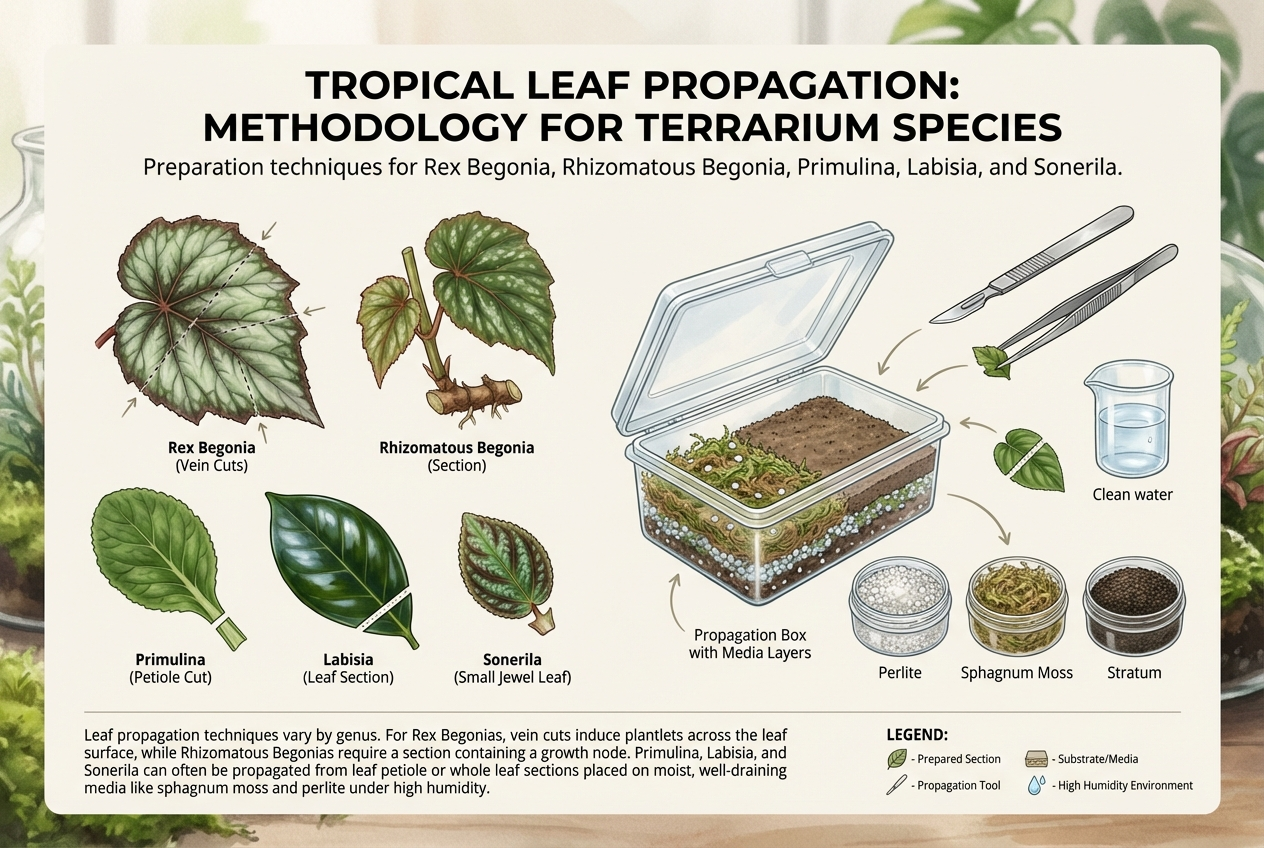
This method involves cutting a leaf into multiple sections, each containing part of a vein. It is highly efficient and works particularly well for Begonia. However, smaller sections are more fragile and require stable humidity.
Vein-Cut Whole Leaf Method
Instead of dividing the leaf, this method keeps it intact. Small cuts are made along the veins, and the leaf is pinned flat onto the substrate. This allows multiple plantlets to form while maintaining better moisture balance.
Petiole Method
This method uses a full leaf with its stalk inserted into the medium. It is especially effective for Primulina and provides a clean, controlled setup. Compared to water propagation, solid media often produces more stable results.
Each method has its strengths—the key is matching the method to the plant.

Matching the Right Method to the Right Genus
Choosing the correct method for each plant makes a significant difference in success rates.
- Begonia is highly flexible and works well with wedge, vein-cut, or petiole methods
- Primulina performs best with the petiole method
- Labisia benefits from careful, minimal handling
- Sonerila should generally be propagated using stem cuttings instead
Trying to apply a single method across all plants is one of the most common mistakes. Successful propagation comes from adapting your approach to the plant’s natural behavior.

Building the Ideal Prop Box
A successful propagation setup depends heavily on the environment.
The ideal prop box maintains high humidity without becoming stagnant. Leaves should remain hydrated, but surfaces should not stay wet for long periods. Light condensation is a good sign; heavy dripping is not.
Airflow is equally important. A slightly open lid or minimal ventilation helps prevent bacterial and fungal issues while still maintaining humidity.
Lighting should be bright but indirect, and temperatures should remain stable. Too much heat or direct sunlight can quickly damage delicate cuttings.
Ultimately, the goal is balance—a humid but breathable environment that supports growth without encouraging decay.

Choosing the Right Substrate
Different substrates serve different roles in propagation.
Perlite provides excellent airflow and is ideal for petiole cuttings.
Sphagnum moss retains moisture well and is better suited for delicate leaf sections.
Fluval Stratum offers a balanced option, combining moisture retention with structure.
The best choice depends on the cutting type. Thin leaf pieces need consistent moisture, while petioles benefit from better oxygen access.
Instead of searching for a single “best” medium, it is more effective to match the substrate to the plant and method.

Auxins, Cytokinins, and Growth Balance
Propagation is driven by the plant’s internal hormone balance.
Auxins promote root formation, while cytokinins encourage shoot development. For a cutting to become a complete plant, both processes must occur.
This is why some cuttings produce roots but fail to grow further—they lack the hormonal conditions needed to form a new shoot.
In delicate plants like Sonerila, excessive intervention can disrupt this balance. Often, stable environmental conditions are more important than adding external treatments.
Understanding this balance helps explain why healthy growth requires more than just rooting.

Troubleshooting “The Melt”
“Melt” is a common term used to describe failed cuttings, but it can have several causes.
- Bacterial rot leads to soft, wet collapse
- Fungal issues appear as spreading patches or fuzz
- Desiccation causes dry, curled tissue
- Callus without shoots results in stalled growth
Each issue requires a different solution. By identifying the type of failure, you can adjust your setup more effectively instead of guessing.
Recognizing these patterns is key to improving your success rate over time.

Cinnamon and Activated Charcoal
Cinnamon and activated charcoal are often used as supportive tools in propagation setups.
Cinnamon may help reduce surface fungal activity, while activated charcoal can assist in maintaining a cleaner environment. However, these should be used sparingly and never as a substitute for proper technique.
The most important factors remain:
- clean cuts
- proper humidity
- adequate airflow
Additives can support the process, but they cannot fix an unstable setup.
Conclusion
Leaf propagation is a balance between regeneration and decay.
Begonia offers the most reliable results, Primulina provides a clean and structured approach, Labisia rewards patience, and Sonerila requires a more cautious strategy.
By understanding how each plant responds—and by building the right environment—you can turn a simple leaf into a thriving new plant.


