
The Hidden Architects of Tropical Forests: A Deep Dive into the Melastomataceae Family
This guide is created by Green Chapter — Nature Workshop Studio, where we focus on creating living ecosystems through hands-on experience. We share practical insights across terrariums, aquascaping, plants, and natural systems to help you build and care for your own.
Global Distribution: Where Melastomes Rule the Tropics
The Melastomataceae family is one of the most widespread plant groups across the tropics, yet its diversity is far from evenly distributed. Instead, it forms distinct biodiversity hotspots shaped by geography, climate, and evolutionary history.
The Neotropics stand as the primary center of diversity. Vast regions such as the Amazon Basin, the Andes, and Brazil’s Atlantic Forest are dominated by melastomes. Genera like Miconia and Tibouchina are especially prominent, forming dense understory shrubs and early colonizers in forest gaps. These regions provide ideal conditions for speciation—steep elevation gradients, constant humidity, and frequent disturbance events create isolated microhabitats where new species can evolve rapidly.
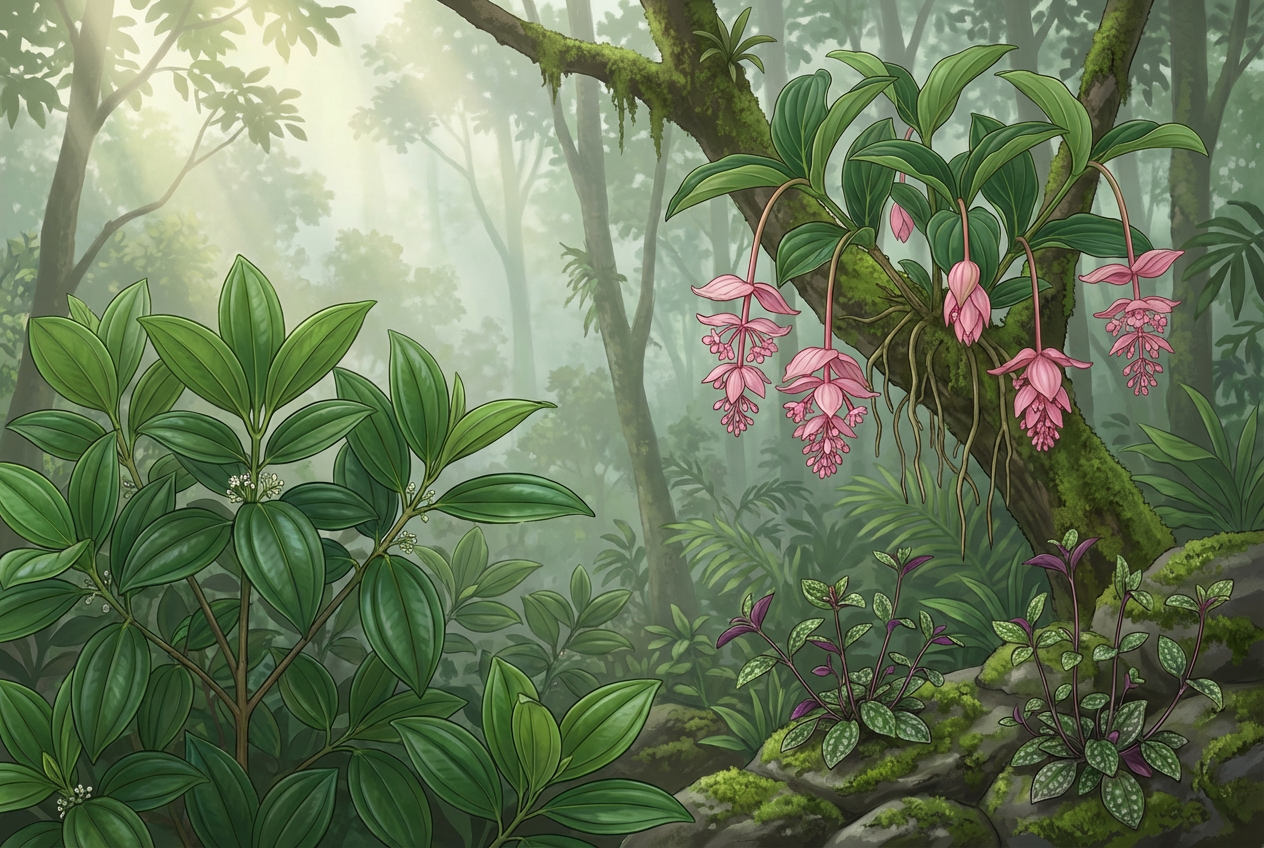
In contrast, the Paleotropics—covering Southeast Asia, Madagascar, and tropical Africa—host fewer species but greater ecological specialization. Genera such as Medinilla dominate canopy and epiphytic niches, while Sonerila and Phyllagathis thrive in shaded forest floors and limestone systems. These environments often lead to highly localized species found nowhere else.
Only a handful of melastomes extend beyond tropical climates. For example, Rhexia appears in warmer temperate regions, but such cases are rare and represent ecological exceptions rather than the norm.

Signature Morphology: The Language of Leaves & Structure
At first glance, Melastomataceae may look like ordinary tropical plants—but a closer look reveals one of their most defining traits: acrodromous leaf venation.
This unique pattern features multiple strong veins running from the base of the leaf toward the tip. It gives the leaf a structured, almost architectural appearance, and more importantly, reinforces the thin leaf tissue commonly found in humid tropical environments. This allows the plant to maintain large surface areas for photosynthesis without sacrificing durability.
Beyond leaves, the family exhibits remarkable diversity in growth form. Some species are delicate forest-floor herbs, others cling to rock faces as lithophytes, while many grow as shrubs or even small trees in the understory. Epiphytic species, particularly within Medinilla, take advantage of vertical space by growing directly on tree trunks and branches.
One of the most fascinating adaptations appears in genera like Tococa. These plants develop specialized structures known as domatia, which house ants. In exchange for shelter, the ants actively defend the plant against herbivores—an elegant example of mutualism shaped by evolutionary pressure.

Altitudinal Zonation: From Jungle Floor to Cloud Forest
Melastomataceae species are not confined to a single layer of the forest—they occupy a wide vertical range, adapting to different climatic conditions along the way.
In lowland rainforests, melastomes thrive under warm, stable temperatures and high humidity. These species are typically fast-growing and evergreen, taking advantage of filtered light beneath the canopy. Many Miconia and Medinilla species belong to this group.
As elevation increases, conditions shift dramatically. Cloud forests introduce cooler temperatures, persistent mist, and nutrient-poor soils. Here, melastomes adapt by slowing their growth, developing compact forms, and optimizing moisture retention. These environments are often described as “eternal spring,” and they host a unique subset of the family.
Some species even extend into seasonally dry savannas, where survival depends on tolerating intense sunlight and limited water availability. In these habitats, plants like Tibouchina evolve tougher leaves and deeper root systems to withstand environmental stress.

Soil & Substrate: Masters of Poor Ground
One of the defining ecological strengths of Melastomataceae is their ability to thrive in nutrient-poor and chemically challenging soils.
Many species are adapted to acidic soils with low nutrient availability—conditions that would limit most other plants. Some melastomes even tolerate or accumulate aluminum, turning what is normally a toxic element into a competitive advantage. This allows them to dominate environments where other species struggle to survive.
In Southeast Asia, certain genera such as Sonerila and Phyllagathis have evolved to specialize in limestone karst landscapes. These habitats feature thin soils, sharp rock formations, and fluctuating moisture levels. The plants that live here are often highly localized, adapted to very specific microhabitats.
Additionally, Melastomataceae includes both lithophytes, which grow directly on rocks, and epiphytes, which grow on trees without drawing nutrients from them. These strategies allow them to bypass competition on the forest floor and exploit alternative ecological niches.

Reproductive Strategy: Precision Pollination
Melastomataceae flowers are deceptively simple, but their reproductive strategy is highly specialized.
Most species rely on buzz pollination, a process where bees vibrate the flower to release pollen. This works because the anthers open through tiny pores—a structure known as poricidal dehiscence. Only specific pollinators can access the pollen, making the process highly efficient and reducing waste.
Fruit types within the family also vary. Some species produce dry capsules that release seeds nearby, while others develop fleshy berries that attract birds. This shift allows certain melastomes to disperse their seeds over much greater distances, expanding their ecological reach.

Pioneer Species: Nature’s First Responders
Melastomataceae plays a critical role in ecological succession, particularly in disturbed environments.
After events like landslides, forest clearing, or fires, melastomes are often among the first plants to return. Their success lies in a combination of traits: they produce large numbers of tiny seeds, germinate quickly, and tolerate poor soil conditions.
As pioneer species, they stabilize the soil, create shade, and gradually improve environmental conditions. This paves the way for more complex plant communities to establish over time.
Rather than being temporary occupants, melastomes act as ecosystem builders, setting the foundation for forest regeneration.

Conclusion: The Adaptive Power of Melastomes
Melastomataceae is a family defined by both consistency and versatility. Its signature leaf structure ties the group together, while its ecological range—from rainforest floors to rocky cliffs—demonstrates remarkable adaptability.
These plants are more than just passive inhabitants of tropical ecosystems. They actively shape landscapes, influence biodiversity, and drive regeneration in disturbed habitats.
Understanding Melastomataceae offers a deeper appreciation of how plants evolve not just to survive—but to engineer entire ecosystems.


