
The Living Blueprint #03: The Volcanic Stairecase
This article is part of Chronicles of the Glass Cage, a collection of explorations into nature, imagination, ecosystems, and the worlds we carry in our minds. Each chapter begins with a question, an observation, a memory, or a possibility, then follows where that path leads.
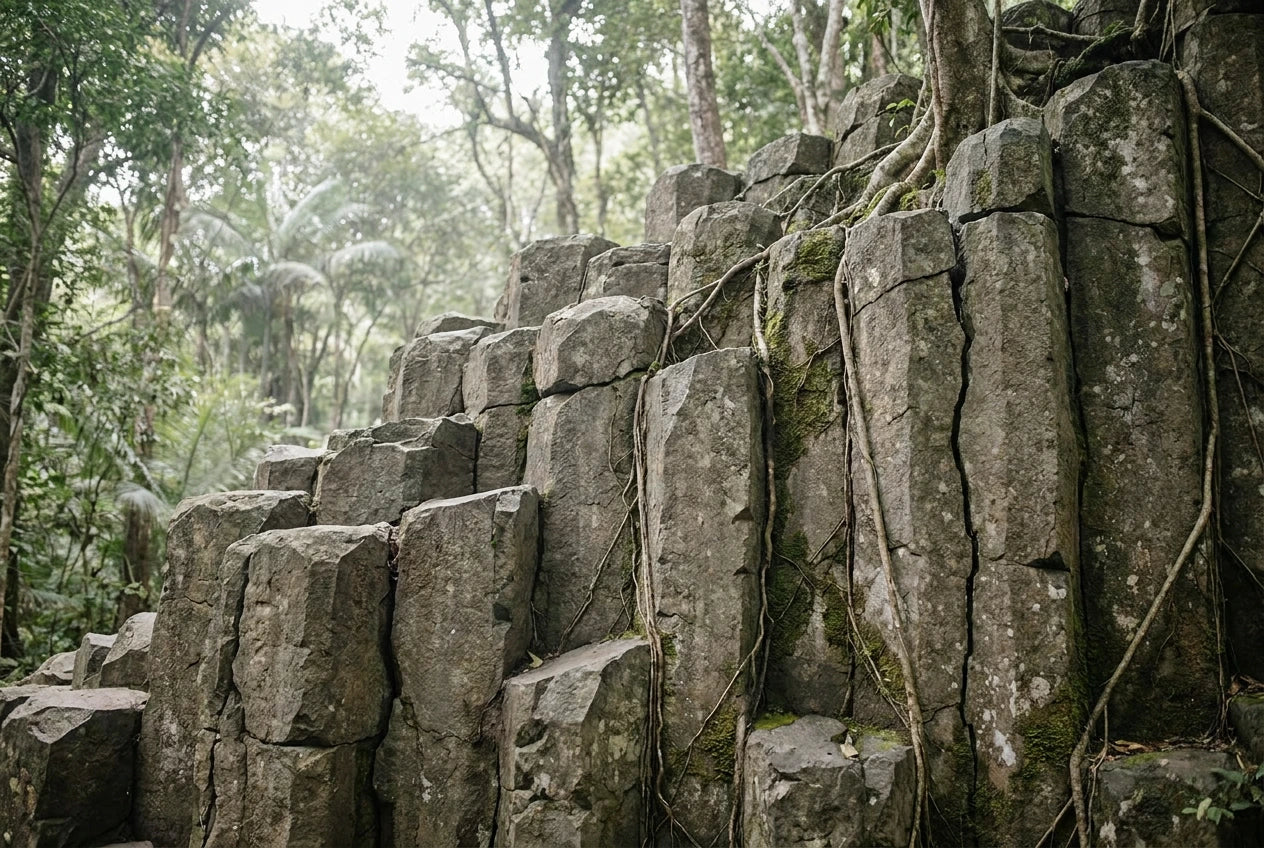
The Volcanic Staircase
Designing Structure Instead of Piles
Prelude: The Skeleton of the Earth

When you enter a mature forest, it is easy to think the plants are holding the landscape together.
The trees fill the view. Vines cross from one trunk to another. Moss spreads across old surfaces. Ferns appear wherever shade and moisture collect.
The green world feels dominant.
But if you look past the leaves, another structure begins to appear.
The plants are not holding up the landscape.
The landscape is holding up the plants.
Stone gives the forest its hidden framework. It decides where a root can grip, where soil can collect, where water can slow down, and where moss can survive long after the sun reaches the exposed surfaces.
Rock is not background.
It is architecture.
Most enclosures begin from the opposite direction. We focus first on the greenery. We choose plants, imagine coverage, plan where the moss will spread, and hope the hardscape will eventually disappear beneath growth.
There is nothing wrong with loving plants. But nature rarely begins there.
In many landscapes, the stone came first.
The plants arrived later and learned to follow it.
This chapter is about that order.
Not how to pile more rocks into a tank.
How to build a structure that everything else can believe.
The Mistake of the Chaotic Heap

There is a common instinct when choosing hardscape.
We search for character stones.
The jagged one. The twisted one. The one with holes, scars, edges, and dramatic shape.
Each stone may be beautiful on its own. The problem begins when several unrelated stones are placed together and expected to become a landscape.
They are stacked, leaned, wedged, and filled with moss. From a distance the arrangement may look impressive. Up close, something often feels wrong.
The eye may not know the exact reason.
But it notices.
One rock grain points left. Another points right. One piece looks like it fell from above. Another looks like it was pushed from the side. A third appears to float without enough weight beneath it.
The scene becomes a collection.
Not a formation.
Randomness is not the same thing as naturalness.
In the wild, stone rarely appears as unrelated objects scattered for decoration. It usually carries some larger rule. A cliff face may fracture in one direction. A riverbed may smooth stone into repeated curves. A sedimentary wall may reveal the same layer again and again across a wide distance.
Nature builds with consistency.
Even when it looks messy, there is usually a history behind the mess.
When a hardscape follows no clear rule, the plants have no believable direction to follow. Water has no logical path. Cracks do not connect. Soil collects in strange places. The scene may still be attractive, but it does not feel old.
It does not feel inherited.
It feels assembled.
The First Rule: Choose A Formation, Not A Collection
Before choosing individual stones, decide what kind of formation the enclosure is borrowing from.
Is it a vertical volcanic wall? A river-worn bank? A layered slate slope? A cracked limestone shelf?
Once the formation is clear, the stones have a job. They are no longer separate decorations. They become pieces of the same story.
A simple structure with one clear rule often feels more natural than ten beautiful stones fighting each other.
The Geometry of History

Walk up to a volcanic cliff face and a quiet relationship begins to appear.
The stone looks rigid and still. Yet almost every living thing around it is following its instructions.
Water disappears into the same narrow channels. Roots descend through the same cracks. Moss gathers inside the same shaded seams.
The rock face is not merely supporting life.
It is directing it.
The plants are not choosing freely where to grow. The geology already narrowed their choices long before they arrived.
Nature's stone formations are not decorations.
They are records.
The sharp columns of a basalt cliff are the visible memory of cooling lava. The layered bands of a shale ridge are the visible memory of pressure. The rounded stones of a riverbank are the visible memory of water.
The geometry of stone is evidence of what happened there before anything green began to grow.
When we build with stone, we are not only choosing texture and colour. We are creating the rules that the rest of the ecosystem must negotiate with.
If the stone has a vertical grain, roots should seem to travel vertically. If the rock face has horizontal layers, moisture should collect along those shelves. If the stone is rounded by water, the whole scene should feel shaped by flow rather than fracture.
The hardscape becomes believable when everything else appears to obey it.
Structure Dictates Flow
Structure is powerful because it limits possibilities.
A root cannot travel through solid stone. A droplet cannot linger on a clean vertical face. A small animal cannot hide on a flat surface with no shadow or gap.
Everything in an environment must negotiate with the geology.
When arranging an anchor structure, do not only ask how it looks. Ask what it forces everything else to do.
If the stones share one direction, moss, roots, and water suddenly have a path to follow. You are not forcing nature into place. The architecture is doing part of the work.
The Crevice Rule

There is a common visual assumption that plants grow on rocks.
From a distance, this seems true.
A cliff looks green. A boulder wears moss. A stone wall carries ferns. The plants appear to be sitting directly on the hard surface.
Step closer and the picture changes.
Plants rarely colonise the strongest part of the rock. They gather in the weaknesses.
The cracks.
The seams.
The small pockets where leaves collect.
The sheltered places where water lingers longer than it does on the exposed face.
A flat stone surface may look impressive, but it offers very little. There is nowhere for a seed to rest, nowhere for roots to grip, and nowhere for moisture to stay.
A crack changes everything.
Wind carries dust into it. Gravity pulls leaf fragments down into it. Water travels through it. Shade protects it. Over time, the weakness becomes the starting point for life.
This is why many artificial layouts feel wrong even when the stone itself is beautiful. Moss is glued across open rock faces. Ferns are placed where no soil could collect. Plants appear on surfaces that would dry too quickly in the real world.
The eye may not know the science.
But it recognises the lie.
When greenery emerges from the cracks, the whole scene changes. The plants no longer look pasted onto the hardscape. They look as if they found their way there.
That difference is small.
But it is everything.
The Crevice Rule
Leave the strongest faces of the stone mostly bare.
Let the cracks carry the life.
Moss, small ferns, creeping roots, leaf litter, and fine debris feel most believable when they appear from protected seams rather than from the middle of exposed stone.
The goal is not to cover the hardscape.
The goal is to let the hardscape explain where life could begin.
When Decoration Becomes Habitat

Walk past a rock face in the wild and the stone itself often appears empty.
The exposed surfaces are dry, bright, and unforgiving. Nothing seems to be using them.
Then your eye reaches a crack.
A narrow shadow between two stones.
A fault line no wider than a finger.
Suddenly the scene changes.
A root disappears into it. A patch of moss emerges from it. A spider retreats into it. A gecko vanishes into the darkness.
The life was there all along.
The crack simply revealed where it was hiding.
An animal does not see a geological formation the way a builder does. A gecko does not care what kind of stone was used. A crab does not care whether a basalt wall looks impressive. An isopod does not care about composition.
They care about use.
Shade.
Protection.
Moisture.
Escape routes.
The geology provides those things quietly, through gaps and seams rather than through decoration.
To a builder, a crack is detail.
To an animal, a crack is shelter.
Nature rarely uses only the strongest part of a structure. Water follows weaknesses. Roots enter weaknesses. Decay begins in weaknesses. Animals hide inside weaknesses.
The crack is where the ecosystem begins to function.
A crab waiting inside a shadowed fissure or an isopod sheltering beneath trapped debris is not proving that the hardscape looks natural. It is proving that the hardscape behaves naturally.
The architecture is validated because life chooses to use the paths, shadows, and shelters that the geology created.
The Architecture of the Fissure
A pile of rocks may look natural from far away.
A formation gives life somewhere to go.
When arranging stones, do not aim for a flawless wall. The useful parts often appear where pieces fail to meet perfectly.
Deep recesses, dark gaps, and narrow cracks give animals places to hide and plants places to begin.
You are not only creating visual breaks for human eyes.
You are creating working spaces for the ecosystem.
Looking Beyond the Staircase

The lesson of this chapter is not limited to volcanic stone.
The staircase simply makes the idea easy to see.
The deeper lesson is consistency.
Natural hardscapes usually carry an underlying rule that ties everything together.
Basalt columns rise in repeated vertical forms. Limestone shelves erode into stepped pockets and ledges. Slate may stack in thin, flat layers like shingles. Sandstone often reveals long grain lines that run across an entire face.
Each formation tells a different story.
Each one asks life to move differently.
A limestone shelf may collect soil and water on its ledges. A slate slope may create tight horizontal hiding spaces. A sandstone wall may guide roots along long shallow cracks. A volcanic column may pull everything downward through vertical seams.
The material changes.
The rule remains.
Structure is not only what the human eye sees.
Structure is what everything else follows.
When an enclosure commits to one geological rule, the whole system begins to feel older. The rocks belong to one another. The plants make sense. The water has somewhere to go. The animals have places to disappear.
The layout stops looking assembled.
It begins to feel inherited.
Master Class Check
Episode 1 asked us to stop building landscapes and start noticing moments. The Fallen Pod showed that a small scene can feel larger than the space it occupies.
Episode 2 asked us to stop building objects and start noticing transitions. The Monsoon Loop showed that a changing layout rewards the observer over time.
This chapter asks a structural question.
If you stripped away every plant and every piece of moss from the enclosure tomorrow, would the hardscape still tell a coherent story about how it got there?
If the answer is no, you built a decorative pile.
If the answer is yes, if the stones share a direction, if the weight feels believable, if the cracks offer real pathways for roots, water, and animals, then you have built a structure.
A pile is assembled.
A formation is inherited.
And once a formation is believable, the rest of the ecosystem finally has something to follow.


