
The Living Blueprint #02: The Monsoon Loop
This article is part of Chronicles of the Glass Cage, a collection of explorations into nature, imagination, ecosystems, and the worlds we carry in our minds. Each chapter begins with a question, an observation, a memory, or a possibility, then follows where that path leads.
The Monsoon Loop
Designing Events Instead of Objects
Prelude: The Illusion of Stillness
Most rainforests look remarkably calm from a distance. The canopy holds its shape. Moss clings to the same surfaces. Roots disappear into the soil exactly where they did yesterday. A fallen branch remains where it landed.
Everything appears settled.
Then the rain arrives.
Not the gentle mist that drifts through a greenhouse. A proper tropical downpour.
The first droplets strike the leaves overhead. Water begins collecting along branches. Dry bark darkens almost immediately. Tiny streams appear where there were none before. A forest can change more in ten minutes of rain than in several days of sunshine.
The strange thing is that the rain itself is often the least interesting part.
Walk through the same place an hour later and the storm is already gone. No droplets are falling. The canopy has stopped shaking. The noise has faded. Yet the landscape is still responding.
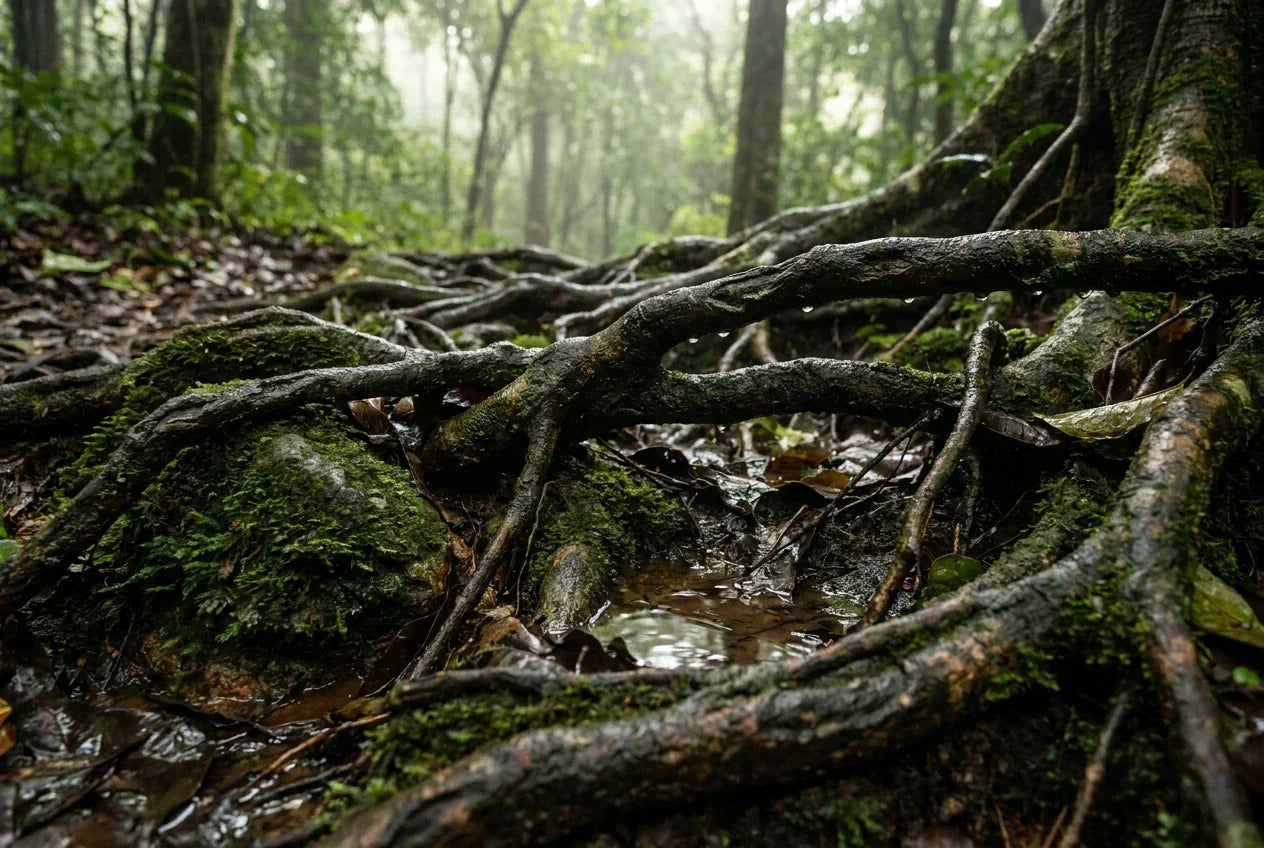
A root remains dark with moisture. A pocket of moss has swollen into a soft green cushion. Water lingers inside a hollow branch. Small pools collect where roots cross the ground.
The rain has left.
Its influence remains.

Walk through enough forests and a pattern begins to emerge. Some of nature's most interesting moments do not happen during an event. They happen afterwards.
A fallen pod slowly disappearing beneath moss. A branch being reclaimed by fungi. A forest floor responding to rain long after the clouds have moved on.
Episode 1 explored the idea of the Micro-Moment: a small scene that feels larger than the space it occupies. This chapter begins with a different observation.
Nature rarely stays still.
Even when it appears motionless, something is usually changing.
The Difference Between Water and Rain
There is a tendency to think of rain simply as water falling from the sky. Nature treats it very differently.
Rain is less an object than a trigger. The moment it arrives, the landscape begins responding. A broad leaf bends beneath the sudden weight. Water gathers inside bark crevices that were dry only moments earlier. Dark roots begin carrying moisture through hidden pathways. Small depressions fill. Temporary pools appear.
The forest shifts into a different state.
This is why rain feels so different from a pond, a reservoir, or even a stream. Water can exist without changing anything. Rain almost always changes something. And that change is often what we remember.
Not the droplet itself.
The response it created.
Many ecosystems in glass capture the appearance of nature exceptionally well. The moss is healthy. The roots are carefully placed. The hardscape feels believable. Everything looks correct.
Yet after a few minutes the observer has already understood the entire scene. Nothing new is happening. Nothing arrives. Nothing leaves. Nothing transforms.
The enclosure becomes a photograph.
Beautiful, but complete.
Rain introduces a different possibility. Not movement for the sake of movement. Not a feature. Not a permanent waterfall. A sequence.
Something happens. The landscape reacts. The evidence remains. The observer returns later and finds a slightly different world waiting behind the glass.
The most memorable ecosystems are often not the ones with the largest features. They are the ones that reward a second look.
And then a third.
And then another tomorrow.
Motion Creates Scale
A puddle reveals itself immediately. You see its boundaries and understand its size.
A droplet moving through a root network behaves differently. Your eye follows it as it disappears beneath bark, reappears somewhere unexpected, pauses inside a moss cushion, then collects before moving again.
The journey becomes larger than the distance itself.
A single centimetre can begin feeling like a landscape. Movement stretches space. That is why a dripping root can sometimes feel larger than a waterfall.
The waterfall explains itself immediately.
The drip asks you to wait.
Practical Translation
A root does not need to carry much water to create this effect. A slow drip travelling through moss, bark, leaf litter, or a hidden channel often feels more natural than a large permanent waterfall.
The goal is not volume.
The goal is anticipation.
The Monsoon Loop
Most people notice the rain. Nature often notices what happens afterwards.
Walk through a forest immediately after a storm and everything appears busy. Water is still dripping from branches. Small channels carry runoff through the leaf litter. Surfaces shine beneath the remaining moisture.
Return several hours later and the scene becomes quieter. The rain is gone, yet traces of the event remain everywhere.
A root remains darker than the soil around it. A patch of moss still holds yesterday's moisture. A hollow branch continues releasing the occasional droplet. A temporary pool shrinks toward its edges.
The landscape remembers.
Not emotionally, but physically.
Nature records events in subtle ways. Rain leaves evidence. Floods leave evidence. Falling leaves leave evidence. Even the movement of animals leaves evidence. The forest floor is filled with traces of things that happened hours, days, or weeks before.
Once you begin noticing these traces, it becomes difficult to stop. You start seeing the history of a place instead of merely its appearance.

This idea has consequences for ecosystem design.
Many layouts focus entirely on the moment water is visible. The waterfall. The stream. The splash. The movement.
Nature often finds the aftermath more interesting.
The damp bark. The darkened root. The moss that remains swollen long after the storm. The temporary pool slowly pulling away from its own edges.
The event itself may last minutes.
The memory of the event may last hours.
Sometimes longer.
Temporary Things Feel More Real
Nature rarely operates at maximum output. Streams rise and fall. Puddles appear and disappear. Wet stone slowly dries back to grey. Flooded roots gradually emerge again.
Many of the most convincing natural scenes are temporary. They exist for a while, then leave.
The observer arrives between those moments and pieces together what happened: a dark trail across bark, a wet patch beneath a root, a moss shelf still glistening in shadow.
The event is gone.
The evidence remains.
That lingering trace often feels more natural than the event itself.
Practical Translation
Water does not always need to remain visible. A damp trail disappearing beneath roots, moisture trapped inside bark cavities, or a moss-covered branch slowly releasing stored water can often create a stronger sense of realism than a permanent waterfall.
Designing for the memory of an event is often more powerful than designing for the event itself.
Why The Animals Care
A landscape may remember rain. The animals notice it.
A springtail does not understand aesthetics. It does not care whether a branch was positioned beautifully or whether the moss follows a pleasing composition.
It responds to opportunity.
A wall that was dry this morning may now support fresh biofilm. A damp pocket beneath bark may suddenly become suitable shelter. A temporary pool may provide access to moisture that did not exist yesterday.
The same pattern appears throughout nature. Frogs emerge when conditions shift. Crabs leave their shelters when humidity rises. Isopods become active when moisture returns to the forest floor.
The trigger is often not the object.
It is the transition.

This is one of nature's most reliable forms of feedback. Animals do not validate a design because it looks natural. They validate a design because it behaves naturally.
The moment life begins responding to a change in conditions, the architecture becomes more than decoration.
It becomes habitat.
The Biological Receipt
A root may look natural. A piece of bark may look natural. A temporary pool may look natural.
Appearance alone proves very little.
The real test arrives when living things begin using those spaces: a springtail feeding along a damp wall, an isopod sheltering beneath newly saturated leaf litter, a crab waiting beside a shrinking pool.
These are not decorations.
They are receipts.
Evidence that the landscape is functioning as more than a display.
Looking Beyond Rain
Once you begin noticing transitions, you start seeing them everywhere.
A monsoon is only one example. The same principle appears throughout nature.
A tidal pool fills and empties twice each day. Morning fog settles across a landscape before disappearing beneath the sun. A dry streambed floods for a few hours before returning to silence. Leaf litter accumulates through one season and slowly disappears through the next.
Even forests themselves operate through cycles of growth, decline, disturbance, and recovery.
Nature rarely remains fixed.
The environments we remember most clearly are often those caught somewhere between one state and another: a shoreline at low tide, a riverbank after flooding, a forest floor after rain, a moss-covered log midway through decay.
These places feel alive because they are in the process of becoming something else.

The lesson of this chapter was never really about rain. Rain simply makes the principle easier to see.
The deeper lesson is that ecosystems become interesting when they change.
Objects can be beautiful.
Transitions create stories.
And stories are what bring people back.
The Observer Should Return
A photograph is understood once. A landscape can be revisited.
One of the quiet differences between decoration and ecosystem design is the presence of anticipation.
The observer wonders what has changed. Has the pool disappeared? Did the moss remain swollen? Have the animals emerged? Is the branch still dripping?
The enclosure stops being something that is merely viewed.
It becomes something that is revisited.
Good design rewards attention.
The best design rewards attention repeatedly.
Practical Translation
Many memorable ecosystems are built around slow changes rather than dramatic features. A damp root that dries throughout the day. A temporary pool that slowly recedes. A moss shelf that stores moisture long after rainfall has ended.
These small transitions often create a stronger sense of life than any permanent display feature.
Master Class Check
Episode 1 asked us to stop building landscapes and start noticing moments. The Fallen Pod showed that a small scene can feel larger than the space it occupies.
This chapter asks a different question.
What happens after the moment?
How does a landscape respond?
What traces remain behind?
The next time you walk through a forest after rain, pay attention to the evidence: the darkened roots, the lingering pools, the swollen moss, the damp trail running beneath a fallen branch.
The rain may already be gone.
The landscape is still telling the story.
And perhaps the most useful question for any ecosystem builder is not:
How do I add water?
But:
What happens after it arrives?
If the pump stopped tomorrow, would anything interesting still happen?
If the answer is no, you built a machine.
If the answer is yes, you built a system.
And systems, much like forests, are always becoming something new.


