
The Living Blueprint #01: The Fallen Pod
This article is part of Chronicles of the Glass Cage, a collection of explorations into nature, imagination, ecosystems, and the worlds we carry in our minds. Each chapter begins with a question, an observation, a memory, or a possibility, then follows where that path leads.
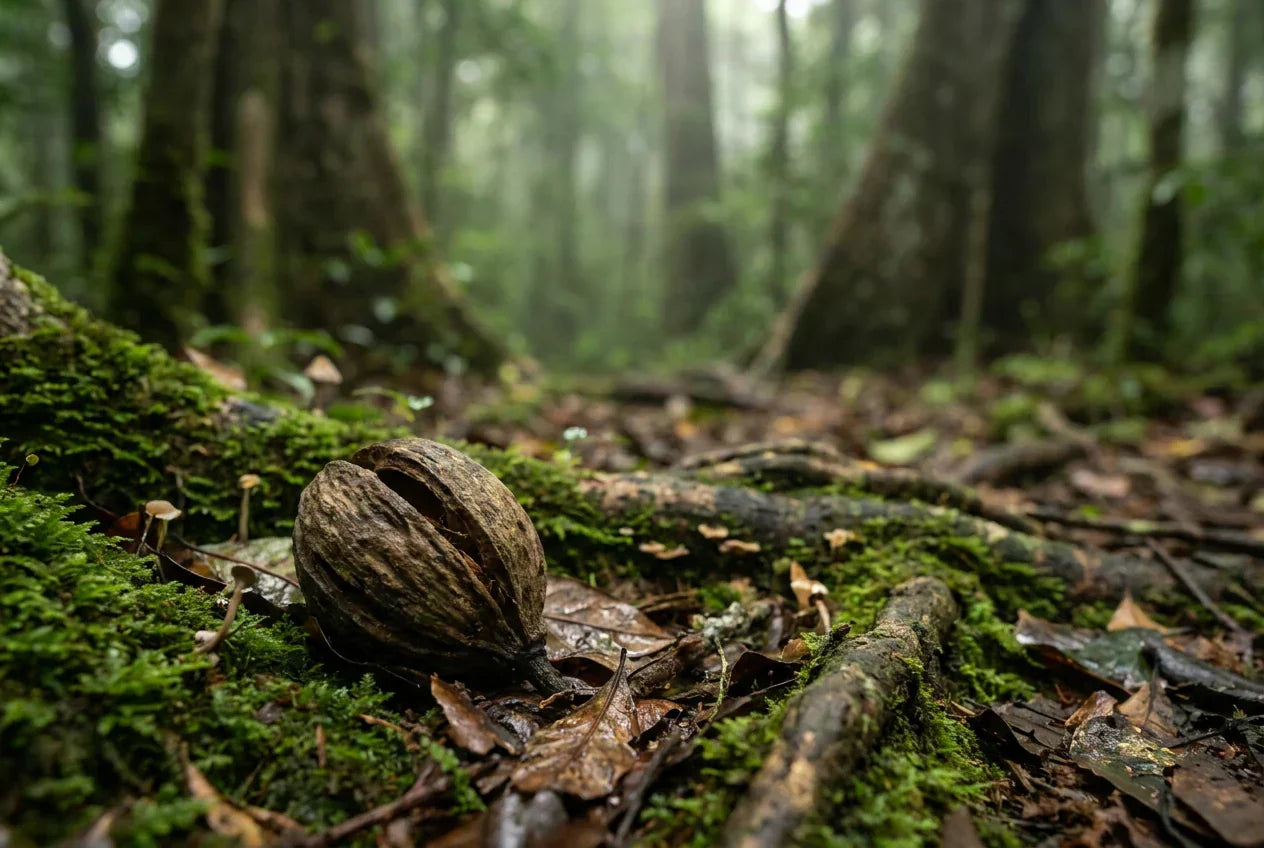
The Fallen Pod
Designing Micro-Moments Over Mountains
Prelude: I Wish This Existed. Let's Make It Happen.
Most people who build terrariums, aquariums, paludariums, and vivariums begin with the same instinct. We see something beautiful in the wild and immediately wonder if it can be recreated.
A misty rainforest valley disappearing into the canopy.
A volcanic mountain ridge fading into low cloud.
A slow blackwater swamp forest stretching beyond sight.
A river cutting through stone.
Then you look down at the table.
The enclosure sitting in front of you is not a river valley or a mountain range. It is an empty glass box measured in centimetres.
Yet some of the most convincing ecosystems ever built fit comfortably inside those exact limits. Why? The answer has very little to do with size.
Nature's most powerful design lessons are often hidden inside small moments that most people walk straight past. A root disappearing beneath moss. A branch slowly being reclaimed by fungi. A pocket of leaf litter trapped against a fallen log. A seed pod quietly becoming part of the forest floor.
The Living Blueprint is an archive of these moments.
Each chapter begins with a small moment and asks a simple question: Why does this scene feel so believable?
The first lesson begins with a fallen pod.
Episode 01: The Fallen Pod — Designing Micro-Moments Over Mountains

Walk through enough forests and a pattern begins to emerge. The features that dominate the landscape are not always the features people remember.
Visitors photograph waterfalls, cliffs, giant trees, and mountain ridges because they are impossible to ignore. Yet when people describe a memorable day in nature, the conversation often drifts toward something much smaller.
A mushroom growing from a fallen branch.
A frog hidden beneath bark.
A hollow log disappearing into darkness.
A seed pod slowly being reclaimed by moss.
The memory becomes more focused as it becomes more personal. Somewhere between noticing a landscape and discovering a detail, the relationship changes.
The scene no longer feels like scenery.
It feels like a secret.

Think about the last time you walked through a nature reserve, a forest trail, a mangrove boardwalk, or a riverbank. What actually stayed with you afterward?
Most people remember details. The twisted root that looked like a sculpture. The strange insect hiding beneath a leaf. The hollow branch that seemed to contain an entire world.
Nature rarely reveals its best stories from a distance. They tend to appear when you slow down.
The Problem with Miniature Mountains

Once you start paying attention to small moments, another pattern begins to emerge. Many of the most convincing naturalistic layouts are not attempting to recreate a landscape at all. They are preserving a fragment of one.
Most naturalistic builders begin from the opposite direction. We see a rainforest valley and try to recreate the rainforest valley. We see a volcanic ridge and try to pile rocks until we duplicate the ridge. We attempt to compress an entire landscape into an enclosure sitting on a table.
For a few weeks, the layout looks convincing. Then the plants grow.
The moss spreads. Leaves expand. Vines begin to traverse the open spaces. The carefully arranged hardscape slowly becomes buried beneath the natural tendency of life to claim territory.
Within months, the original idea fades. The proportions warp, the depth flattens, and the visual illusion collapses.
The problem is how we think about scale.
Some landscapes are simply too large to shrink successfully. A mountain is impressive because of its physical volume. A forest is impressive because of its complexity. The moment we compress those macro-experiences into a small glass box, we strip away the exact qualities that made them interesting in the wild.
The Rule of the Anchor
A mountain asks every object around it to support the illusion of a mountain. A pod asks very little.
A leaf can be larger than a pod. A patch of moss can grow over it. A root can partially bury it. Nothing breaks the scale because the scene already exists at the scale we are trying to preserve.
When choosing an anchor, look for objects that already feel complete on their own. A hollow branch, a weathered stone, a root cavity, or a fallen pod can each support an entire story without requiring the rest of the landscape to be recreated.
Why Questions Are Stronger Than Answers

A miniature mountain range tells its entire story immediately. You look at it, your brain registers a pile of rocks, and your eyes move on. It is a statement. It is a closed book.
A fallen seed pod behaves differently. It does not offer answers; it presents a series of quiet, unresolved questions. How long has it been wedged between those roots? What occupies the darkness inside its hollow core? What happens to the creatures inside when water drops from the leaves above?
The layout stops being something you look at. It becomes something you explore.
This is where the real power of design sits. A display says: Here is everything. A discovery says: Come closer.
When every feature of an ecosystem is pushed flush against the front glass and flooded with bright light, the observer's curiosity is removed. True micro-moments rely on the physical architecture of occlusion. Parts of the story are hidden so the scene cannot be fully understood from across the room.
The moment you hide a visual line, the behaviour of the person standing in front of the glass changes. They do not just stand back and view scenery. They lean forward. They tilt their head to see around a root shard. They look behind a stone, crouch a little, and return for a second look.
The best layouts create physical movement in the observer. By asking them to change their posture to solve a visual puzzle, you have turned an observer into an explorer.
Hidden Space vs. Visible Space
Many builders try to show everything. Nature rarely does.
A root disappears beneath moss. A branch vanishes beneath leaf litter. A burrow entrance curves out of sight.
The missing part becomes part of the story. When a viewer cannot fully see a space, they begin imagining it. That imagined space is often larger than the enclosure itself.
A partially hidden cavity can feel deeper than a fully visible one. A tunnel entrance can feel longer than the actual tunnel. A pod opening facing slightly away from the front glass often feels more mysterious than one facing directly forward.
The goal is not to hide everything. The goal is to leave something undiscovered.
The Forest Floor is the Real Teacher

Many hobbyists spend years studying towering waterfalls, mountain paths, and canopy trees. The forest floor often contains better lessons.
This is where decomposition becomes growth. Where moisture is trapped. Where shelter is created. Where nutrients are recycled. Where countless small organisms spend their entire lives.
The pod is only one example. Once you begin looking for micro-moments, they appear everywhere. A piece of bark lifting away from a branch. A flooded leaf pocket after rain. A tunnel beneath exposed roots. A cluster of moss surrounding a decaying twig.
Nature is full of scenes that would be easy to step over and surprisingly difficult to forget.
When Decoration Becomes Habitat

The organisms you place inside an enclosure do not care about your design principles. They do not care about composition, balance, or the aesthetic weight of a rock.
They care about opportunity.
A hollow space that remains damp long after the surrounding surface has dried. A pocket of leaf litter that traps food. A sheltered cavity where movement can happen completely out of sight. The pod creates all of these things without trying. That is why life gathers around it.
A few springtails appear first. Then more. Tiny white specks moving across the damp interior surfaces. A patch of fungi begins working through the fibres of the wood. Moss establishes itself where moisture remains longest. An isopod disappears into a crack and emerges hours later from somewhere completely different.
The scene starts changing. Not because the builder adjusted it.
Because biology accepted it.
Good design is not validated by appearance. It is validated by use. A beautiful hollow that nothing occupies is merely decoration. A simple cavity that becomes part of daily animal behaviour is architecture.
A small frog may never spend its entire life inside the pod. That is not the point. The frog pauses there because the conditions are useful, the same way a traveller might stop beneath a tree during rain. The pod has become part of the landscape.
And the moment an animal begins making decisions around a structure, the structure stops being decoration. It becomes habitat.

The Saturated Edge
In nature, moss rarely grows evenly. One side of a branch remains damp. The other dries more quickly. A hollow collects water. An exposed edge catches sun.
Over time, these differences become visible. The structure begins telling a story about where water travels, where shade lingers, and where life finds a foothold.
When observing fallen pods, root cavities, or weathered bark, pay attention to these uneven patterns. They often reveal more about the history of a place than the object itself.
Looking Beyond the Pod

The lesson of this chapter has very little to do with seed pods. It is about attention.
Many builders spend months searching for the largest rock, the most dramatic branch, or the rarest plant, while completely overlooking the tiny scenes that make nature feel alive.
The next time you walk through a forest, a local park, a mangrove boardwalk, or a riverbank, slow down. Look near your feet. Ignore the horizon. Ignore the biggest tree.
What small scene makes you stop? What detail feels like it contains an entire world?
A weathered stone wedged into a muddy bank. A loose strip of bark lifting away from a branch. A flooded pocket of leaves after rain.
That moment might be your next project. Because the most convincing ecosystems rarely begin with grand scale.
They begin with observation.
Master Class Check
Choose one natural object—not a landscape, not a habitat—just one object. A pod, a root, a hollow branch, or a single stone.
Now ask yourself: What would happen if the entire enclosure was designed around that single moment? Not around the landscape it came from, but around the story it is already telling?


