
The Living Blueprint #04: The Forgotten Layer
This article is part of Chronicles of the Glass Cage, a collection of explorations into nature, imagination, ecosystems, and the worlds we carry in our minds. Each chapter begins with a question, an observation, a memory, or a possibility, then follows where that path leads.
The Forgotten Layer
Designing Clues Instead of Explanations
Prelude: The Landscape of Fragments

Walk into an old woodland and you will notice something strange.
Nature rarely presents anything in full.
You do not see an entire tree. You see a massive trunk rising into a canopy too dense to read.
You do not see a complete root system. You see one thick root breaking through the soil, curving around a stone, then disappearing beneath leaf litter.
You do not see the whole river. You see dark water bending behind ferns, roots, and fallen branches.
The wild is a landscape of fragments.
Yet those fragments do not feel incomplete.
They feel larger than what we can see.
A root that disappears beneath a stone still feels anchored deep into the earth. A stream that bends out of sight still feels like it continues. A hollow beneath a tree still feels occupied, even when nothing moves inside it.
The mind does not need the whole picture.
It only needs enough clues to believe the world continues.
The Problem With Explaining Everything
In a glass enclosure, the beginner's instinct is often to show too much.
We want to show the whole branch, so we place it in the centre. We want to show every plant, so we clear space around it. We build open paths, bright slopes, visible caves, and clean backgrounds.
Everything can be seen.
Everything can be understood.
Everything has an ending.
That is the problem.
When the eye can trace every root to its tip, every stone to its base, and every hollow to its back wall, the scene becomes smaller. The viewer stops exploring because every question has already been answered.
A display explains itself.
A place leaves clues.
Nature rarely says, "Here is the whole thing."
It shows part of the root. Part of the stream. Part of the hollow. Part of the path.
The rest is completed quietly by the mind.

This is why a small woodland hollow can feel deeper than a wide open slope.
The hollow does not show more space.
It suggests more space.
The End of the Line
A strong visual line creates expectation.
A root crossing moss. A branch leaning through shadow. A path moving between stones.
The eye follows because it expects the line to continue.
If the line ends in full light against a flat surface, the journey stops. The viewer understands the boundary immediately.
The world has ended there.
This is why exposed back walls, flat background panels, and fully visible branch tips can make an enclosure feel smaller than it really is.
The eye has reached the edge.

The Hollow
A hollow is not just an empty space.
A hollow is a place where the eye cannot find the ending.
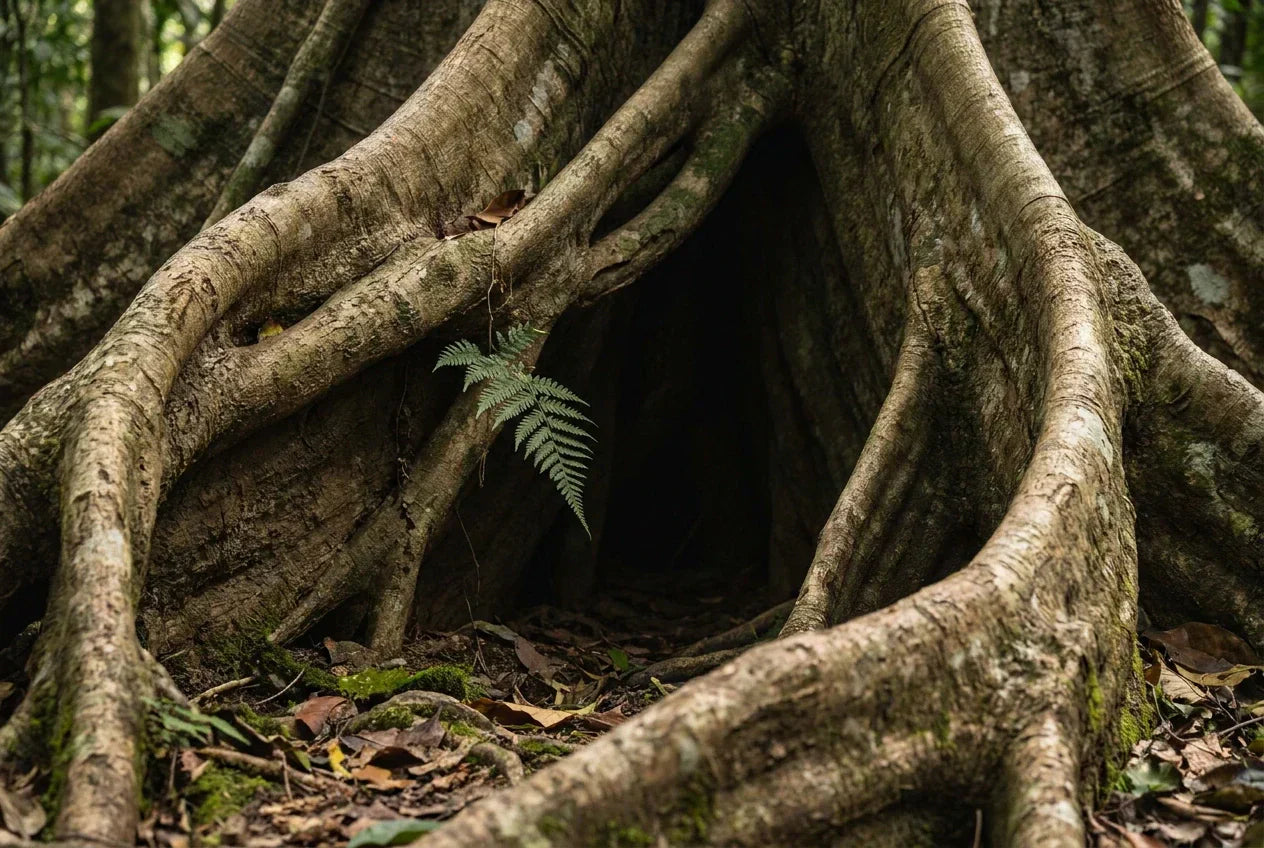
Look at the base of an old tree after rain. The roots fold over one another. Soil collects in the deeper pockets. Leaf litter gathers at the entrance. Light reaches the front, then weakens as the space bends inward.
Nothing dramatic is happening.
But the eye slows down.
The front of the hollow is clear. The bark is textured. The leaf litter is visible. A small fern may hang over the edge.
Then the information begins to fade.
The space narrows.
The light drops.
The back of the hollow disappears.
This is where depth begins.
Not because the hollow is physically large, but because the viewer cannot measure it completely.
Nature rarely reveals where things end.
That is one of its strongest design lessons.
The Funnel, Not The Wall
A dark corner is not automatically depth.
If the viewer can see the flat back wall, the illusion fails. The shadow becomes a dead end.
A real hollow usually behaves more like a funnel.
The entrance is readable. The middle becomes tighter. The back turns away from the eye. Light becomes weaker as the space recedes.
When building this feeling inside glass, avoid placing hardscape flat against the back like a wall. Let roots, stones, or bark pieces angle away from the viewer as they move inward.
The goal is not to make a black hole.
The goal is to let the eye lose the ending naturally.

Clues Instead of Explanations
To design with depth, you do not need to hide everything.
You need to show the right things.
A dead leaf caught at the mouth of a hollow.
A root dipping into shadow.
A damp patch just inside a dark pocket.
A line of moss that fades where the light cannot reach.
These are clues.
They tell the viewer that something continues beyond sight.
This is very different from leaving an empty black space.
An empty black space says nothing.
A hollow with clues suggests history, direction, and use.
The viewer begins to imagine what lies behind the visible edge. The space becomes larger because the mind is allowed to finish the story.
In a small enclosure, this matters more than people think.
You cannot create endless distance inside a glass box.
But you can create the feeling that the world continues beyond the part being shown.
That feeling is depth.
Not distance.
Depth.
When The Animal Leaves Our View
A hollow does not need an animal to become interesting.
It should already feel like a place before anything enters it.
The animal simply confirms what the viewer already believes.
Watch a crab move along a shadowed crevice and slip beneath a low root. Watch a small gecko pause at the entrance of a hollow, then vanish behind bark. Watch an isopod disappear beneath a folded leaf where the back of the space cannot be seen.
If the design is flat, the illusion breaks immediately.
The animal reaches the back wall.
The world ends.
But if the hollow narrows, turns, and disappears into shadow, the feeling changes. The animal does not look trapped. It looks like it has returned to somewhere private.
By leaving our view, it makes the space feel larger.

This is not about hiding animals from people.
It is about giving the landscape somewhere to continue.
A place becomes more believable when not every part of it belongs to the viewer.
Private Space Creates Public Depth
A habitat that shows everything can feel like a stage.
A habitat with true private space feels like a world.
The difference is not darkness alone. It is whether the unseen area feels connected to the visible one.
A root entering shadow. Leaf litter gathered at the entrance. Moss fading toward the back. These details help the viewer believe the hidden space belongs to the same landscape.
The animal benefits from the shelter.
The viewer benefits from the mystery.
Looking Beyond The Hollow
The hollow is only one example.
The same principle appears everywhere in nature.
A stream disappears under a fallen log.
A trail bends behind tall grass.
A crack in a rock face becomes too narrow to see into.
A root runs across the surface, then sinks beneath the soil.
Each one gives the eye a beginning, then removes the ending.
That is enough.
The Forgotten Layer is not about making things dark.
It is about knowing when to stop explaining.

Once you begin noticing hollows, you start seeing them everywhere.
Not as empty spaces.
As unfinished sentences.
Places where the landscape trusts the viewer to continue the thought.
Master Class Check
Episode 1 asked us to stop building landscapes and start noticing moments.
Episode 2 asked us to stop building objects and start noticing events.
Episode 3 asked us to stop building piles and start noticing structure.
This chapter asks us to stop explaining everything.
Look at your current layout.
Can the eye follow every root to its tip?
Can it see the back of every hollow?
Can it trace every path to the wall?
If yes, the enclosure may be beautiful.
But it has answered every question.
The final check is simple.
If a creature disappeared behind your hardscape, would you believe there was somewhere for it to go?
If the answer is no, the animal has reached the edge of the world.
If the answer is yes, you have built more than a display.
You have built a place that continues beyond sight.


