
Experimental Ecosystem Builds — Part 4: Building The Bioluminescent Night-Mode Canopy
This article is part of Chronicles of the Glass Cage, a collection of explorations into nature, imagination, ecosystems, and the worlds we carry in our minds. Each chapter begins with a question, an observation, a memory, or a possibility, then follows where that path leads.
In the earlier parts of this series, we explored:
- floating ecosystems
- waterfall humidity systems
- suspended jungle bridges
- drifting fog chambers
- magnetic ecosystem engineering
But eventually, another question appears:
What happens when the environment transforms at night?
This is where the Bioluminescent Night-Mode Canopy begins.
Instead of treating lighting as simple illumination, we begin using light itself as environmental atmosphere.
The goal is not:
- RGB gaming setups
- cyberpunk neon
- fantasy sci-fi lighting
The goal is something softer.
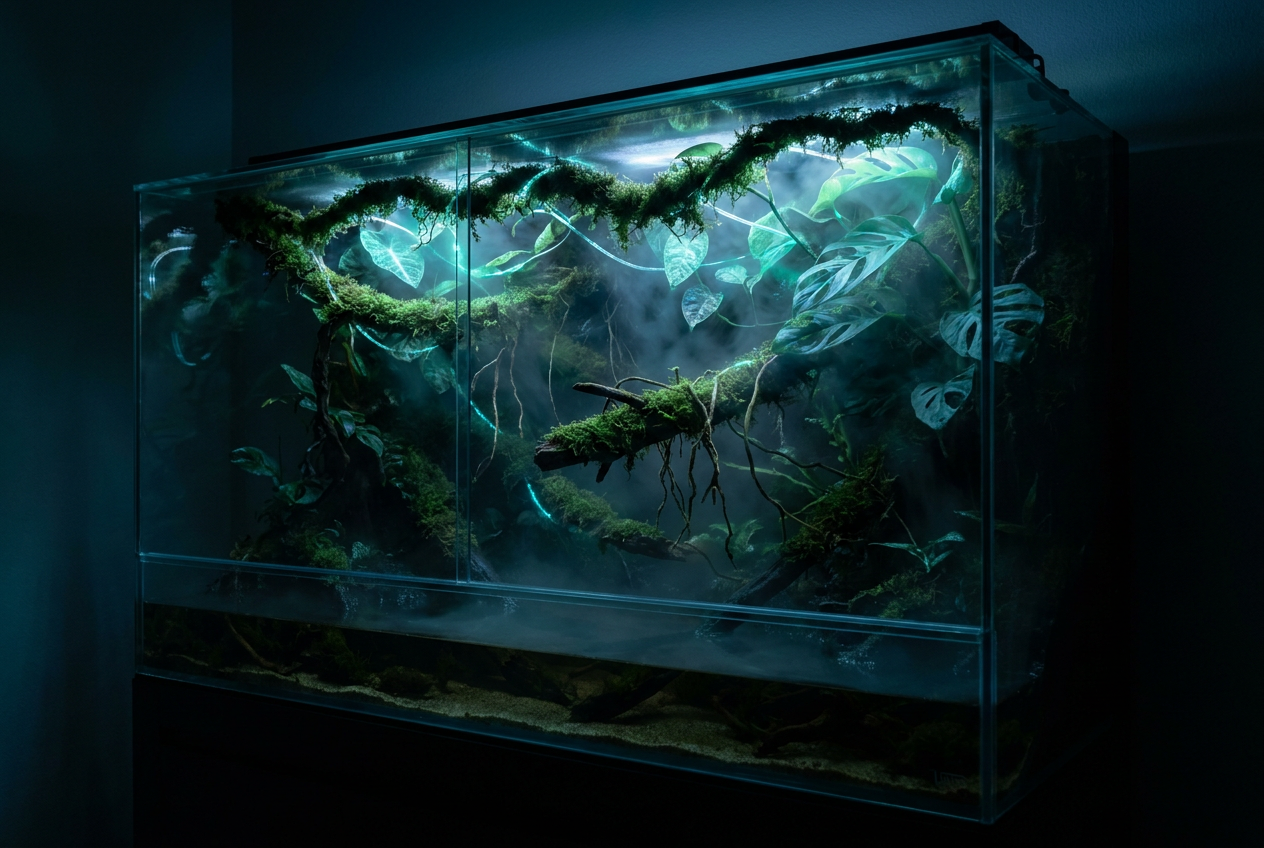
A suspended rainforest canopy that glows subtly after dark.
Humidity drifting beneath illuminated vines.
Translucent leaves catching hidden light.
Fog slowly revealing environmental depth.
The result feels less like decorative lighting — and more like entering an entirely different ecosystem after sunset.
Why Night Lighting Changes The Entire Ecosystem Emotionally

Daytime ecosystems feel:
- fresh
- natural
- vibrant
- botanical
But nighttime ecosystems trigger something completely different psychologically.
The enclosure suddenly becomes:
- immersive
- mysterious
- cinematic
- atmospheric
- calming
Even tiny lighting changes can dramatically affect how “deep” the environment feels.
Especially once:
- fog begins catching light
- roots disappear into darkness
- reflections soften
- leaves glow from behind
- suspended bridges fade into shadow
The ecosystem starts feeling larger than the glass enclosure itself.
Why Fiber Optics Work Better Than Visible LEDs

One major mistake beginners make is exposing visible LED strips directly inside the enclosure.
That usually creates:
- harsh hotspots
- artificial glow
- visible hardware
- unrealistic lighting
Fiber optics solve this beautifully.
Instead of placing electricity directly inside the ecosystem, the lighting engine remains outside the enclosure while only light travels through the fiber optic strands.
This creates:
- safer humid environments
- softer illumination
- hidden lighting sources
- more natural environmental glow
The result feels less like:
“lights installed in a tank”
and more like:
“the ecosystem itself is glowing.”
Why Side-Glow Fiber Creates Better Jungle Veins

Standard fiber optics usually emit light only from the tip.
But side-glow fiber optics leak light gently along the entire cable length.
This is extremely useful for ecosystem vines.
Once wrapped beneath:
- Hygrolon
- moss
- bark texture
- climbing plants
the vine begins glowing softly through tiny gaps and cracks.
The effect resembles:
- bioluminescent roots
- rainforest fungal veins
- glowing jungle fissures
- illuminated humidity channels
But importantly:
the lighting remains subtle.
That restraint is what keeps the ecosystem believable.
Why The Lighting Must Stay Hidden

The illusion completely breaks once viewers can see:
- LED bulbs
- exposed wiring
- bright light strips
- glowing hardware
The ecosystem should never feel:
“electronically decorated.”
Instead, the light source should remain mysterious.
The best builds hide lighting:
- beneath Hygrolon
- inside synthetic vines
- behind bark textures
- under moss edges
- beneath climbing plants
This creates:
- indirect glow
- environmental diffusion
- soft atmospheric lighting
- layered visual depth
The viewer should feel:
the environment itself is emitting light.
Why Fog Becomes More Important At Night

Fog behaves completely differently under nighttime lighting.
During daytime:
fog mainly adds humidity and softness.
At night:
fog becomes visible atmosphere.
Light suddenly reveals:
- drifting air currents
- suspended depth
- environmental layering
- hidden structure silhouettes
Especially beneath suspended bridges or floating islands, illuminated fog creates the illusion that entire sections of the ecosystem are hovering above clouds.
This is one reason restrained fog usage works best.
Too much fog destroys visibility.
Gentle layered fog creates mystery.
Why Certain Plants React Beautifully To Night Lighting

Some tropical plants become dramatically more interesting under low directional lighting.
Especially:
- Oil Fern (Microsorum thailandicum)
- Peacock Begonia (Begonia pavonina)
- Jewel Orchids
- Marcgravia
- translucent miniature aroids
These plants:
- reflect light differently
- reveal leaf veins
- shimmer subtly
- glow around edges
- create layered textures
Instead of using brightly colored artificial decor, the ecosystem uses the plants themselves as part of the nighttime lighting effect.
That keeps the environment feeling biological instead of artificial.
Why Overlighting Ruins The Entire Illusion

One of the biggest mistakes in bioluminescent-inspired builds is making everything too bright.
Real nighttime ecosystems are:
- dim
- soft
- partially obscured
- shadow-heavy
Darkness itself becomes part of the composition.
If every corner glows brightly:
- depth disappears
- mystery disappears
- humidity layering weakens
- the enclosure starts feeling artificial
The strongest night-mode ecosystems usually illuminate only:
- selected vine sections
- fog layers
- root silhouettes
- translucent leaves
- partial reflections
The shadows do the rest.
Why The Environment Should Feel Alive — Not Sci-Fi

It is very easy for glowing ecosystems to accidentally become:
- cyberpunk
- alien
- nightclub-like
- overdesigned
That is NOT the goal of this series.
The strongest builds still feel:
- rainforest-inspired
- humid
- natural
- physically believable
- ecosystem-driven
Even with glowing vines and illuminated fog, the environment should still feel biologically grounded.
The lighting should support the ecosystem.
Not overpower it.
Start Small Before Building A Full Night Canopy

You do not need to immediately illuminate an entire ecosystem.
A single glowing vine experiment already teaches:
- light diffusion
- fog interaction
- hidden cable routing
- moisture-safe positioning
- nighttime atmosphere
- environmental depth
Small prototypes are extremely useful because lighting behaves very differently once humidity, reflections, moss, and fog interact together.
Experimentation is the entire point.
In Part 5:
The Sunken Ruin Shattered Pillars

In the final chapter of this series, we shift away from suspended jungle vines and move into floating ancient architecture.
Using magnetic pillar fragments, carved foam rock structures, moss fissures, and reclaimed ruin aesthetics, we create ecosystems that feel like ancient floating civilizations slowly being reclaimed by nature.
Part 5 explores:
- floating shattered pillar systems
- magnetic architectural fragments
- carved rock textures
- moss fissure growth
- vertical floating ruin composition
- environmental storytelling through structure
Final Thoughts

The Bioluminescent Night-Mode Canopy is not really about lighting.
It is about environmental transformation.
The same ecosystem suddenly becomes:
- calmer
- deeper
- softer
- more atmospheric
- more immersive
And once fog, suspended roots, translucent leaves, and hidden glowing vines begin interacting together, the enclosure starts feeling less like a terrarium and more like a living rainforest environment slowly disappearing into darkness.
That emotional transformation is what makes nighttime ecosystems so powerful.
Continue To The Finale
Across this series, we explored floating ecosystems, waterfall humidity systems, suspended jungle bridges, and glowing nighttime rainforest canopies.
But in the final chapter, the ecosystem stops feeling constructed entirely.
In Part 5: Building The Sunken Ruin Shattered Pillars, we shift into floating ancient architecture reclaimed slowly by moss, roots, fog, humidity, and time.
Using suspended broken pillar fragments, reclaimed stone textures, drifting atmospheric fog, and survivor-style planting, the enclosure begins feeling less like a terrarium — and more like a forgotten rainforest world continuing quietly on its own.


