
Experimental Ecosystem Builds — Part 5: Building The Sunken Ruin Shattered Pillars
This article is part of Chronicles of the Glass Cage, a collection of explorations into nature, imagination, ecosystems, and the worlds we carry in our minds. Each chapter begins with a question, an observation, a memory, or a possibility, then follows where that path leads.
Across this series, we explored:
- floating ecosystems
- waterfall vortex systems
- suspended jungle bridges
- glowing nighttime canopies
But eventually, another idea begins appearing naturally.
What if the ecosystem no longer looked constructed?
What if it looked discovered?
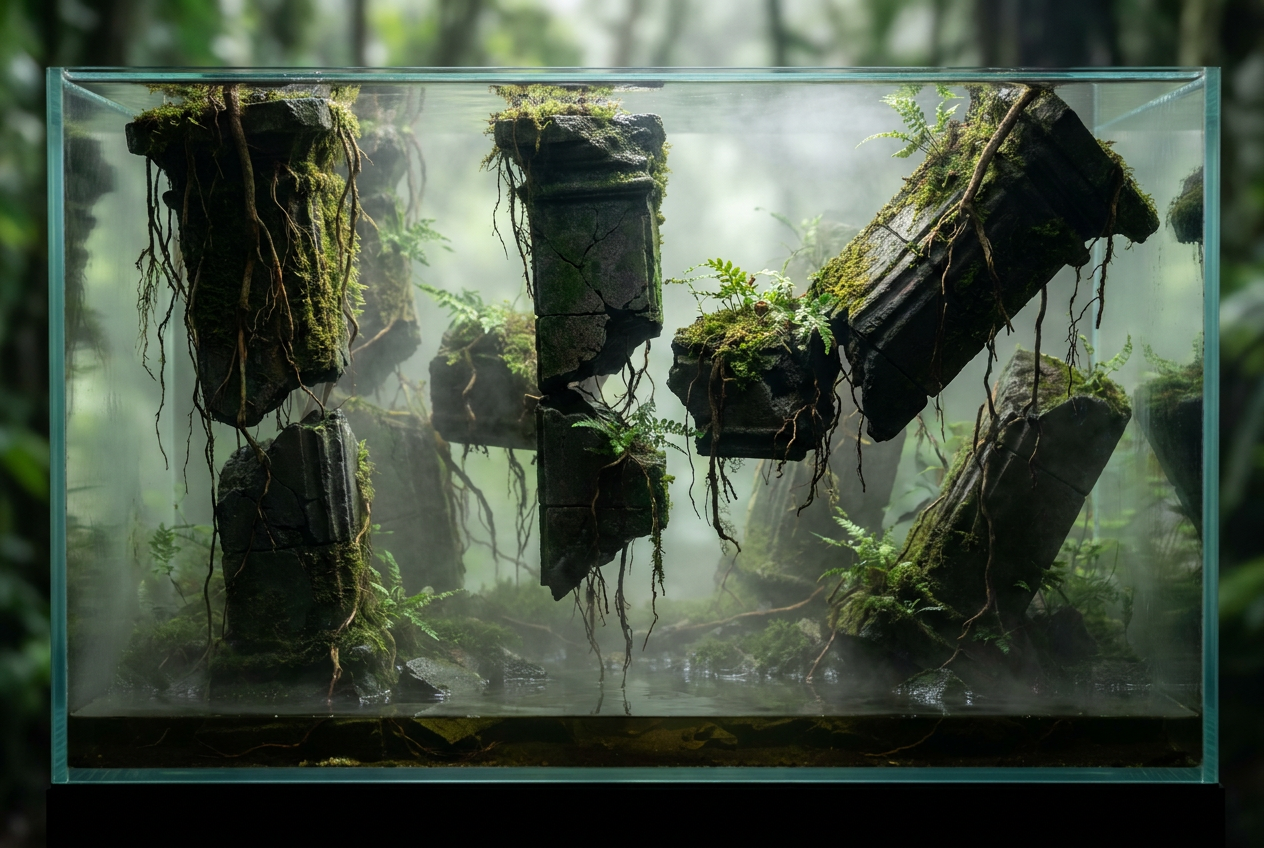
The Sunken Ruin Shattered Pillars shift the visual language completely.
Instead of:
- vines
- roots
- suspended jungle bridges
we now introduce:
- floating stone fragments
- broken ancient pillars
- reclaimed architecture
- moss-filled fissures
- drifting ruin atmospheres
The result feels less like a terrarium build and more like uncovering the remains of a forgotten rainforest civilization slowly disappearing beneath humidity, moss, roots, and time.
Why Broken Structures Feel More Natural Than Perfect Geometry

Perfect symmetry rarely feels natural inside ecosystems.
Nature:
- cracks
- shifts
- collapses
- erodes
- reclaims
Broken structures immediately create:
- tension
- movement
- realism
- environmental storytelling
Especially once pillar fragments:
- tilt slightly
- separate unevenly
- drift apart visually
- cast layered shadows
the enclosure suddenly feels:
older and larger.
Even empty gaps between fragments become part of the atmosphere.
Why Floating Ruins Feel Heavier Than Floating Islands

Floating islands feel lightweight and organic.
Ruins feel ancient and massive.
This psychological difference is extremely important.
Even though the structures are secretly lightweight foam and PVC internally, the visual language communicates:
- stone weight
- collapse
- erosion
- age
This creates stronger cinematic presence.
Especially once:
- fog gathers beneath structures
- roots hang downward
- moss softens edges
- shadows deepen between fragments
the pillars begin feeling monument-like instead of decorative.
Why Jagged Separation Creates Better Environmental Depth

The gaps between shattered pillar sections are just as important as the pillars themselves.
Those open spaces create:
- visual breathing room
- layered fog chambers
- negative space
- depth separation
- environmental tension
If all fragments touch perfectly together, the illusion weakens.
Slight offsetting feels much more believable.
Especially when fragments:
- lean slightly
- rotate subtly
- separate asymmetrically
The environment begins feeling suspended in motion.
Almost as if the ruins are still drifting apart.
Why Moss Inside Cracks Feels So Powerful

One of the strongest visual tricks is allowing life to emerge from structural damage.
Moss growing inside:
- fissures
- cracks
- broken edges
- carved seams
creates the feeling that nature is slowly reclaiming abandoned architecture.
This transition is emotionally powerful because the ecosystem stops feeling:
“built by humans.”
Instead, it begins feeling:
“taken back by nature.”
Especially when moss softens:
- sharp geometry
- hard edges
- pillar corners
- broken surfaces
the ruins begin blending naturally into the rainforest environment.
Why Lightweight Foam Works Better Than Real Stone

Many beginners assume real stone creates better realism.
Ironically, lightweight carved foam often works better for suspended ecosystems.
Why?
Because floating structures create leverage stress against glass.
Heavy real stone:
- limits positioning
- increases danger
- reduces flexibility
- complicates magnetic mounting
Foam allows:
- larger structures
- dramatic fragmentation
- safer mounting
- easier carving
- cleaner weight distribution
Once coated properly with:
- grout
- hydraulic cement
- textured paint
- moss
- humidity aging
the illusion becomes surprisingly convincing.
Why Tilted Pillars Feel More Cinematic

Perfectly vertical pillars feel static.
But slightly tilted fragments create:
- movement
- instability
- drama
- environmental storytelling
The ecosystem suddenly feels:
mid-collapse.
This works especially well when:
- upper fragments drift outward
- roots visually reconnect structures
- fog fills the empty spaces
- moss grows unevenly
The enclosure starts resembling a suspended archaeological site slowly dissolving into rainforest humidity.
Why Plants Should Look Like Survivors — Not Decorations

The planting strategy changes dramatically in ruin ecosystems.
Instead of:
- colorful decorative layouts
- dense planted compositions
the plants should feel:
persistent and resilient.
The strongest choices are:
- creeping figs
- mosses
- small ferns
- root-heavy epiphytes
- fissure plants
The growth should appear:
accidental and opportunistic.
As though tiny rainforest species slowly colonized abandoned architecture over decades.
This restraint is what prevents the ecosystem from feeling overly designed.
Why Fog Makes The Ruins Feel Ancient

Fog transforms floating ruins psychologically.
Without fog:
the pillars simply look suspended.
With fog:
the environment gains:
- mystery
- age
- atmospheric scale
- environmental depth
Especially beneath fragmented pillars, drifting fog creates the illusion that the structures disappear downward into unseen space.
The enclosure begins feeling much larger than it actually is.
Subtle fog always works better than dense smoke.
The goal is atmosphere.
Not spectacle.
Why These Ecosystems Feel More Like Worldbuilding

At this stage, the terrarium stops feeling like:
- planted decor
- aquascaping
- traditional enclosure design
Instead, it begins resembling:
environmental storytelling.
Every structural choice now communicates:
- history
- collapse
- survival
- environmental transformation
The ecosystem starts feeling emotionally immersive instead of visually decorative.
And this is where experimental ecosystem building becomes truly powerful.
Looking Back At The Entire Series

Across these five parts, we explored how ecosystems can evolve from simple planted environments into suspended living worlds.
We learned:
- floating ecosystem engineering
- magnetic mounting systems
- humidity layering
- suspended bridges
- hidden lighting
- fog atmosphere
- reclaimed architecture
- environmental storytelling
But perhaps the most important realization is this:
The strongest ecosystems are not the ones with the most expensive materials.
They are the ones that feel:
alive, believable, and emotionally immersive.
Final Thoughts

The Sunken Ruin Shattered Pillars conclude this series by showing something important:
Terrariums do not need to imitate nature literally.
They can interpret it.
Through:
- suspended structures
- drifting fog
- glowing canopies
- reclaimed ruins
- layered ecosystems
we create environments that feel:
part rainforest,
part architecture,
part atmosphere,
and part imagination.
And once roots begin hanging through broken pillars while fog drifts beneath moss-covered ruins, the enclosure no longer feels like a glass box on a table.
It begins feeling like a tiny world continuing quietly on its own.


