
Experimental Ecosystem Builds — Part 3: Building The Eclipse Zero-Gravity Archway
This article is part of Chronicles of the Glass Cage, a collection of explorations into nature, imagination, ecosystems, and the worlds we carry in our minds. Each chapter begins with a question, an observation, a memory, or a possibility, then follows where that path leads.
In Part 2 of this series, we explored floating waterfall ecosystems and suspended rainforest islands.
Now we move into something even stranger.
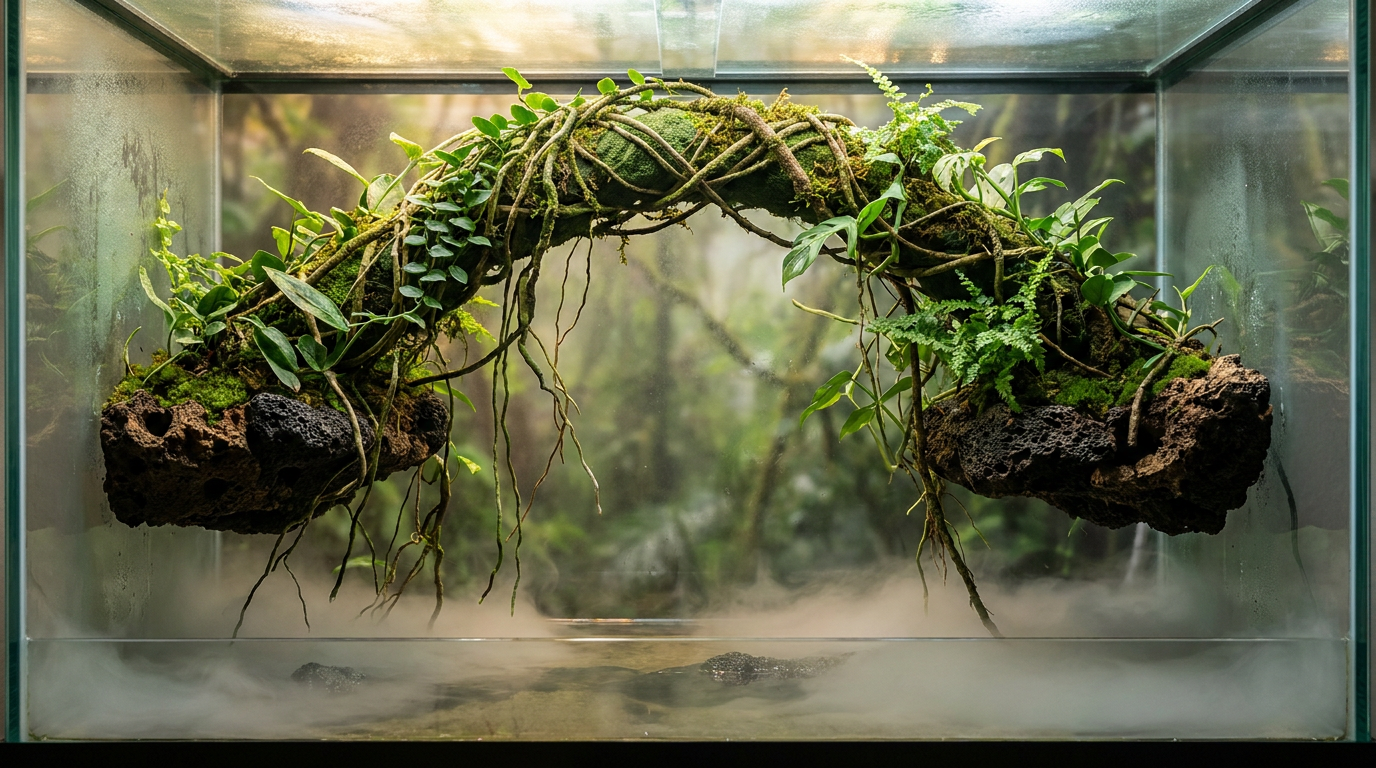
Instead of building one floating structure, we create two independent floating islands connected by a living jungle bridge suspended entirely in mid-air.
At first glance, the structure feels impossible.
A curved suspended archway.
Plants climbing across the bridge.
Roots dangling into open space.
Fog drifting beneath the structure.
But once you understand the engineering logic behind tension, balance, and lightweight materials, the illusion suddenly becomes achievable.
And unlike traditional terrariums where plants simply grow upward from the ground, this ecosystem creates something different entirely:
A suspended living pathway growing across empty air.
Why The Floating Archway Feels So Different

Most terrarium layouts feel grounded.
Even highly planted setups usually rely on:
- substrate
- rocks
- wood
- background walls
The Eclipse Zero-Gravity Archway changes that visual language completely.
Instead of building upward from the ground, the ecosystem begins spanning horizontally through open space.
That changes how the enclosure feels emotionally.
Suddenly the environment feels:
- suspended
- dimensional
- cinematic
- architectural
- alive
The archway becomes more than decoration.
It becomes a living structural spine connecting the entire ecosystem together.
Understanding The Hidden Tension System

The secret behind the archway is tension.
The curved bridge itself helps stabilize the two floating islands.
Instead of acting like a loose hanging vine, the arch behaves like a structural spring.
A thick aluminum armature wire runs through the center of the bridge and locks deeply into both floating islands.
This creates:
- rigidity
- balance
- controlled curvature
- anti-sag support
The result is surprisingly stable once mounted correctly.
And because the bridge distributes force across two mounting points, the ecosystem often feels more secure than single-sided floating builds.
Why Aluminum Armature Wire Works So Well

The archway depends heavily on the right internal structure.
Thin flexible wires usually fail because:
- they sag
- twist
- rotate
- deform under humidity and plant weight
Heavy aluminum armature wire solves this beautifully.
Especially:
- 4 mm
- 5 mm
- or thicker structural armature wire
The wire becomes the skeleton of the ecosystem.
And once covered by:
- foam
- Hygrolon
- bark texture
- moss
- climbing plants
the engineering completely disappears.
The ecosystem begins looking like an ancient suspended jungle root instead of a constructed object.
Why Hygrolon Changes The Entire Build

Without Hygrolon or moisture-wicking fabric, the bridge would mostly remain decorative.
But once the arch is wrapped with:
- Hygrolon
- microfiber fleece
- moisture-retentive fabric
the structure suddenly becomes biologically active.
The bridge now:
- holds humidity
- supports root attachment
- traps moisture
- stabilizes moss
- allows climbing plants to shingle naturally
This is where the arch transforms from:
“hardscape”
into:
“living ecosystem infrastructure.”
Why Climbing Plants Make The Archway Feel Alive

The real magic begins once climbing plants start colonizing the bridge.
Especially species like:
- Marcgravia rectiflora
- Rhaphidophora hayi
- creeping figs
- miniature aroids
These plants naturally seek vertical and horizontal surfaces.
As they slowly spread across the arch:
- leaves begin overlapping
- roots attach into fabric
- moss establishes around stems
- the structure visually softens
Eventually the ecosystem stops looking engineered.
It begins looking grown.
That transformation is one of the most satisfying parts of the entire build.
Why The Archway Should Never Be Perfectly Symmetrical

One beginner mistake is making the bridge too mathematically perfect.
Perfect symmetry often makes ecosystems feel artificial.
Real jungle roots:
- twist
- sag slightly
- shift direction
- fork unpredictably
- vary in thickness
Small asymmetries dramatically improve realism.
Especially:
- uneven curves
- slight directional bends
- irregular root branching
- asymmetrical moss growth
- offset planting pockets
The more organic the structure feels, the more immersive the ecosystem becomes.
Why Dual Floating Islands Create Stronger Environmental Depth

One floating island already creates vertical depth.
But two separated floating islands create:
- environmental tension
- visual framing
- negative space
- layered perspective
- suspended environmental flow
The empty air between the islands becomes incredibly important.
Instead of filling the enclosure completely, the ecosystem now uses negative space as part of the design.
That open space:
- amplifies fog
- highlights suspended roots
- increases visual elevation
- strengthens the floating illusion
Sometimes what you do NOT fill becomes equally important.
Why Magnets Completely Changed Terrarium Engineering

Before strong neodymium magnets became widely accessible, builds like this were extremely difficult.
Most suspended structures required:
- permanent silicone
- visible supports
- bulky frameworks
- awkward suspension rigs
Magnetic systems changed everything.
Now floating islands can:
- slide
- reposition
- detach
- reconfigure
- evolve over time
without permanently locking the ecosystem layout.
This flexibility is incredibly valuable because ecosystems constantly change as plants mature.
Why Fog Works Beautifully Beneath The Archway

The open negative space beneath the bridge creates a perfect fog chamber.
Instead of fog filling the entire enclosure evenly, the archway allows fog to:
- drift
- pool
- separate visually
- frame suspended structures
The result feels cinematic.
Especially once:
- roots hang downward
- moss softens edges
- reflections shimmer below
- humidity layers build gradually
The bridge begins floating above clouds instead of above glass.
Start With A Smaller Arch First

You do not need to immediately build a massive suspended ecosystem bridge.
A smaller experimental arch already teaches:
- tension behavior
- magnet placement
- sag control
- moisture retention
- climbing plant attachment
- fog layering
- structural balance
Even a modest build can completely change how you think about ecosystem design.
And honestly, experimentation is the entire point of this series.
In Part 4:
The Bioluminescent Night-Mode Canopy

In the next article, we move beyond purely physical ecosystems and begin exploring environmental lighting itself.
Using hidden fiber optics and integrated lighting systems, we create synthetic jungle vines that glow softly at night beneath living tropical plants.
Part 4 explores:
- side-glow fiber optics
- hidden lighting integration
- translucent leaf effects
- bioluminescent atmosphere
- nighttime ecosystem transformation
Final Thoughts

The Eclipse Zero-Gravity Archway is not just a floating structure.
It is suspended environmental storytelling.
The bridge creates:
- movement
- direction
- tension
- connection
- atmosphere
- visual flow
And once living plants begin growing across the structure, the ecosystem starts feeling less like an enclosure and more like a suspended jungle corridor evolving over time.
That is the real beauty of these experimental ecosystem builds.
You are not simply arranging plants.
You are designing environments that continue transforming long after the build is finished.


