
Experimental Ecosystem Builds — Part 2: Building The Misty Waterfall Vortex
This article is part of Chronicles of the Glass Cage, a collection of explorations into nature, imagination, ecosystems, and the worlds we carry in our minds. Each chapter begins with a question, an observation, a memory, or a possibility, then follows where that path leads.
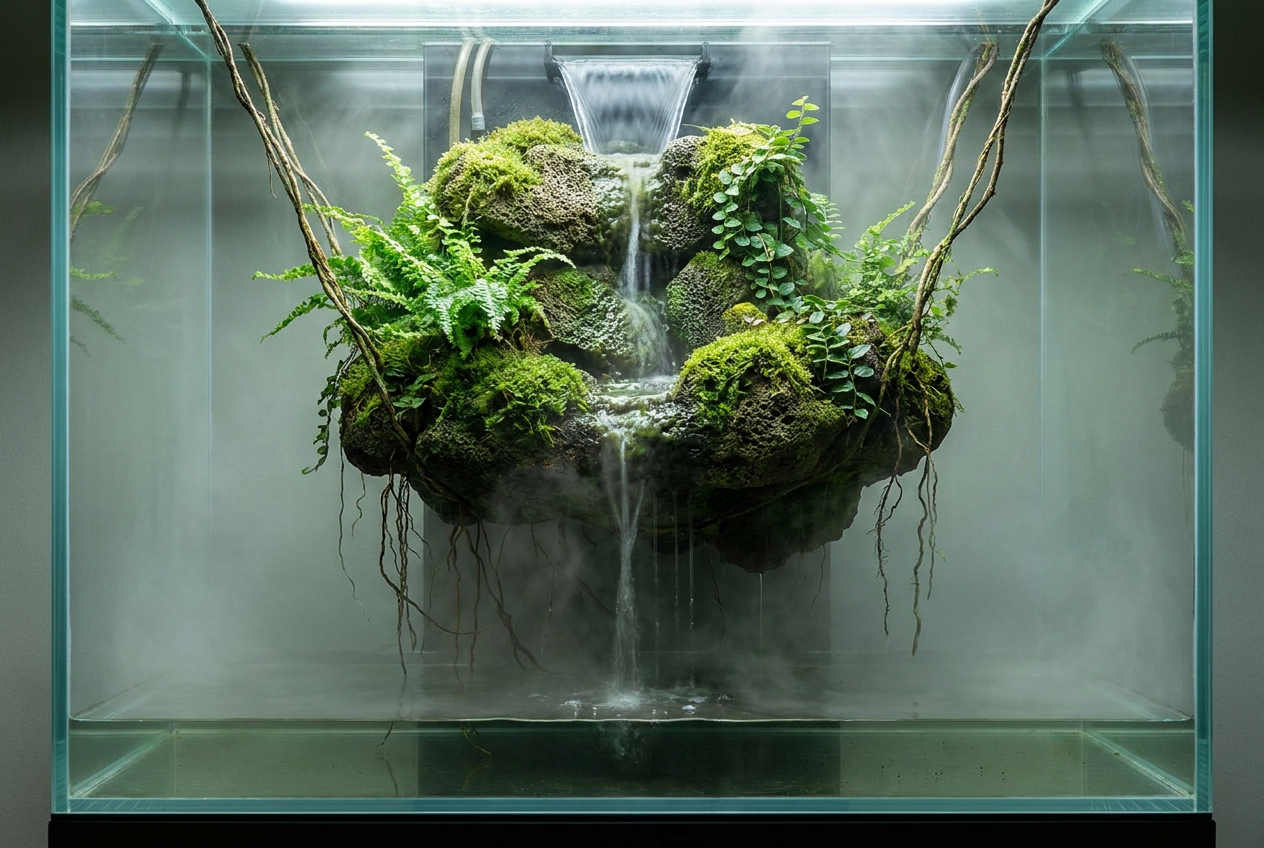
In Part 1 of this series, we explored the hidden principles behind floating ecosystem engineering:
- lightweight structures
- capillary moisture
- misting systems
- magnets
- porous hardscape
- suspended planting
Now we begin building our first major ecosystem concept.
And honestly, this is probably one of the most visually magical setups you can create inside a terrarium or paludarium.
A floating island.
Suspended above water.
With mist drifting below.
Roots hanging downward.
And a waterfall cascading from the floating structure itself.
At first glance, it looks impossible.
But once you understand the engineering logic behind it, the entire system becomes surprisingly achievable.
And the best part?
Many of the materials used are already common terrarium and aquascaping materials:
- pumice stone
- moss
- Hygrolon
- tubing
- pumps
- cork bark
- miniature tropical plants
- foggers
- epiphytic plants
This is not just decoration.
The waterfall itself becomes part of the ecosystem.
Why The Misty Waterfall Vortex Feels So Alive

Traditional terrariums are usually static.
Plants grow.
Humidity cycles.
But visually, the environment remains relatively still.
The Misty Waterfall Vortex changes that completely.
Suddenly you introduce:
- moving water
- drifting fog
- hanging roots
- layered humidity
- splash zones
- reflective movement
- vertical ecosystem depth
The enclosure begins feeling like a miniature rainforest valley instead of a planted container.
And because water is continuously cycling through the floating structure, the ecosystem feels constantly active and evolving.
That movement is what makes the setup feel immersive.
Why Pumice Stone Is Almost Perfect For Floating Ecosystems

One of the biggest challenges in floating ecosystem design is balancing:
- realism
- weight
- moisture behavior
- structural safety
This is where pumice becomes incredibly powerful.
Pumice looks visually massive and rocky.
But internally, it is filled with microscopic air pockets.
That means it is:
- lightweight
- porous
- moisture-retentive
- easy for moss attachment
- excellent for root grip
- naturally textured
Large pumice stones are especially useful because they can visually resemble:
- floating mountains
- jungle cliffs
- suspended canyon fragments
- waterfall islands
without becoming dangerously heavy for glass terrariums.
And because water naturally spreads across porous surfaces, pumice helps create softer, more natural waterfall behavior instead of aggressive straight water streams.
Understanding The Water Loop

The hidden secret behind the Misty Waterfall Vortex is the water circulation loop.
The system is surprisingly simple.
A hidden submersible pump sits below inside the aquatic section.
Water travels upward through hidden silicone tubing routed inside a synthetic vine or structural support.
The tubing exits near the top of the floating island.
Gravity then pulls the water downward naturally across the porous rock surface.
The water eventually drips back into the lower water reservoir.
And the cycle repeats continuously.
This creates:
- continuous moisture
- moving reflections
- moss hydration
- splash-zone humidity
- layered evaporation
- drifting atmospheric mist
without flooding the entire enclosure.
Why Hidden Tubing Matters So Much

One major difference between amateur waterfall builds and immersive ecosystem builds is whether the engineering disappears visually.
Visible pipes immediately break the illusion.
That is why many advanced systems hide tubing inside:
- synthetic vines
- Hygrolon structures
- hollow cork bark
- armature frameworks
- moss-covered supports
Once the tubing disappears, the structure suddenly feels natural.
The water appears to emerge organically from the floating island itself.
That hidden engineering is what creates the “How is this possible?” reaction.
Why Waterfalls And Moss Work So Well Together

Moss absolutely loves waterfall environments.
Especially:
- splash zones
- humid airflow
- porous surfaces
- indirect moisture
- moving oxygen-rich water
Unlike stagnant wet surfaces, waterfall environments create continuous oxygen exchange while still remaining humid.
That combination helps many mosses thrive beautifully.
Waterfall systems also naturally create different moisture zones:
- extremely wet near water output
- humid near drifting splash
- slightly drier near elevated edges
This creates opportunities for layering different plants throughout the structure.
The Role Of Foggers In The Waterfall Vortex

Foggers become extremely powerful in this type of setup.
Because the waterfall already increases humidity naturally, the fogger acts as an atmospheric amplifier instead of the primary moisture source.
When positioned below the floating island:
- fog drifts upward naturally
- roots disappear into clouds
- reflections soften
- lighting diffuses beautifully
- the enclosure gains visual depth
This is what creates the “floating mountain above clouds” effect.
But just like Part 1 explained:
fog alone is not hydration.
The actual ecosystem still depends on:
- misting
- splash moisture
- porous hardscape
- humidity retention
- capillary movement
The fog enhances the illusion.
The water system keeps the ecosystem alive.
Why Hanging Roots Make The Illusion Stronger

One small detail dramatically improves realism:
dangling root systems.
Without roots, floating islands can feel visually disconnected.
But once hanging roots begin extending downward:
- the structure feels anchored biologically
- the ecosystem feels mature
- the island feels integrated into the environment
Good root materials include:
- coco fiber
- fine synthetic vines
- live creeping roots
- moss-covered strands
- Hygrolon tendrils
These roots also help:
- trap humidity
- collect mist droplets
- soften transitions
- diffuse water drips
which makes the waterfall feel even more natural.
Why The Water Flow Must Stay Gentle

One of the biggest beginner mistakes is using pumps that are too strong.
Aggressive waterfall flow creates:
- splashing
- flooding
- unstable humidity
- flying moss
- noisy systems
- visual harshness
The best floating waterfall systems usually use:
- gentle flow
- thin sheet-like movement
- slow dripping behavior
- porous rock spreading
- subtle cascading paths
Think:
humid rainforest seepage.
Not:
garden fountain.
The softer the water behavior becomes, the more immersive the ecosystem feels.
Why This Build Feels Different From Traditional Paludariums

Most paludariums still feel grounded.
The Misty Waterfall Vortex introduces suspended elevation.
Instead of:
- rocks sitting below
- plants growing upward
- water flowing downward from ground level
you suddenly create:
- floating visual weight
- elevated ecosystems
- layered atmosphere
- vertical movement
- hanging structures
- drifting fog beneath hardscape
That inversion completely changes how the enclosure feels emotionally.
The environment begins feeling cinematic instead of simply decorative.
Start Smaller Than You Think

One important lesson:
you do not need a giant floating island immediately.
Even a small 5–10 cm floating pumice structure can already teach you:
- water flow behavior
- splash management
- moss attachment
- humidity layering
- fog interaction
- tubing concealment
Starting smaller helps you understand:
- how moisture spreads
- how quickly surfaces dry
- where moss establishes best
- how water channels naturally through porous rock
Those observations become incredibly valuable when scaling larger later.
In Part 3:
The Eclipse Zero-Gravity Archway

In the next article, we move away from waterfalls and explore structural tension systems.
Using dual floating islands connected by a suspended synthetic vine bridge, we will build a floating jungle archway that slowly becomes covered by climbing tropical plants.
This next build focuses heavily on:
- suspended tension
- armature engineering
- modular magnet systems
- climbing plant behavior
- living structural vines
Final Thoughts

The Misty Waterfall Vortex is not just a terrarium build.
It is an ecosystem experience.
The moving water, drifting humidity, porous stone, hanging roots, and layered atmosphere all work together to create something that feels alive in a very different way from traditional planted tanks or terrariums.
And honestly, once you successfully build your first floating waterfall ecosystem, you stop thinking purely in terms of:
- tanks
- pots
- hardscape
You begin thinking in terms of:
- environmental layering
- suspended habitats
- atmospheric ecosystems
- living structures
And that shift in thinking is where experimental ecosystem design truly begins.
Continue The Series
What happens when floating ecosystems stop being isolated islands — and begin connecting across open air?
In Part 3: Building The Eclipse Zero-Gravity Archway, we explore how to create suspended jungle bridges using floating islands, structural tension systems, hidden armature wire, Hygrolon-wrapped ecosystem vines, drifting fog chambers, and climbing tropical plants that slowly reclaim the structure over time.
The result feels less like a planted enclosure — and more like a living rainforest corridor suspended in mid-air.


