
Experimental Ecosystem Builds — Part 1: How Floating Terrarium Structures Actually Work
This article is part of Chronicles of the Glass Cage, a collection of explorations into nature, imagination, ecosystems, and the worlds we carry in our minds. Each chapter begins with a question, an observation, a memory, or a possibility, then follows where that path leads.
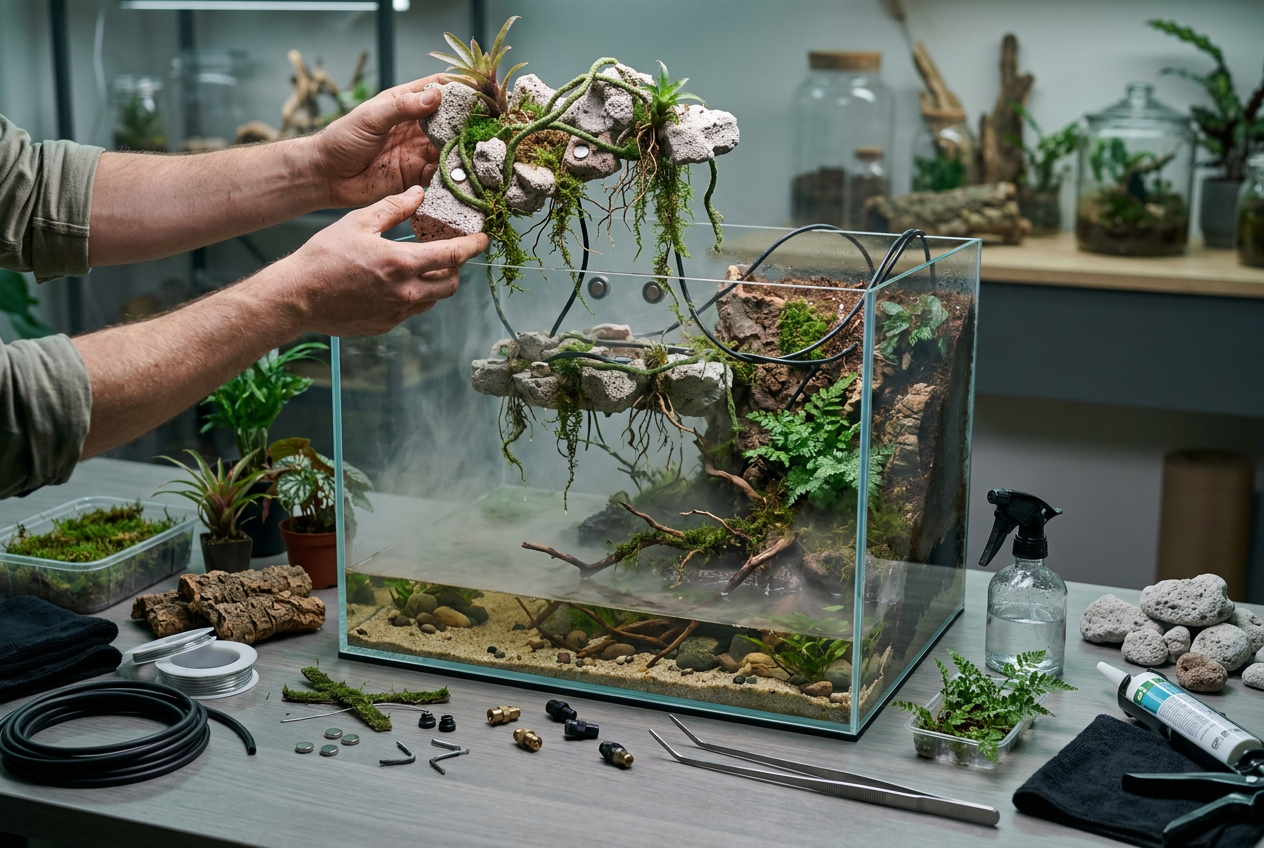
Floating terrarium structures look almost impossible the first time you see them.
A moss-covered island hanging in mid-air.
A glowing jungle vine twisting across glass.
Roots disappearing into fog.
Water flowing down a floating mountain.
At first glance, these setups feel more like fantasy movie scenes than something hobbyists can actually build at home.
But once you understand the hidden engineering behind them, the illusion suddenly starts making sense.
And honestly, that realization is where the fun begins.
Most advanced floating ecosystem builds are not relying on magic.
They are relying on:
- lightweight materials
- hidden structural support
- capillary moisture movement
- humidity control
- mist cycles
- porous surfaces
- clever visual illusion
This article is not about building one specific setup.
Instead, this is the foundation guide.
Before we build floating waterfalls, glowing Pandora jungles, or shattered floating ruins in the later parts of this series, we first need to understand why these systems actually work.
Once you understand the core principles, you stop seeing a glass box.
You begin seeing a miniature ecosystem that can be layered, suspended, sculpted, and engineered.
Why Floating Ecosystems Are Possible

The biggest misconception beginners have is this:
“The plants are floating without water.”
In reality, floating terrarium structures are carefully designed to manage moisture indirectly.
Many tropical plants naturally grow in environments where they are:
- attached to trees
- clinging to cliffs
- hanging above streams
- rooted into tiny debris pockets
- exposed to moving humid air instead of wet soil
These plants are called epiphytes.
And many of the plants used in advanced terrariums naturally evolved for exactly these conditions.
This includes:
- mosses
- miniature orchids
- Marcgravia
- Rhaphidophora
- bromeliads
- creeping figs
- micro ferns
Instead of relying on deep soil, these plants rely on:
- surface moisture
- humid airflow
- periodic hydration
- textured attachment surfaces
- small root zones
Floating ecosystem builds simply imitate these natural rainforest conditions.
The Most Important Rule:
Lightweight Systems Are Stable Systems

If there is one principle that controls almost every advanced floating build, it is this:
Weight is the enemy.
Glass terrariums are not designed to support extremely heavy suspended structures.
That is why experienced builders rarely use massive solid rocks for floating hardscape.
Instead, they use lightweight materials that create the illusion of mass.
Common materials include:
- pumice stone
- feather rock
- cork bark
- expanding foam
- hollow PVC
- Hygrolon
- microfiber fleece
- aluminum armature wire
These materials are lightweight while still providing:
- texture
- root attachment
- moisture retention
- visual realism
- structural flexibility
The structure only needs to look massive.
It does not actually need to be massive.
That illusion is one of the biggest secrets behind advanced terrarium engineering.
Understanding Capillary Action
The Hidden Water Movement Inside Terrariums

One of the most important discoveries in advanced terrarium building is that water can move upward without pumps.
This process is called capillary action.
Certain materials naturally wick water upward through microscopic spaces within their fibers.
That is why materials like:
- Hygrolon
- microfiber fleece
- moss
- tree fern fiber
- absorbent fabrics
can remain damp even when only their lower portions touch water.
This allows builders to create:
- moss walls
- climbing vines
- floating root systems
- vertical planting surfaces
- suspended humid zones
without flooding the entire enclosure.
Instead of soaking the tank, moisture slowly travels upward through the material itself.
This creates a balance between:
- hydration
- airflow
- oxygen exchange
- moisture retention
which dramatically reduces rot problems.
Why Foggers Look Amazing
But Cannot Replace Watering

Foggers are one of the most misunderstood tools in terrarium building.
They create atmosphere beautifully.
But they are not true watering systems.
Ultrasonic foggers create microscopic airborne water particles that:
- increase humidity
- create visual depth
- soften lighting
- simulate rainforest mist
- produce cinematic atmosphere
But fog alone usually does not provide enough sustained hydration for roots.
That is why advanced floating systems often combine:
- foggers
- misting systems
- porous materials
- capillary fabrics
- textured surfaces
- humid airflow
The fog creates the illusion.
The actual hydration comes from moisture-retentive materials and controlled mist cycles.
That combination is what makes these systems feel alive.
Why Porous Materials Matter So Much

Smooth surfaces dry out very quickly.
Porous materials hold tiny reservoirs of moisture.
That is why advanced floating builds heavily use materials like:
- pumice
- lava rock
- cork bark
- textured foam
- carved cement
- tree fern panels
These surfaces:
- trap moisture
- slow evaporation
- anchor roots
- support moss attachment
- create microbial zones
- improve humidity stability
Moss especially prefers rough surfaces because its tiny rhizoids can physically grip into cracks and textures.
That is why smooth plastic surfaces usually struggle long-term unless they are wrapped in textured fabric or coated with bark-textured silicone.
Why Misting Systems Change Everything

Without periodic misting, many floating systems dry out too aggressively.
But constantly wet systems become stagnant and rot.
The goal is balance.
Think rainforest.
Not swamp.
A proper misting system helps:
- hydrate surfaces lightly
- refresh mosses
- maintain humidity
- cool the enclosure
- support epiphytes
- stabilize moisture zones
while still allowing:
- airflow
- oxygen exchange
- drying periods
between cycles.
That wet-dry rhythm is extremely important.
Many advanced terrarium systems succeed not because they stay permanently wet — but because they dry slightly between hydration cycles.
Why Magnets Changed Terrarium Design

Magnets completely changed what hobbyists could build inside terrariums.
Before strong neodymium magnets became easily available, most hardscape structures needed to be:
- permanently siliconed
- supported from below
- awkwardly suction-cupped
- difficult to maintain
Modern N52 neodymium magnets allow entire structures to become:
- removable
- adjustable
- modular
- repositionable
without permanently gluing them into the enclosure.
This opened the door for:
- floating planters
- suspended cliffs
- removable moss walls
- floating bromeliad ledges
- magnetic hardscape pods
- floating islands
The real magic happens when the engineering becomes hidden.
Once magnets disappear behind:
- bark textures
- moss
- vines
- roots
- hardscape
…the structure suddenly feels impossible.
Synthetic Vines Are More Than Decoration

Synthetic terrarium vines are not just visual elements.
In advanced ecosystem builds, they often become functional infrastructure.
Using combinations of:
- aluminum armature wire
- silicone tubing
- Hygrolon
- microfiber fleece
- bark-textured silicone coatings
builders can create vines that:
- wick moisture
- support climbing plants
- hide irrigation systems
- conceal wiring
- suspend hardscape
- route water tubing
- hold moss
all at the same time.
This is where terrarium building begins blending:
- ecology
- engineering
- sculpture
- aquascaping
- environmental design
into a single living system.
Why Floating Ecosystems Feel So Magical

Traditional terrariums are usually built on a single horizontal plane.
Floating ecosystems introduce vertical layering.
Suddenly you have:
- suspended roots
- drifting fog
- elevated hardscape
- hanging moss
- floating shadows
- climbing vines
- layered humidity zones
The enclosure begins feeling like a miniature environment instead of a planted container.
And because many tropical plants naturally climb, spread, attach, and cascade over time, the system continuously evolves as it matures.
That natural evolution is part of the beauty.
Start Small First

One important thing to remember:
You do not need to immediately build a giant floating Pandora mountain.
The best way to learn these systems is through experimentation.
Start with:
- a tiny magnetic moss ledge
- a simple Hygrolon vine
- a floating cork planter
- a misted moss branch
- a miniature fern pocket
Observe:
- how moisture moves
- how moss reacts
- how fast surfaces dry
- how humidity changes
- how plants attach over time
That experimentation is where the real learning happens.
And honestly, that experimental spirit is what makes advanced terrarium building so addictive.
In The Next Parts Of This Series

Now that you understand the foundation principles, we can begin building more advanced floating ecosystem concepts.
The next four articles in this series will progressively explore:
- The Misty Waterfall Vortex
- The Eclipse Zero-Gravity Archway
- The Bioluminescent Night-Mode Canopy
- The Sunken Ruin Shattered Pillars
Each one explores a different combination of:
- ecosystem layering
- structural illusion
- humidity engineering
- moss growth
- lighting
- water movement
- floating hardscape design
Final Thoughts

Floating ecosystem builds are not just about fantasy aesthetics.
They teach you to think differently about:
- moisture
- gravity
- airflow
- plant behavior
- ecosystem layering
- environmental design
Once you understand the underlying principles, terrariums stop feeling like simple glass containers.
They begin feeling like miniature living worlds that can be suspended, layered, engineered, and explored creatively.
And honestly — that experimentation is where some of the most exciting terrarium ideas begin.
Continue The Series
Floating ecosystems become even more immersive once moving water enters the environment.
In Part 2: Building The Misty Waterfall Vortex, we explore how to create suspended waterfall islands using lightweight pumice stone, hidden water circulation, drifting fog, moss-covered splash zones, and layered rainforest humidity systems.
The result is a floating ecosystem that feels less like a terrarium — and more like a living suspended rainforest valley.


