
Why Chocolate Gourami, Samurai Gourami & Wild Betta Often Die in Aquariums
This guide is created by Green Chapter — Nature Workshop Studio, where we focus on creating living ecosystems through hands-on experience. We share practical insights across terrariums, aquascaping, plants, and natural systems to help you build and care for your own.
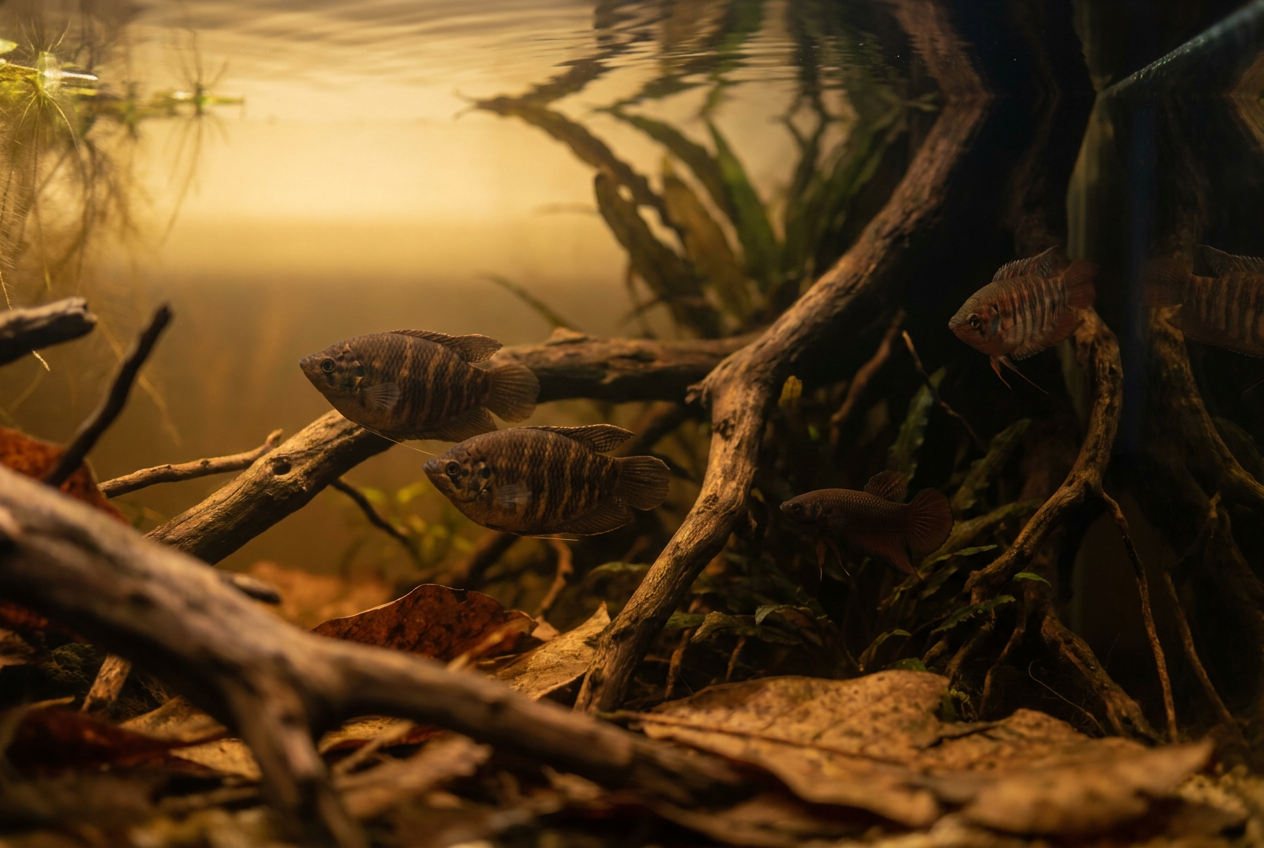
Chocolate Gouramis, Samurai Gouramis, and many Wild Bettas are some of the most beautiful fish in the freshwater hobby. They are quiet, gentle, and full of character. They do not need large tanks, they are not aggressive, and they often look like they should be easier to keep than fast, active community fish.
But many aquarists experience the same problem.
The fish looks healthy in the shop. It is brought home, acclimated, and placed into what seems like a clean and stable aquarium. Then, within a few days, it hides, refuses food, develops white spots, or slowly fades away.
This can be very frustrating because the aquarium may not look “wrong” at all. Ammonia may be zero. Nitrite may be zero. The water may be clear. Other fish may be doing perfectly well.
The issue is that these species are not ordinary community fish. They come from a very different kind of freshwater world.
They Come From a Different Kind of Water

To understand these fish, we need to look at the habitats they are adapted to.
Chocolate Gouramis and Samurai Gouramis are closely associated with peat swamp and blackwater environments. Many Wild Bettas also come from shallow forest streams, swampy margins, and acidic waters where fallen leaves, branches, and organic material slowly stain the water brown.
This is not dirty water. It is natural blackwater.
The water in these habitats is often extremely soft, low in minerals, low in dissolved solids, and rich in tannins and humic substances. In some peat swamp systems, the pH can drop far below what most aquarium fish would tolerate.
This changes everything.
In these environments, the water is not just “slightly acidic.” It is part of the fish’s biology. Their slime coat, immune response, stress tolerance, and feeding behaviour are shaped by this kind of water.
When we move them into a standard aquarium with neutral or harder tap water, the tank may look clean to us, but it can feel completely foreign to them.
Why Normal Aquariums Can Be Too Harsh
Most aquarium advice is built around common fish that adapt well to a broad range of water conditions. Guppies, tetras, rasboras, corydoras, and many farm-bred Bettas can usually handle normal aquarium routines when the tank is cycled and stable.
Chocolate Gouramis, Samurai Gouramis, and many Wild Bettas are different.
For them, “clean water” is not only about zero ammonia and zero nitrite. The mineral content, pH, conductivity, dissolved organic compounds, bacterial balance, and overall maturity of the system all matter.
This is why a standard planted tank can still be unsuitable.
A bright, clear, neutral-pH aquarium may be excellent for many fish, but for blackwater specialists, it can quietly wear them down. They may not collapse immediately. Instead, they become stressed, hide more, breathe differently, refuse food, or become vulnerable to disease.
This is where many losses begin.
Not from one obvious mistake, but from a mismatch between the fish and the environment.
The White Spot Problem After Purchase

One of the most common problems with these fish is white spot appearing shortly after purchase.
At first, it looks like the fish “came with disease.” Sometimes that is possible, especially with imported fish that have already passed through several holding systems. But very often, the visible outbreak is triggered by stress after the fish is moved into a different environment.
Transport is already hard on sensitive fish. They are netted, bagged, shipped, unpacked, held, and moved again. By the time they reach a home aquarium, their bodies may already be under pressure.
If the new tank has very different water chemistry, the stress becomes worse.
Their protective slime coat weakens. Their immune system struggles. Parasites and opportunistic infections gain an opening. What looks like a sudden disease problem is often the final sign of a fish that could not adapt quickly enough.
This is also why treatment can be difficult. Medication alone may not solve the problem if the environment continues to stress the fish.
For blackwater fish, the first “medicine” is often the correct water.
Why RO Water and Botanicals Are Often Used
Many experienced keepers do not rely on tap water alone for these species. Instead, they use RO water and carefully rebuild the water to suit blackwater fish.
RO water gives the aquarist a softer starting point. From there, the water can be adjusted gently instead of forcing the fish to adapt to hard or mineral-rich conditions.
Botanicals also play an important role. Indian Almond Leaves, alder cones, seed pods, peat, and driftwood release tannins and humic substances into the water. They create the amber colour that many people associate with blackwater tanks, but the colour is not just decoration.
These natural compounds help create a calmer, more suitable environment. They also make the tank feel more shaded and secure, which encourages shy fish to settle.
A good blackwater tank does not need to look messy. It can be beautiful in a very different way — softer, darker, quieter, and more natural.

Acclimation Must Be Slower Than Usual
For hardy community fish, a simple acclimation routine is often enough. Float the bag, mix in some tank water, and release the fish after a short while.
For Chocolate Gouramis, Samurai Gouramis, and sensitive Wild Bettas, this can be too fast.
The danger is not only temperature shock. The bigger issue is the sudden change in water chemistry. If the fish moves from one conductivity level to another too quickly, its body has to work hard to rebalance itself. This can lead to osmotic stress, even if the fish looks fine at first.
Some fish die quickly. Others seem okay for one or two days, then suddenly decline.
A slower acclimation gives the fish a better chance to adjust. Dim lighting, quiet surroundings, and minimal disturbance also help. These are not fish that should be rushed from bag to tank in a busy, brightly lit room.
With sensitive blackwater fish, patience during the first few hours can affect the next few weeks.
Mature Tanks Make a Big Difference
A newly cycled tank may be safe for many beginner fish, but it is not always ideal for blackwater specialists.
These fish usually do better in aquariums that have had time to mature. A mature tank has more stable biological activity, more natural biofilm, more settled surfaces, and fewer sudden shifts. The leaf litter, wood, and substrate begin to work together as a small ecosystem.
This matters because sensitive fish dislike instability.
They may tolerate a narrow range of conditions if those conditions are steady, but they often suffer when the aquarium is still changing from week to week.
A mature blackwater aquarium also provides more natural cover and feeding opportunities. Tiny organisms, soft biofilm, and shaded hiding spaces help the fish behave more naturally. When they feel secure, they are more likely to feed, display, and settle.
=
Feeding Is Another Challenge
Many of these fish do not arrive ready to eat pellets.
After transport, they may be shy, stressed, and slow to feed. Some are wild-caught or recently imported. They may recognise live or frozen foods more readily than dry food.
This does not mean they can never accept prepared food, but the first stage is about getting them to eat something.
Frozen daphnia, brine shrimp, bloodworms, mosquito larvae, and small live foods can make a big difference. Once the fish is feeding confidently, prepared foods can be introduced slowly.
The mistake is expecting them to behave like farm-bred community fish on day one.
A fish that is already stressed and not eating will weaken quickly. In delicate species, a few missed days can become serious.

Why Wild Bettas Belong in This Conversation
Not all Bettas are the same.
The common domestic Betta is usually much more adaptable than many wild species. Some Wild Bettas come from acidic forest streams and blackwater habitats. Others need softer water, quieter tanks, more cover, and less competition than a typical community setup provides.
This is why Wild Bettas often belong in the same difficulty conversation as Chocolate and Samurai Gouramis.
They may not always need the exact same conditions, but the mindset is similar. They are not fish to “add into any tank.” They do best when the aquarium is planned around them.
Many Wild Bettas are also shy, subtle, and easily stressed by strong flow, bright light, active tankmates, or unstable water. When given the right environment, however, they can be incredibly rewarding. Their behaviour, colours, pair bonds, and breeding habits are often far more interesting than people expect.

These Fish Are Not Impossible
It is important not to describe these fish as impossible to keep.
They are not impossible.
They are simply specialized.
The problem is that they are sometimes sold or treated like normal aquarium fish when they are better understood as ecosystem fish. Their success depends less on decoration and more on whether the aquarium recreates the kind of conditions their bodies expect.
A suitable setup should usually be soft, mature, calm, shaded, and stable. Tankmates should be chosen carefully, or avoided entirely. Flow should be gentle. Feeding should begin with foods they are likely to accept. Acclimation should be slow and careful.
Once they settle, these fish can be remarkable.
Chocolate Gouramis glide gently through shaded water. Samurai Gouramis show unique colour and behaviour. Wild Bettas reveal personalities that are often missed in bright community tanks.
They reward patience, not shortcuts.
Final Thoughts
Chocolate Gouramis, Samurai Gouramis, and many Wild Bettas teach us an important lesson in fishkeeping.
A clean aquarium is not always the same as a suitable aquarium.
For most common fish, a stable community tank may be enough. For blackwater specialists, the aquarium needs to respect where they came from. Their health is connected to soft water, tannins, shelter, maturity, and calm.
If these fish die shortly after purchase, it does not always mean the aquarist was careless. Often, it means the fish was placed into an environment that looked safe to us, but felt stressful to them.
When we understand that difference, we stop asking, “Why are they so fragile?”
Instead, we start asking, “What kind of world are they built for?”
That is the mindset that gives these fish a real chance to thrive.


