
Vampire Crabs: The Beautiful Mystery We Still Don’t Fully Understand
This guide is created by Green Chapter — Nature Workshop Studio, where we focus on creating living ecosystems through hands-on experience. We share practical insights across terrariums, aquascaping, plants, and natural systems to help you build and care for your own.
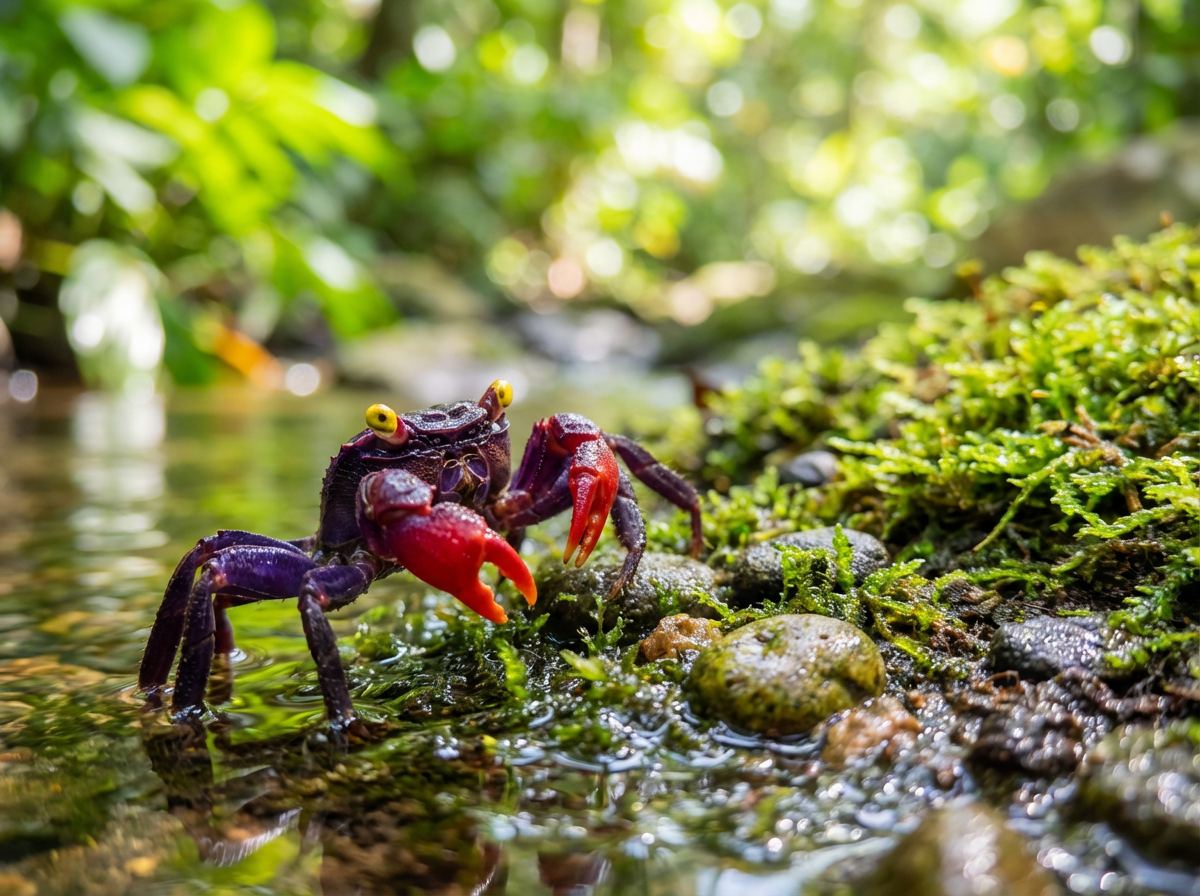
Before scientists gave them names…
Before their habitats were mapped…
Before anyone understood what they truly were…
They were already being sold.
Bright purple bodies. Glowing yellow eyes. Blood-red claws.
They looked designed — not discovered.
And for nearly a decade, that’s exactly how they existed.
What You’re About to Discover
This isn’t just another species guide.
In this article, we’re going to uncover:
- How Vampire Crabs were sold before science even knew they existed
- Why their name might not mean what you think
- The rare species that live inside carnivorous plants
- The uncomfortable truth about the aquarium trade
- And the hidden behaviors that make them far more complex than they appear
Take your time with this one —
because the deeper you go, the stranger they become.
What Are Vampire Crabs? — A Genus Hidden in Plain Sight
Vampire crabs (Geosesarma spp.) are small, vividly colored, semi-terrestrial crustaceans native to Southeast Asia — particularly Indonesia.
They are best known for their striking appearance:
- Deep purple bodies
- Bright red claws
- Glowing yellow or orange eyes
These features give them an almost surreal presence — one that feels designed rather than evolved.
Despite their name, they are not blood-feeders.
The term “Vampire Crab” is believed to come from their nocturnal behavior and intensely reflective eyes, which seem to glow under low light.
Over the past decade, they have become increasingly popular in the aquarium trade as ornamental species — often admired more for their appearance than their behavior.

Natural Habitat and Biology
In the wild, Vampire Crabs occupy a very specific ecological niche — one that sits between land and water.
Origin
They are primarily found in humid rainforest valleys across Southeast Asia, especially on islands such as Java and Sulawesi. These environments are typically located near shallow freshwater streams, seepage zones, and densely vegetated forest floors.
Lifestyle
Vampire crabs are semi-terrestrial.
They spend the majority of their time on land — often between 80–95% — returning to water mainly to:
- Rehydrate their gills
- Molt safely
- Release larvae
This makes them very different from fully aquatic crabs.
Size
They are relatively small:
- Carapace width: ~2–3 cm
- Total leg span: up to ~5 cm
Their size allows them to navigate tight spaces within leaf litter, burrows, and root systems.
Diet
They are omnivorous scavengers, feeding opportunistically on:
- Small insects
- Worms
- Decaying plant matter
- Organic debris
This diet plays an important role in nutrient recycling within their ecosystem.
Lifespan
Vampire crabs are relatively short-lived, with a typical lifespan of 2 to 3 years in captivity.

Key Insight
Vampire crabs are not aquatic animals that occasionally climb onto land.
They are land-dominant creatures that rely on water as a support system, not a primary environment.
Understanding this single point changes everything about how they should be kept — and how they should be understood.
Known Vampire Crab Species (A Growing List)
Core Species (Common in Trade)
- Geosesarma dennerle
- Geosesarma hagen
- Geosesarma bicolor
Lesser-Known Scientific Records
- Geosesarma perracae
- Geosesarma rouxi
- Geosesarma tiomanicum
New Discoveries
- Bunian Vampire Crab (Malaysia, 2025)
Key Insight
Many “species” in the trade are not formally described.
What you see may be:
- Undiscovered species
- Regional variations
- Or mixed populations
Biology or Branding? — The Mystery Behind the Name
The name “Vampire Crab” was never officially assigned by science.
It emerged from the trade.
Possible reasons include:
- Their glowing yellow eyes
- Deep purple and red coloration
- Markings resembling wings or cloaks
But the real mystery isn’t the name.
It’s the timeline.

For years, these crabs were sold globally before being formally described.
In 2015, species like Geosesarma dennerle were traced back to hidden locations in Java.
This reversed the natural order:
Trade → Curiosity → Scientific Discovery
And even today, new species continue to emerge.
Guardians of the Pitcher Plants — A Hidden Symbiosis
Some vampire crabs don’t live on the forest floor.
They live inside plants.

Species like Geosesarma perracae have been observed inhabiting Nepenthes ampullaria.
Inside the pitcher:
- Insects are trapped
- Liquid maintains humidity
- Crabs scavenge for food
This is not accidental.
It is a specialized ecological relationship.
Conservation — The Race Against the Clock
The same beauty that made Vampire Crabs popular…
may also threaten their survival.

Many species are:
- Extremely localized
- Found only in specific valleys or slopes
Habitat destruction can erase entire populations instantly.

In the trade, they are often sold in mixed groups.
But these species:
- Do not naturally coexist
- Compete aggressively
Which leads to:
- Injury
- Death
- Misunderstood behavior
Architects, Opportunists, and Silent Killers
If you think Vampire Crabs are just decorative…
You haven’t watched them long enough.
They are not passive inhabitants of a terrarium.
They are active participants — constantly shaping, defending, and adapting to their environment.

They Build — With Intent
Vampire crabs do not simply occupy space.
They reshape it.
Given the right conditions, they will:
- Dig burrows into soft substrate
- Reinforce entrances with soil and debris
- Carve out hidden pathways beneath moss and leaf litter
Over time, a flat enclosure becomes a layered micro-landscape — structured by their movement and decisions.
This is not random digging.
It is environmental engineering.

They Map Their World
Spend enough time observing them, and patterns begin to emerge.
Each crab develops a relationship with its surroundings:
- Preferred hiding zones
- Repeated movement paths
- Defined territory boundaries
These invisible borders are rarely obvious — until they are crossed.

The Social Paradox
They tolerate their own kind…
until they don’t.
A colony may appear calm and stable — individuals moving past one another without issue.
But under the surface, tension is always present.
A shift in:
- Space
- Resources
- Maturity
…can trigger sudden escalation.
Claws rise.
Postures change.
Territory is challenged.
And the outcome is rarely accidental.
Breeding, Territory, and Survival — The Unseen Dynamics
Vampire crabs are relatively easy to breed in captivity — but that does not mean they are simple.
Unlike most crabs, they do not release free-swimming larvae.
Instead, they exhibit a rare reproductive strategy known as direct development.
Females carry large eggs, which hatch into fully formed miniature crabs — skipping the vulnerable larval (zoea) stage entirely.

This allows them to reproduce successfully in land-dominant environments, where open water is limited.
But this efficiency introduces a different kind of pressure.
Vampire crabs are inherently territorial.
Males, in particular, may become aggressive toward one another — especially in confined environments.
To reduce conflict, many keepers maintain a ratio of one male to multiple females, helping distribute tension more naturally.
Even more surprising is their behavior toward their own young.
Adult crabs have been observed preying on juveniles, particularly when space or resources are limited.

In the wild, dense leaf litter and complex terrain provide enough hiding spaces for young crabs to survive.
In captivity, however, survival often depends on:
- Heavy environmental cover
- Separation of juveniles
- Or accepting natural population control
Individual Personalities (Yes, Really)
Look closer, and the illusion of simplicity disappears entirely.
Some individuals:
- Roam openly and explore
- Claim territory and defend it aggressively
- Retreat instantly at the slightest disturbance
Others remain hidden for days, emerging only under the right conditions.
They are not identical.
They are not predictable.
They are individuals — shaped by environment, hierarchy, and survival pressure.
What You’re Really Looking At
What appears to be a small, colorful crab…
Is in reality a living system of:
- Territory
- Competition
- Adaptation
- And survival
They are not decorations.
They are architects of their world —
and when necessary, defenders of it.
CONCLUSION — A STORY STILL BEING WRITTEN
Vampire Crabs are not just another terrarium species.
They are:
- Discovered after being sold
- Still being studied
- Possibly disappearing faster than we understand them
And somewhere, in forests not far from us…
There are still species waiting to be found.


