
How Do New Frog Morphs Develop? From Genetic Mutation To Selective Breeding
This guide is created by Green Chapter — Nature Workshop Studio, where we focus on creating living ecosystems through hands-on experience. We share practical insights across terrariums, aquascaping, plants, and natural systems to help you build and care for your own.
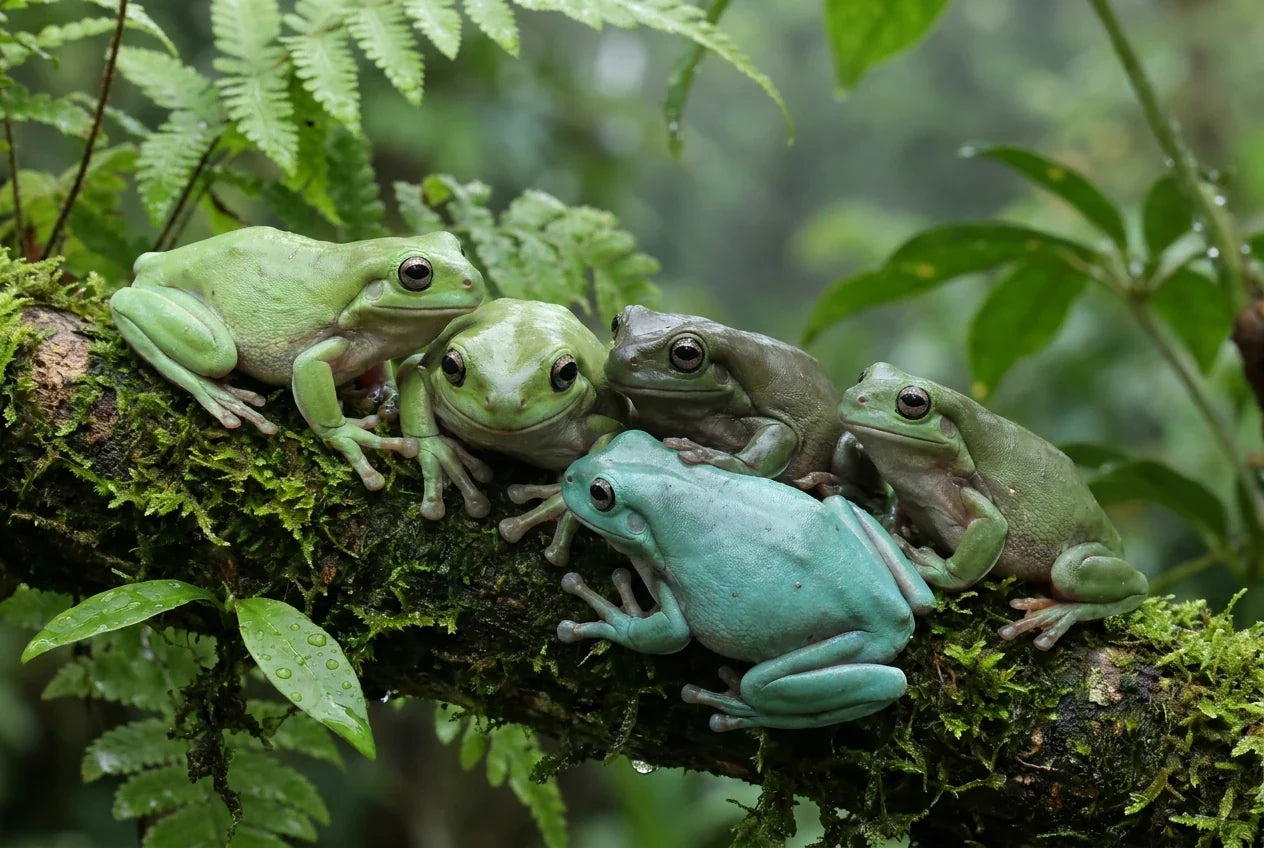
Imagine a breeder raising hundreds of young White's Tree Frogs (Litoria caerulea, also known as Ranoidea caerulea).
Most are green. Some are brighter, some darker, and a few have different markings. Then one frog stands out. Perhaps it looks unusually blue, has striking white spots, or develops a warm golden appearance.
Where did that difference come from? Did the breeder create it? And could this one unusual frog eventually become the beginning of a new morph?
The answer involves three connected processes: genetic variation, inheritance and selective breeding. They help explain how distinctive captive appearances develop, although the precise genetic origins of commercial Blue Phase, Snowflake and Honey lines are not all established.
DOES EVERY MORPH START WITH A NEW MUTATION?
Not necessarily. A mutation is a change in DNA. It may arise naturally when DNA is copied or repaired, and some changes can affect pigmentation or development. Many mutations have no visible effect, and some are harmful. Only a subset produce a visible difference that could be inherited.
An unusual appearance can emerge in at least three ways.
First, a new mutation may arise in an egg, sperm or early embryo. If it enters the reproductive lineage, it may be passed to descendants. A change confined to some body cells might alter the individual's appearance without being passed on.
Second, a variant may already be present but hidden. Two normal-looking parents can each carry a recessive variant. An offspring receiving the relevant variant from both parents may display a trait neither parent shows. Nothing new necessarily happened to the DNA in that generation: an existing combination simply became visible.
Third, a trait may reflect variation across many genes. Some frogs may naturally be a little bluer, lighter or more heavily marked. If those differences are heritable, breeders can select animals with the preferred appearance across generations. The trait can become more pronounced without any newly identified mutation.
That distinction matters. A newly marketed morph is not automatically a newly arisen mutation.

HOW CAN TWO NORMAL-LOOKING FROGS PRODUCE AN UNUSUAL BABY?
Consider a simplified hypothetical trait controlled by one recessive variant. Call the usual gene version A and the recessive version a. AA frogs look ordinary; Aa frogs also look ordinary but carry the variant; aa frogs show the unusual appearance.
If two Aa carriers reproduce, the expected probabilities for each offspring are: AA: 25% — ordinary appearance, not a carrier.
Aa: 50% — ordinary appearance, carrier.
aa: 25% — unusual appearance.
These are probabilities, not guaranteed ratios in every clutch. A small group of offspring might contain none, one or several unusual frogs.
Now suppose an aa frog is paired with an AA frog. All offspring would be Aa under this simple model: ordinary-looking carriers. The visible trait appears to vanish. Yet if two of those carriers later reproduce, aa offspring can appear again.
This is why appearance alone cannot reveal every inherited variant. It also shows why a breeder cannot establish a recessive inheritance claim from a single unusual frog.
Important: this is a teaching example, not a proven inheritance model for Blue Phase, Snowflake or Honey White's Tree Frogs.

WHY DO GENETIC DIFFERENCES CHANGE FROG COLOUR?
A frog's green appearance is not simply produced by one green pigment. Amphibian colour often depends on layers of specialised cells.
Xanthophores contribute yellow, orange and related pigments. Iridophores contain microscopic structures that reflect and scatter light. Melanophores contain dark pigment and affect shading and contrast.
In many green frogs, yellow pigmentation interacts with light reflected from underlying structures to produce the green we see. If the yellow contribution is reduced, blue may become more apparent. Changes in dark pigment can alter overall brightness, while differences in pigment-cell distribution may affect patches and markings.
But similar appearances can have different biological causes. A blue-looking frog is not automatically missing the same pigment as another blue-looking frog. Nor does a golden frog necessarily have a recognised form of albinism.
There is a second complication: colour is not always fixed from moment to moment. White's Tree Frogs can change their visible coloration with physiological state and environmental conditions. A frog that looks turquoise in one photograph may look greener or duller later. A temporary colour change does not mean its genes changed.
To investigate an inherited appearance, breeders therefore need observations over time, not only a single striking photograph.

HOW DO FAMILIAR WHITE'S TREE FROG MORPHS DEVELOP?
The names are familiar, but their precise genetics are not equally well documented. We can explain how breeders may select these appearances and what the pigmentation biology suggests without inventing a definitive origin story.
BLUE PHASE — MORE THAN CHOOSING THE BLUEST FROG
Blue Phase frogs are valued for turquoise or blue-green coloration. White's Tree Frogs already show variation in colour, and breeders may choose animals that repeatedly show stronger blue tones. If that tendency is inherited, selecting similar animals over generations may make the appearance more common in a captive line.
Blue coloration in amphibians can result from changes in the interaction of yellow pigment and reflective skin structures. That is a plausible biological context, not proof that every commercial Blue Phase frog has a particular pigment-cell mutation.
A breeder also needs to separate a persistent tendency from temporary colour expression. The bluest animal on one afternoon may not remain the bluest after maturation or under different conditions. Comparing frogs at similar ages and observing them repeatedly is more informative than ranking photographs.
The useful lesson is that a recognisable blue line may be developed by selection even when the exact genes are unknown. A trade name tells buyers about a sought-after appearance, not necessarily a laboratory-confirmed genotype.
SNOWFLAKE — WHY WHITE SPOTTING VARIES
Snowflake frogs show irregular white spots or patches. Some have modest spotting; others have much more extensive markings, sometimes advertised as Super Snowflake.
How might breeders develop heavier spotting? They can observe which parents produce spotted offspring and whether selecting more extensively marked animals changes the distribution of markings in later generations. Repeated results could support a heritable component.
But two questions must be kept separate: what makes spotting appear at all, and what determines how much spotting a frog develops? In some traits, one major variant influences presence while other genetic factors influence extent. That is a general possibility, not an established genetic model for Snowflake White's Tree Frogs.
Breeder accounts of Snowflake inheritance differ, and a definitive published genetic explanation for commercial lines should not be assumed. Likewise, 'Super' in a sales description may simply mean more extensive white spotting. It does not automatically mean a specific two-copy genetic state.
A heavily spotted pair may produce offspring with varied markings. That variation is useful information, not evidence by itself that the breeder did something wrong. Tracking the actual offspring distribution over generations is more informative than interpreting the name.
HONEY — WHY GOLDEN COLOUR DOES NOT IDENTIFY A GENE
Honey frogs are associated with warm yellow or golden appearances. Because skin colour reflects interactions among pigment cells and reflective structures, several different biological changes could produce a lighter or warmer look.
A breeder might select consistently golden animals and examine whether their offspring tend to share that appearance. But the existence of a golden line does not establish whether the effect comes from one major variant, multiple genes or a particular pigment-cell change.
It would be misleading to call every golden-looking frog albino or hypomelanistic. Those words describe particular pigmentation conditions and require more evidence than colour alone. Likewise, a young frog's colour may change as it matures.
The important insight is that understanding how pigmentation works does not mean we know the precise genetic origin of a commercial Honey line.
BLUE-EYED AND COMBINATION APPEARANCES
Eye appearance introduces another visible characteristic. The processes contributing to eye pigmentation need not match those producing body colour. Breeders may also try to produce frogs that show blue-green coloration together with prominent white spotting.
If two characteristics are inherited, they may sometimes be combined through selection. But a combined trade name does not establish that two independently identified mutations were joined. The inheritance of each trait still needs evidence.
Across all these examples, the safest distinction is between a visual description, a repeatably inherited characteristic and a scientifically established genetic mechanism. They are three different levels of knowledge.
FROM ONE UNUSUAL FROG TO A BREEDING LINE
Imagine a breeder discovers a juvenile with an unusual pale marking. This is a hypothetical example, not the recorded origin of any named White's Tree Frog morph.
The first step is observation. Does the marking remain as the frog matures? Is it visible across different conditions? Is the animal healthy? A persistent difference is interesting, but persistence alone does not prove inheritance.
Next comes the first breeding generation, when the animal is mature and an appropriate unrelated partner is available. Suppose none of the offspring show the marking. Several explanations remain possible. The trait might be recessive, involve multiple genes, depend on development, or not be inherited at all.
Further documented breeding results can narrow the possibilities. If the appearance repeatedly occurs in descendants from particular pairings, that supports a heritable component. Records should identify parents, offspring numbers, appearance at different ages and relevant health observations. A single successful pairing is not enough to identify the responsible gene.
If the characteristic is inherited, a breeder may select healthy descendants with the desired appearance over additional generations. The trait might become more common or more consistent. Alternatively, the results may remain unpredictable, and the line may never become established.
There is no universal number of generations at which an unusual appearance becomes an official morph. A stable captive line is a practical breeding description, not proof that a genetic mechanism has been mapped.

WHY DON'T TWO ATTRACTIVE PARENTS ALWAYS PRODUCE MATCHING BABIES?
Imagine two strongly spotted Snowflake frogs producing offspring with very different amounts of spotting. That result would not be surprising if the appearance were influenced by several genes, developmental factors or variation in how a trait is expressed.
An offspring inherits combinations of genetic variants, not a photocopy of its parents' visible features. A characteristic influenced by many genes may vary continuously rather than fitting a simple 25% recessive pattern.
This distinction gives intermediate keepers an important way to assess breeding claims. A line can respond to selection even when no single-gene formula predicts every offspring. Conversely, a neat ratio observed in one small clutch is not enough to prove a recessive mechanism. Larger numbers, repeated pairings and consistent records provide stronger evidence.
A breeder may know from experience that certain pairings tend to produce bluer or more heavily marked frogs without knowing the exact genes. That practical knowledge is useful, but it should not be described as molecular genetic proof.
CAN BREEDERS CREATE A DESIRED MUTATION ON PURPOSE?
Conventional selective breeding does not instruct DNA to make a particular mutation. Pairing two green frogs does not cause a new blue-colour mutation simply because the breeder wants blue offspring.
Mutations can arise spontaneously. Breeders usually discover inherited variation that already exists, test how it behaves and select among offspring. Over generations, selection can change how frequently a characteristic appears in the breeding population.
Laboratory methods can induce mutations or alter genetic material, but these are separate from ordinary captive frog breeding and should not be implied by a commercial morph label.
A useful way to remember the distinction is: mutation introduces a genetic change; inheritance passes variants between generations; selection influences which inherited variants become more common.
WHEN DOES A NEW LOOK BECOME A NEW MORPH?
There is no single scientific authority that approves every trade morph name. A breeder might develop a recognisable line with repeatable coloration. Another seller might use the same name because a frog looks similar. A third might introduce a new label for a combination of familiar characteristics.
None of these names alone establishes a new mutation.
Terms such as 'rare', 'recessive', 'line-bred' and 'super' may be meaningful, but they make different claims. 'Rare' refers to availability or frequency, not inheritance. 'Line-bred' indicates selection across a breeding line. 'Recessive' is a specific genetic claim that requires suitable evidence. 'Super' may be a visual marketing description unless a defined genetic usage has been demonstrated.
For buyers, this means a beautiful frog can be accurately described by appearance while its precise genotype remains unknown. For breeders, clear lineage records and careful wording make a claim more credible.

WHY HEALTH AND GENETIC DIVERSITY STILL MATTER
Selecting a colour does not automatically harm an animal. Problems can arise, however, if breeders repeatedly use closely related animals while neglecting genetic diversity. Close-relative breeding can increase the chance that harmful recessive variants become expressed.
Some changes affecting pigmentation in animals can also affect other developmental processes, but unusual colour alone does not establish a health problem. The appropriate response is to evaluate the actual animals and breeding results rather than assume every unusual frog is either unhealthy or perfectly healthy.
Good breeding decisions consider normal development, behaviour, fertility, health and lineage alongside appearance. A spectacular colour is not a substitute for a healthy frog.
WHAT SHOULD A BUYER ASK ABOUT A NAMED MORPH?
For a beginner, the first question is practical: what does the frog look like now, and how might its appearance change as it matures? White's Tree Frogs can change visible colour, so a sales photograph is not a guarantee of a permanent shade.
For a more experienced keeper, the next question is about evidence. Has the breeder repeatedly produced the trait? Are the parents and offspring documented? Is the name a description of appearance, a selected line or a claim about a specific inheritance pattern?
A seller may know the lineage very well without knowing the responsible genes. That is not inherently a problem. The important point is to separate what has been observed from what has been proven.
DOES SELECTIVE BREEDING AFFECT FROG HEALTH?
Selective breeding is not automatically harmful. However, problems can arise when breeders repeatedly pair closely related frogs or focus too heavily on achieving a particular colour.
Over time, this can reduce genetic diversity and increase the chance of inherited health problems, including reduced fertility or developmental abnormalities.
A responsible breeding programme should consider health, normal development and genetic diversity alongside appearance.
A beautiful morph is not necessarily a healthy morph.
CONCLUSION — THE COLOUR IS THE RESULT, NOT THE WHOLE STORY
A Blue Phase, Snowflake or Honey White's Tree Frog may look like a striking new creation, but its appearance could reflect a long-existing genetic variant, a hidden trait that became visible, or generations of selection from ordinary variation.
Sometimes a mutation is part of the story. Sometimes selective breeding is the more important explanation. And for many commercial lines, the precise genetic history remains uncertain.
That uncertainty does not make the subject less interesting. It reveals the difference between seeing an unusual frog and understanding how that appearance came to be.
To compare familiar White's Tree Frog appearances and their trade names, read the earlier Green Chapter guide:
EDITORIAL NOTE
The inheritance examples are simplified teaching models. They are not documented genetic formulas for the named commercial morphs. Verify morph-specific photographs and any breeder-origin claims before publication.


