
Litoria caerulea Morphs Explained: Trade Names, Color Development, and What Buyers Should Know
This guide is created by Green Chapter — Nature Workshop Studio, where we focus on creating living ecosystems through hands-on experience. We share practical insights across terrariums, aquascaping, plants, and natural systems to help you build and care for your own.
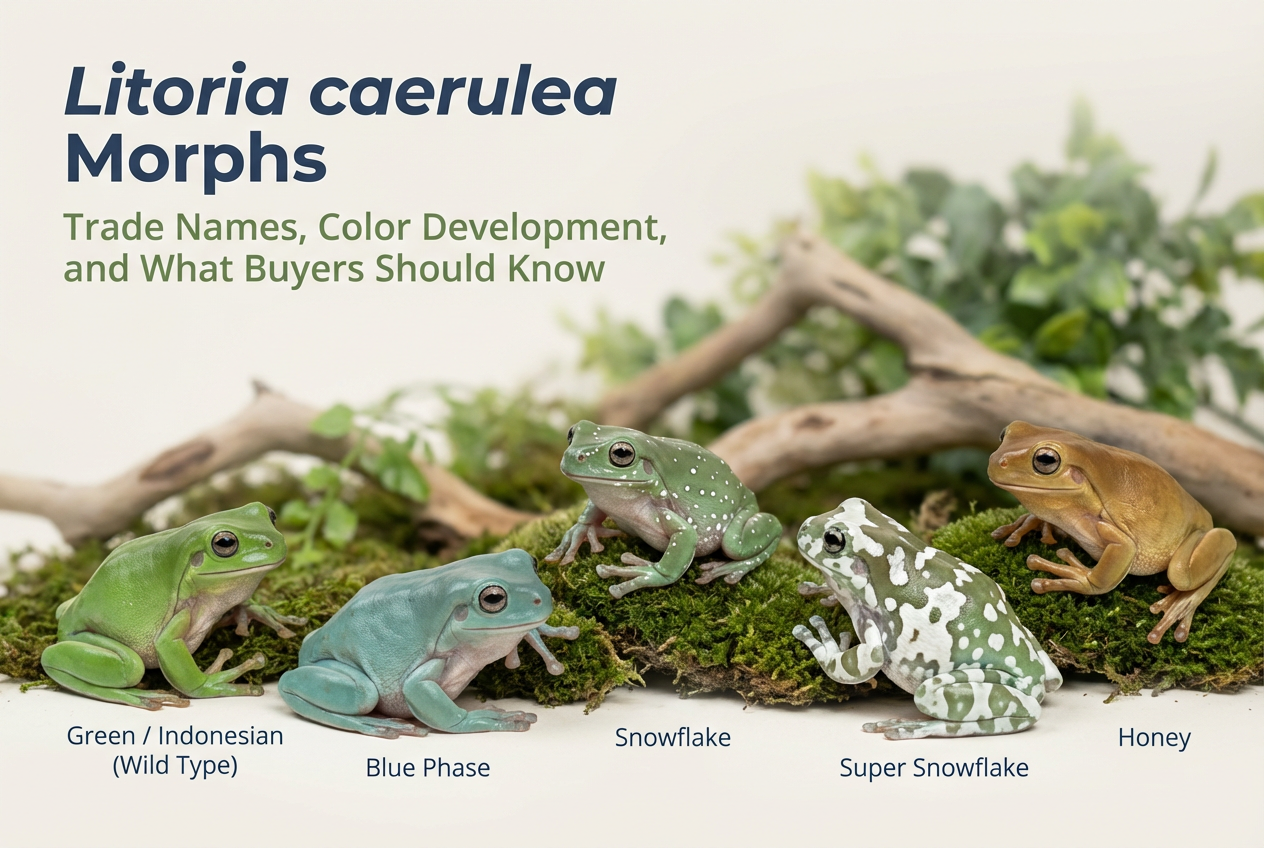
Introduction — Why White’s Tree Frog Morphs Can Be Confusing
If you have been browsing White’s tree frogs, you have probably seen names like Blue Phase, Snowflake, Honey, or Blue-Eyed. These names are widely used in the hobby, but they do not always mean the same thing as a classic reptile “morph.” In White’s tree frogs, many named forms appear to be line-bred visual traits, locality-linked looks, or stacked trade names, rather than neatly proven single-gene mutations. That is why two frogs sold under the same label can still look quite different.

What Counts as a “Morph” in Litoria caerulea?
For this species, it helps to sort the hobby names into four buckets:
1. Locality-linked appearance
These are broad source-line looks, such as Indonesian versus more commonly marketed Australian/Blue Phase animals. The exact look can differ by line and breeder, but the naming often reflects origin or established hobby line, not a confirmed simple gene.
2. Line-bred traits
These are traits strengthened over generations by selectively breeding frogs that already show more of a look, such as heavier white speckling or a bluer overall tone. Snowflake and Super Snowflake are usually discussed this way in the trade.
3. Probable genetic morphs
Some names, especially Honey, are often treated by keepers and sellers as more mutation-like, but hobby naming is still looser than in many reptile groups. Unless a breeder has solid lineage data, it is better to describe inheritance carefully rather than state it as settled fact.
4. Combo or stacked trade names
Names such as Snowflake Honey Blue-Eyed are usually combinations of visible traits used for marketing and identification. They are useful labels, but they do not automatically prove a fully standardized genetic formula.
The Main Trade Names You Will See
Green / Indonesian
“Green” or “Indonesian” White’s tree frogs are typically marketed as the more classic bright green look. In hobby listings, Indonesian is explicitly used as a separate White’s tree frog trait label.

Blue Phase / Australian Blue
“Blue Phase” is one of the most common named looks in the hobby. These frogs usually show a cooler teal, blue-green, or reduced-yellow appearance rather than a truly saturated pure blue. Hobby trait lists and sale listings both recognize Blue Phase as a distinct market label.

Snowflake
Snowflake frogs show white flecking or spotting over the body. The amount can vary widely, which is one reason the trait is best explained as a visual line rather than a guaranteed identical outcome. Marketplace listings show Snowflake as an established trait label and also show Snowflake being combined with Blue Eyed and Super Snowflake listings.

Super Snowflake
Super Snowflake is the heavier-expression version, with denser white coverage than a standard Snowflake. In practice, this is best described as a stronger visual expression within the same broad trait family.

Honey
Honey White’s tree frogs are commonly marketed as yellow, cream, or warm-toned animals, sometimes with blue eyes. Hobby sources clearly use Honey as a recognized trait label, but the safest wording is that it is a commonly recognized morph name in the trade, not that every seller is working from a universally proven inheritance model.

Blue-Eyed
Blue-Eyed frogs are sold for their eye color rather than only their body color. This trait is also frequently stacked with other labels in sale listings, which reinforces that hobby naming is often modular.
How Frog Color Actually Develops
A White’s tree frog’s color is not just “paint on the skin.” Amphibian color is produced by interactions among three major chromatophore types: melanophores, xanthophores, and iridophores. Reviews of amphibian coloration describe these three cell types as the core system behind skin color and pattern.
Melanophores contribute dark pigment.
Xanthophores contribute yellow pigment.
Iridophores reflect light and help create structural blue effects.

This is the simplest way to think about it:
- A frog looks greener when yellow and structural blue combine strongly.
- A frog can look bluer or teal when yellow contribution is reduced and the reflective layer shows through more strongly.
- A frog may look cream or yellow when darker pigment is reduced and warmer tones become more visible.
- White spotting patterns, such as Snowflake-type looks, are best understood as localized differences in pigment or pigment expression rather than a separate “paint layer.”
Why the Same Frog Can Change Color
White’s tree frogs are also dynamic animals. Their visible color can shift with humidity, temperature, lighting, stress, and general condition. Care references for White’s tree frogs note that they can darken or change tone when enclosure conditions move outside their preferred range, and more general amphibian research supports environment-linked color shifts in frogs.
That means a frog can look:
- brighter green on one day,
- more teal or cool-toned on another,
- or duller and browner when stressed or kept too wet.

This is important for buyers because color in frogs is not always as fixed as color in many reptiles. A listing photo shows one moment, not the full range a frog may display.
How Morphs Become Established in the Hobby
Most named White’s tree frog looks are best explained through selective breeding. Breeders pair frogs with the look they want to intensify, such as:
- cooler blue-green tone,
- more obvious spotting,
- stronger eye color,
- or a warmer Honey appearance.
Over multiple generations, those traits can become more consistent, but they may still remain variable because amphibian coloration is built from interacting pigment systems rather than one simple visible switch.

Common Buyer Mistakes
A common mistake is assuming every frog label works like a reptile gene calculator. With White’s tree frogs, that is often too simple. Trade names are useful, but they do not always guarantee the same inheritance certainty that some reptile buyers expect.
Another mistake is choosing only by rarity. Because frogs can shift color with conditions and because line-bred traits vary in expression, buyers should look at:
- overall health,
- body condition,
- breeder reputation,
- lineage information,
- and whether the visual look matches what they actually enjoy.
Which Type Is Right for You?
For many keepers, the best progression looks like this:
Beginner-friendly: Green / Indonesian, Blue Phase
These are easy entry points because the appeal is obvious and expectations are usually straightforward.
Pattern-focused: Snowflake, Super Snowflake
These are ideal for keepers who want stronger visual pattern without needing to chase the rarest labels.
Collector-leaning: Honey, Blue-Eyed, stacked combos
These appeal to buyers who enjoy unusual color expression and are comfortable with more nuanced morph language.

Final Thoughts
The safest and most accurate way to understand Litoria caerulea morphs is this: many of the names in the hobby are real and widely used trade labels, but not all of them represent a proven simple single-gene system. White’s tree frog color develops through interactions among pigment cells, and the final look can be influenced by breeding, expression, and environment. Buyers who understand that will make better choices and appreciate these frogs more fully.


