
Best Substrate for Tree Frogs
This guide is created by Green Chapter — Nature Workshop Studio, where we focus on creating living ecosystems through hands-on experience. We share practical insights across terrariums, aquascaping, plants, and natural systems to help you build and care for your own.
How to Build a Healthy, Drainable Terrarium Base (Complete Guide)
Introduction — The Hidden System That Determines Success
When setting up a tree frog terrarium, most people focus on what’s visible — plants, lighting, and décor. But the true foundation of a successful setup lies beneath everything: the substrate.
For species like Ranoidea caerulea, substrate is not just decorative. It controls how water moves through the system, how plants grow, and how waste is managed over time. A poorly designed base often leads to waterlogging, bad odours, and unstable humidity. A well-built one creates a balanced environment that is far easier to maintain.
In this guide, we’ll break down how to build a substrate system that works as a functional ecosystem, not just a base layer.
What Tree Frogs Actually Need From Substrate
Even though tree frogs spend most of their time climbing, the substrate plays a major role in stabilising the entire enclosure.
A proper substrate system should hold moisture without becoming soggy, allow excess water to drain away, and remain loose enough for air to circulate. It should also support plant roots and beneficial microbes that help keep the system clean.
The key is balance — moist, breathable, and stable, not dry and not waterlogged.
In humid climates like Singapore, this balance becomes even more important, as excess moisture can easily build up if the system is not designed correctly.

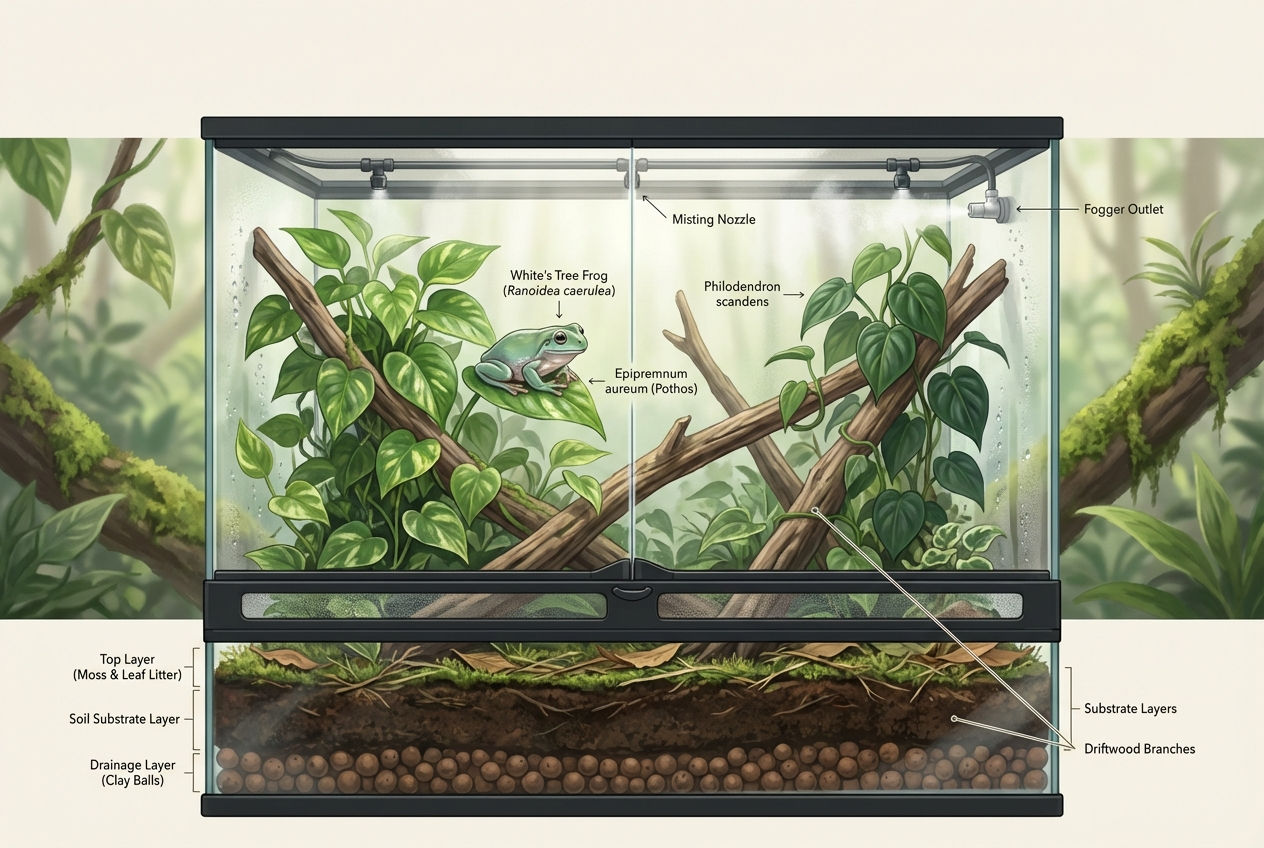
The Ideal Substrate System (Layered Approach)
The most reliable way to build a terrarium base is through a layered system, where each component has a clear role.
At the bottom sits the drainage layer, typically made from clay balls. This layer collects excess water from misting, plant watering, and waste, preventing the soil above from becoming saturated.
Above this is a mesh separator, which keeps the soil from mixing into the drainage layer. This ensures that the system continues to function properly over time.
The main substrate layer sits above the mesh. This is where most biological activity happens. A loose, moisture-retaining soil allows plant roots to grow while maintaining airflow.
Finally, the top layer is made up of moss and leaf litter. This helps retain surface moisture, reduces evaporation, and creates a natural environment for the frog.
When combined, these layers form a system that controls water movement while supporting both plants and animals.

Bioactive vs Non-Bioactive Substrate
When building your substrate, you’ll typically choose between a bioactive or non-bioactive setup.
A bioactive system includes live plants and natural decomposition processes. Over time, waste is broken down within the system, reducing the need for frequent cleaning and creating a more stable environment.
A non-bioactive setup is simpler but requires more manual maintenance. Waste needs to be removed more frequently, and the substrate may need replacement over time.
For most planted terrariums, especially those using misting systems, a bioactive or semi-bioactive approach provides better long-term stability.

Substrate & Drainage — The Most Critical Factor
In a planted terrarium, water is constantly being introduced — through misting, plant care, and natural humidity cycles.
Without proper drainage, this water builds up within the substrate. Over time, the soil becomes compacted, roots begin to rot, and waste accumulates. This often leads to unpleasant smells and unstable conditions.
A proper drainage system allows water to move downward through the layers and collect at the bottom. This keeps the upper layers healthy, breathable, and suitable for plant growth.
When paired with a terrarium that allows water management, the entire system becomes significantly easier to maintain.

How Deep Should Substrate Be?
Substrate depth directly affects how well your terrarium functions.
A balanced system should include a drainage layer of around 2–5 cm, followed by a main soil layer of approximately 5–10 cm. On top of that, a thinner layer of moss and leaf litter helps regulate surface moisture.
This structure provides enough depth for plant roots while maintaining proper moisture distribution throughout the enclosure.

Recommended Substrate Combination
For a reliable and easy-to-maintain setup, a layered combination works best.
Start with a clay ball drainage layer, followed by a mesh separator. Add a main soil layer using a moisture-retaining substrate such as ZooMed ReptiSoil or Exo Terra Plantation Soil. Finish with moss and leaf litter on top.
This combination supports plant growth, regulates humidity, and helps manage waste naturally. When paired with proper misting and airflow, it creates a stable environment that requires less intervention over time.
Common Substrate Mistakes to Avoid
Many substrate issues come from skipping key steps or trying to compensate with more water.
Using only a single layer of soil, skipping the drainage layer, or keeping the substrate constantly wet are common mistakes that lead to long-term problems. Dense or compact soil can reduce airflow, while decorative gravel often fails to serve any functional purpose.
A proper layered system avoids these issues from the start, making your setup more predictable and easier to maintain.

How This Connects to Your Full Setup
Substrate is only one part of a complete terrarium system.
To fully optimise your setup, it should be combined with proper lighting, humidity control, feeding routines, and maintenance practices.
👉 Refer to your full guide:
White’s Tree Frog Care Guide (Ranoidea caerulea)
This ensures that all elements of your terrarium work together as a cohesive ecosystem.
Final Thoughts
A well-built substrate system is the foundation of a successful tree frog terrarium.
When designed correctly, it stabilises humidity, supports plant life, and reduces maintenance effort over time. Instead of treating substrate as a decorative layer, think of it as the engine that keeps your entire enclosure running smoothly.
Once the foundation is right, everything above it becomes easier to manage.


