
What Is Kokedama? Origins, Purpose, and How It Evolved
This guide is created by Green Chapter — Nature Workshop Studio, where we focus on creating living ecosystems through hands-on experience. We share practical insights across terrariums, aquascaping, plants, and natural systems to help you build and care for your own.
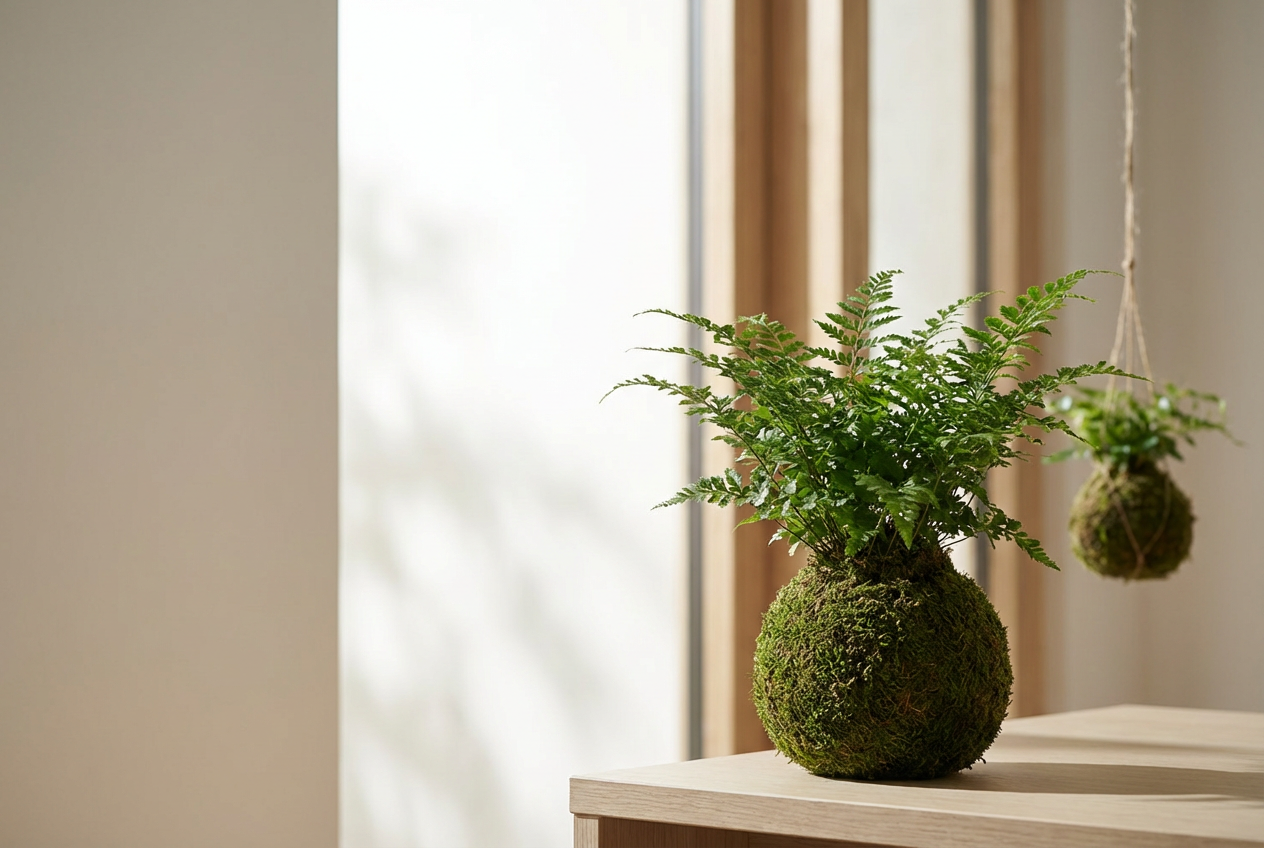
Kokedama is often introduced as a “moss ball plant.” While this description is technically correct, it does little to explain why this form exists, or why it continues to attract people across different cultures today.
At its core, Kokedama is a way of presenting a plant without the visual weight of a container. Instead of placing the plant inside a pot, the root system is shaped into a compact soil form and wrapped in moss. What remains is something softer, more organic—an object that feels less like a product, and more like a living piece of nature.
To understand Kokedama properly, we need to move beyond how it looks today, and look at where it came from, and what it was meant to achieve.
The Meaning Behind the Word “Kokedama”
The word Kokedama (苔玉) comes from two Japanese terms: koke, meaning moss, and dama, meaning ball. Together, it translates directly to “moss ball.”
However, like many Japanese terms, the meaning goes beyond the literal. The name reflects an idea of reduction—removing unnecessary elements until only the essential form remains. In this case, the plant, its roots, and a natural surface that holds everything together.

Where Did Kokedama Come From?
Kokedama originates from Japan, but it was not created as an isolated practice. It evolved from earlier gardening traditions, particularly those connected to bonsai culture.
One of the strongest influences is the philosophy of Wabi-sabi—an appreciation for simplicity, imperfection, and natural aging. Rather than striving for perfection, this philosophy embraces irregularity and quiet beauty.
Another influence comes from bonsai styles such as Nearai bonsai, where plants are sometimes grown without traditional pots, allowing more of their natural structure to be visible.
Kokedama can be seen as a softer, more accessible interpretation of these ideas. It removes the formal container and reduces the structure, allowing the plant to exist in a more natural, less controlled presentation.

What Was Kokedama Originally For?
Kokedama was not originally intended as decorative home décor. Its purpose was both practical and philosophical.
In traditional Japanese gardening, there is a strong emphasis on reducing distraction and allowing the viewer to focus on the subject itself. By removing the pot, the plant becomes the complete object. There is no boundary between container and content.
This also allowed for more flexible ways of display. Kokedama could be placed directly on surfaces, paired with simple trays, or integrated into spaces without the visual heaviness of ceramic pots.
The result is a presentation that feels quieter and more balanced, where the plant is not framed, but simply allowed to exist.

For Fun: Is Kokedama Really a “Poor Man’s Bonsai”?
You might come across Kokedama being described as a “poor man’s bonsai.” It’s a catchy phrase—but not a very accurate one.
The comparison usually comes from the fact that both share similar roots. They are compact plant displays, influenced by Japanese gardening traditions, and both emphasize simplicity and form.
Kokedama is also more accessible. It uses fewer materials, takes less time to create, and does not require years of shaping and pruning. Because of this, people sometimes assume it is a simplified or lower-tier version of bonsai.
But that interpretation misses the intention behind it.
Kokedama is not a lesser form of bonsai. It reflects a different direction—one that leans more toward natural presentation and quiet balance, closely aligned with ideas like Wabi-sabi.
Rather than being a “cheaper bonsai,” it is better understood as a more relaxed and accessible expression of similar philosophies.
So while the term can be fun to mention, it is best taken lightly.

How Kokedama Evolved Into Modern Plant Art
As Japanese design and aesthetics gained global attention, Kokedama gradually moved beyond its original context.
It began appearing in homes, studios, and workshops around the world. Its appeal was immediate. The form is compact, visually soft, and adaptable to different environments.
Today, Kokedama is commonly seen:
- Resting on trays
- Suspended as hanging displays
- Used as gifts or personal décor
The purpose has shifted over time. While it still carries its philosophical roots, it has also become a lifestyle object—something people interact with, care for, and build themselves.

Why Kokedama Became Popular Today
Kokedama fits naturally into modern living.
In urban environments, where space is limited and time is often constrained, people look for ways to reconnect with nature in manageable ways. Kokedama offers a small, contained ecosystem that is easy to maintain while still feeling meaningful.
It also invites interaction. Watering is done by soaking or misting, and the object itself is often handled directly. This creates a more tactile relationship between the person and the plant.
During periods when people spent more time at home, simple and calming activities like building and caring for Kokedama became especially appealing.
It is not just about owning a plant—it is about engaging with it.

How Kokedama Is Practiced Today
Today, Kokedama is practiced in both traditional and modern ways.
Some follow established methods, using specific soil blends and moss types. Others experiment freely, adapting the form to different plants and creative styles.
Common plant choices include:
- Ferns
- Ficus
- Pothos
- Orchids
It is also widely taught in workshops, where participants create their own Kokedama from scratch. This hands-on process transforms the object into something personal, making it more than just decoration.

A Living Balance Between Past and Present
Kokedama sits between tradition and modern life.
It carries ideas from Japanese philosophy—simplicity, balance, and respect for natural form—while adapting easily into contemporary spaces and lifestyles.
This balance is what allows it to remain relevant. It is not tied to a specific time or place. Instead, it responds to a universal need to slow down and reconnect with something living.
Conclusion
Kokedama is not just a gardening method. It is a way of presenting nature in its simplest form.
By removing the pot, it removes distraction. What remains is the plant, the structure that supports it, and the quiet presence it brings into a space.
From its origins in Japanese gardening traditions to its place in modern homes, Kokedama has evolved—but its core idea remains the same:
A natural form.
A balanced structure.
A calm, living presence.


