
What Is Bonsai? Origins, Purpose, and How It Evolved
This guide is created by Green Chapter — Nature Workshop Studio, where we focus on creating living ecosystems through hands-on experience. We share practical insights across terrariums, aquascaping, plants, and natural systems to help you build and care for your own.
Introduction — More Than a Small Plant
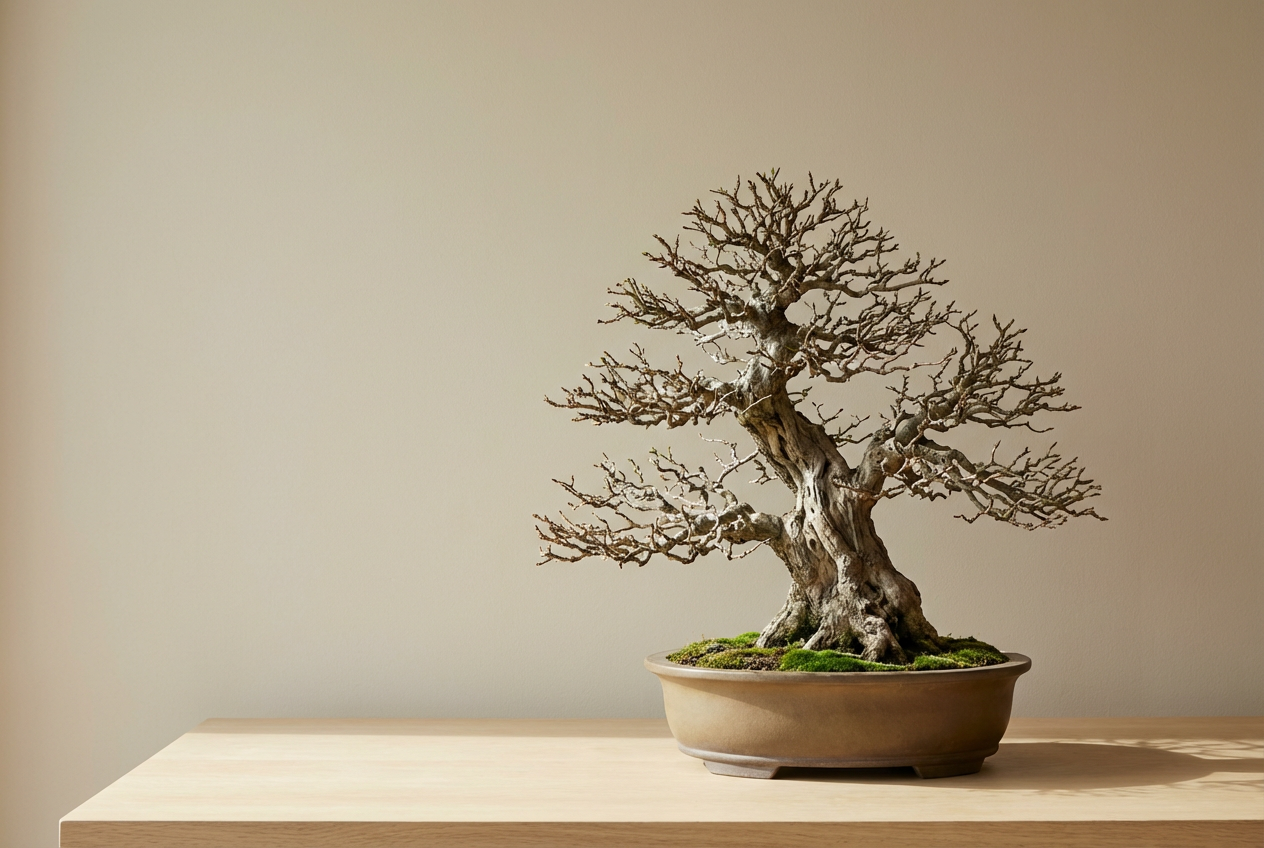
Bonsai is often mistaken for simply being a small plant in a pot. In reality, it is a carefully cultivated representation of a full-sized tree, shaped over time to reflect how nature grows, ages, and adapts.
The word itself comes from Japanese — “bon,” meaning tray or shallow container, and “sai,” meaning to plant or cultivate. While the literal translation is straightforward, the idea behind bonsai is much deeper. It is not about keeping a tree small, but about expressing the character and presence of a much larger tree within a confined space.
Origins — The Chinese Foundation

Long before bonsai was recognised in Japan, its roots can be traced back to ancient China through the practice of Penjing. This early form was not limited to trees alone, but often combined rocks, moss, and terrain to recreate entire landscapes in miniature.
Rather than focusing purely on appearance, penjing carried philosophical meaning. It reflected the Daoist view of nature — not something to be controlled, but something to be understood and harmonised with. These compositions were often found in the spaces of scholars and thinkers, where they served as quiet objects of contemplation.
Development in Japan — Refinement into Bonsai

When this practice was introduced to Japan, it gradually evolved into what we now recognise as Bonsai. Over time, the Japanese refined the concept, shifting the focus away from landscapes and toward the individual tree.
This shift brought a different kind of discipline. Instead of recreating entire scenes, the emphasis was placed on restraint, balance, and subtlety. Influenced by Zen aesthetics, bonsai became quieter in its presentation, yet deeper in its expression, with every curve and branch suggesting age, movement, and natural struggle.
What Bonsai Meant in Ancient Times
In its earlier stages, bonsai was not something widely practiced or easily accessible. It was closely associated with nobility, monks, and scholars — individuals who had both the time and inclination to engage with it.
Beyond its visual appeal, bonsai served as a form of meditation and discipline. Caring for a tree over years, sometimes decades, required patience and attention, making it as much a personal practice as it was an artistic one. It was never simply about decoration; it was about observing nature closely and learning to guide it without forcing it.
Global Spread — From Cultural Art to Worldwide Practice

Bonsai remained largely within Japan until it began appearing in international exhibitions such as the World Exposition during the 19th century. These events introduced the art form to audiences who had never encountered anything quite like it.
From there, interest spread steadily. Collectors, artists, and enthusiasts began studying the techniques, while Japanese masters played a key role in sharing knowledge abroad. Over time, bonsai developed into a global practice, adapted across cultures but still rooted in its original principles.
Bonsai Today — A Living Practice

Today, bonsai exists in a very different context. While it retains its traditional foundations, it has become far more accessible and widely practiced, no longer limited to a particular group or background.
For many people, bonsai serves as a way to slow down and engage with something tangible. The process of trimming, shaping, and maintaining a tree creates a rhythm that contrasts with the pace of everyday life. It becomes not just a hobby, but a consistent, grounding activity that evolves alongside the person caring for it.
Types of Bonsai — Understanding Styles

Bonsai is typically categorised by style rather than by plant species. These styles are based on how trees grow in natural environments, shaped by factors such as wind, terrain, and light.
Common forms include upright, slanting, cascading, and forest compositions, each representing a different natural condition. While these categories provide guidance, they are not strict rules. Instead, they serve as references that help practitioners understand and interpret growth patterns more effectively.
Who Defines Bonsai Today?
Unlike scientific systems that are governed by formal institutions, bonsai does not have a single authority that dictates how it should be practiced. However, organisations such as the Nippon Bonsai Association and the World Bonsai Friendship Federation help to preserve traditions and promote consistency in terminology.
Even so, bonsai continues to evolve through the contributions of artists and communities around the world. Each practitioner brings a slightly different interpretation, which is part of what keeps the art form alive.
Conclusion — A Practice That Continues to Evolve
Bonsai began as a philosophical expression rooted in nature, was refined into a disciplined art form, and has since become a widely practiced activity that blends creativity with care.
What makes it enduring is not just its history, but its adaptability. It allows each person to engage with it in their own way, while still connecting back to the same core idea — observing and shaping nature with patience and intention.
Lifestyle & Modern Relevance
In today’s context, bonsai fits naturally into modern lifestyles because it offers a manageable way to reconnect with nature. It does not require large spaces or complicated setups, yet it provides a consistent sense of progress and involvement.
Over time, it becomes more than just a plant. It becomes part of a routine — something that quietly anchors attention and creates space for focus, reflection, and calm.


