
The Evolution of Terrariums — From Science to Modern Living
This guide is created by Green Chapter — Nature Workshop Studio, where we focus on creating living ecosystems through hands-on experience. We share practical insights across terrariums, aquascaping, plants, and natural systems to help you build and care for your own.
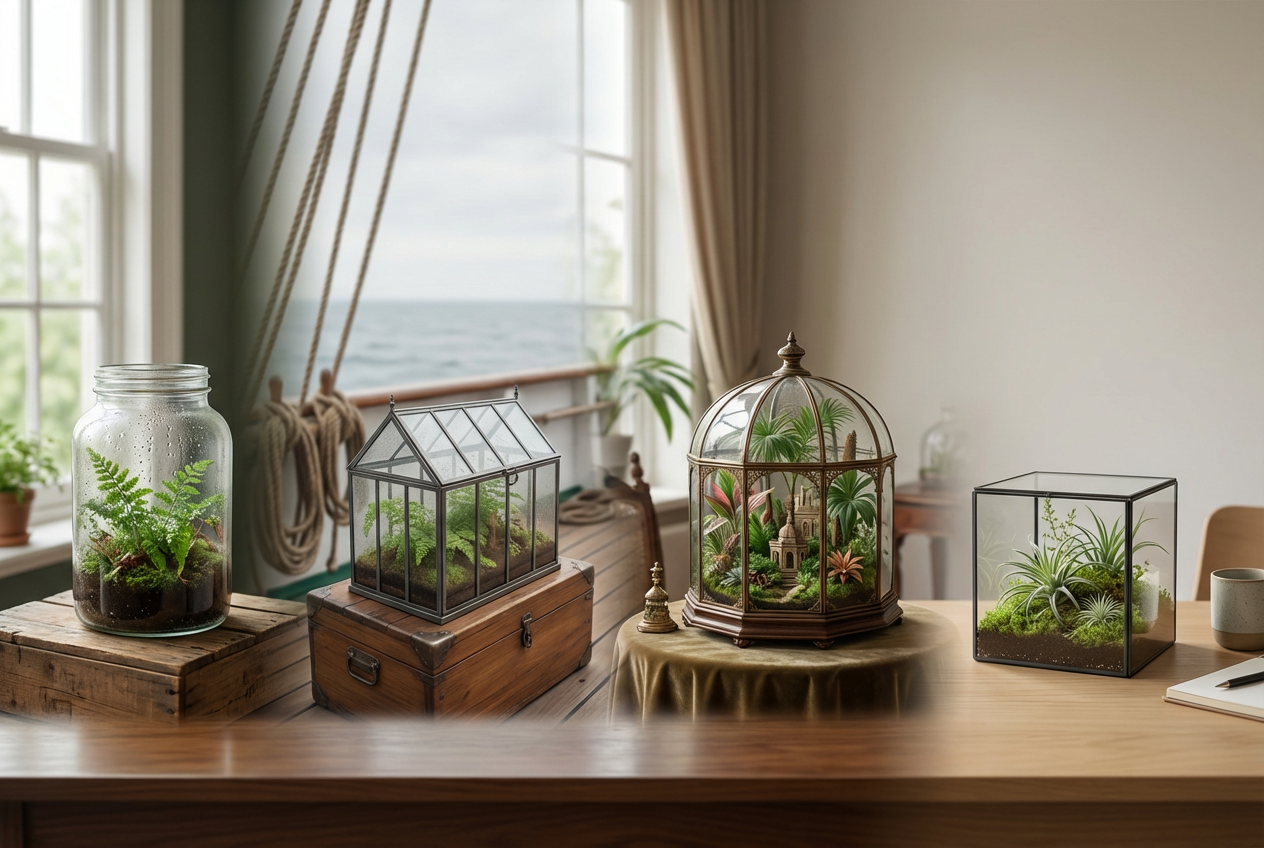
Terrariums today are often seen as calm, decorative pieces—something you place on a desk, gift to someone, or build during a workshop.
But their origins were far from decorative.
What began as an accidental discovery went on to influence scientific research, global plant trade, and even social culture. Over time, it evolved again into something quieter and more personal—small living systems that fit naturally into modern life.
The Accidental Discovery

The story begins in the early 1800s with Nathaniel Bagshaw Ward, a British doctor with a strong interest in plants.
While observing insect specimens in a sealed glass container, he noticed something unexpected. Ferns and grasses began to grow inside the jar without being watered.
What made this remarkable was not just the growth, but the stability. Moisture condensed on the glass, returned to the soil, and repeated the cycle. The plants continued to survive in a self-contained environment.
This was one of the earliest observations of a closed ecosystem—a system where water and air cycle naturally within a confined space.
It was a simple moment, but it introduced an idea that would travel far beyond the jar itself.
The Wardian Case — Changing How Plants Travel

Ward later developed this concept into what became known as the Wardian Case—a sealed glass container designed to protect plants during long sea journeys.
Before this, transporting live plants across continents was unreliable. Salt air damaged leaves, freshwater was limited, and long journeys often led to complete loss of specimens.
The Wardian Case changed that.
By sealing plants within a controlled environment, it protected them from external conditions while allowing moisture to recycle internally. This dramatically improved survival rates during transport.
What started as a scientific curiosity quickly became a practical solution—one that made global plant movement possible.
A Quiet Force Behind Global Plant Trade

With the ability to transport plants reliably, the Wardian Case began to influence something much larger—global agriculture and trade.
Plants that were once confined to specific regions could now be moved and cultivated elsewhere. Tea was transported from China to India, rubber from Brazil to Southeast Asia, and cinchona—used for producing quinine—was distributed to support tropical settlements.
These movements reshaped industries and economies.
While the terrarium itself remained a simple glass container, its application enabled the spread of crops that would define entire regions. It quietly supported a shift from local plant knowledge to global agricultural systems.
From Science to Status — The Victorian Era

By the mid-1800s, terrariums had moved beyond laboratories and ships into homes.
In Victorian Britain, collecting and displaying plants became fashionable, especially among the middle and upper classes. Glass cases filled with ferns and exotic species were placed in parlors and drawing rooms.
Owning a terrarium was no longer just about plants. It reflected curiosity, education, and access to global exploration.
During this period, terrariums became part of interior life—objects that combined science, design, and personal identity. They were both decorative and symbolic, representing a connection to knowledge and discovery.
A Period of Decline

As transportation improved and greenhouse technology advanced, the need for Wardian Cases gradually declined.
Plants could be moved more efficiently, and large-scale cultivation reduced reliance on enclosed systems. Terrariums faded from everyday use and became less visible in both scientific and domestic settings.
They did not disappear entirely, but their role became quieter—appearing occasionally in research or as small decorative pieces rather than cultural centrepieces.
The Modern Revival

In recent decades, terrariums have returned, but in a very different form.
They are now accessible, compact, and designed for everyday environments. Instead of being tools for survival or symbols of status, they have become part of lifestyle culture.
In cities like Singapore, where space is limited, terrariums offer a way to introduce greenery into small interiors. They require little space and can be adapted to different styles and preferences.
Workshops, DIY kits, and curated designs have made them approachable even for beginners, shifting their role from specialist object to everyday experience.
A Recent Turning Point

During periods such as the COVID-19, when more time was spent indoors, interest in hands-on, calming activities increased.
Terrariums naturally fit into this shift.
They offered a small, manageable project that could be done at home, while still involving living plants. The process of building and maintaining them provided a sense of structure and quiet focus.
This period accelerated their return—not as rare objects, but as accessible, meaningful experiences.
Why Terrariums Fit Into Modern Life

Today, terrariums remain relevant because they align well with how people live.
They are contained systems that do not require large spaces or complex routines. Once established, they are relatively stable, with moisture cycling internally in closed setups or controlled watering in open ones.
This makes them approachable, even for those without gardening experience.
At the same time, the process of building and caring for a terrarium encourages a slower pace. Small adjustments—placing plants, arranging materials, observing changes over time—create a focused, hands-on experience.
It becomes less about maintenance and more about engagement.
In that sense, a terrarium is not just a decorative object. It is a small, living system that brings attention back to natural processes, even within a compact space.
Conclusion

From an accidental discovery in a glass jar to a tool that shaped global plant movement, and finally to a modern lifestyle piece, the terrarium has gone through multiple transformations.
Each phase reflects a different relationship between people and plants—scientific curiosity, industrial necessity, cultural expression, and now personal experience.
Today, the terrarium returns to something simple.
A contained system. A quiet process. A way to observe how living environments function, on a smaller and more manageable scale.
Continue Exploring
If you’re interested in starting your own, explore the beginner path here:


